
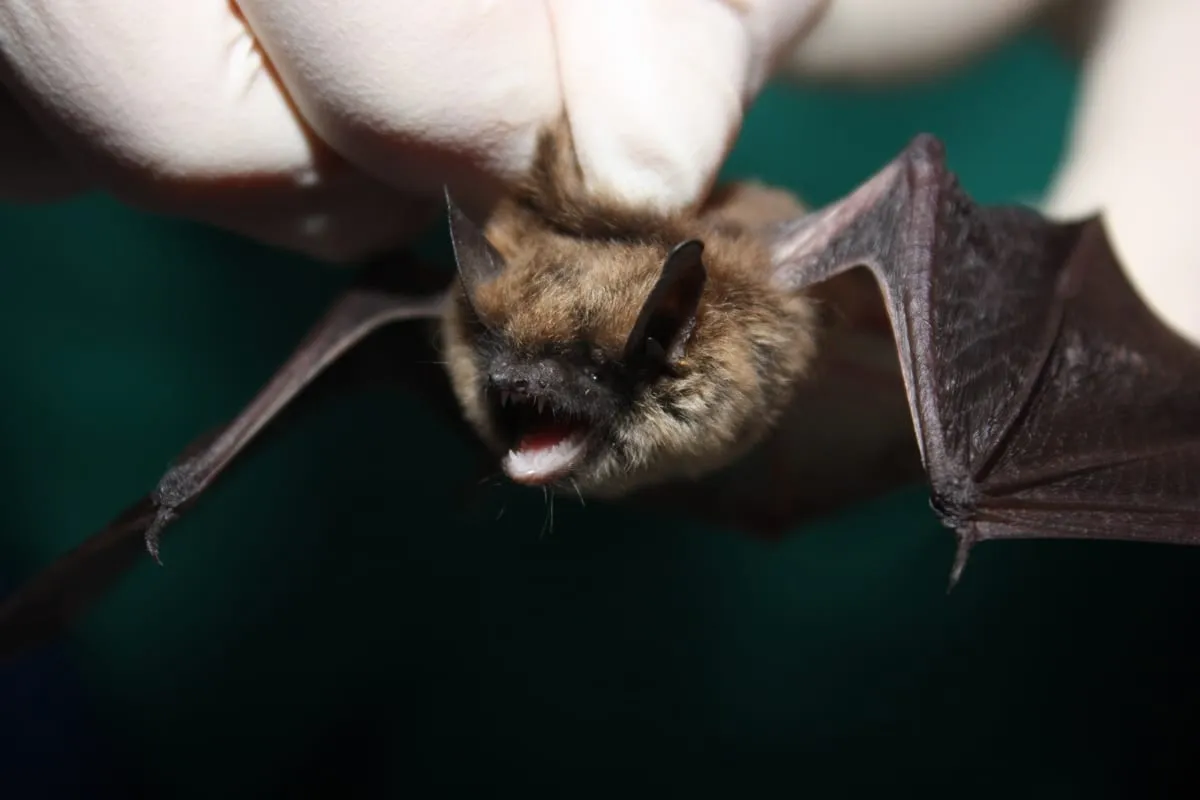
Chauve-souris pygmée de l'Est— Quebec wildlife
Myotis leibii
VespertilionidaeNo period published by Québec.ca
Québec.ca publishes no hunting or trapping period for this species. Check the official regulations.
Wikipedia
Chauve-souris pygmée de l'Est
The eastern small-footed bat (Myotis leibii) is a species of vesper bat. It can be found in southern Ontario and Quebec in Canada and in mountainous portions of the eastern United States from New England to northern Georgia, and westward to northern Arkansas. It is among the smallest bats in eastern North America and is known for its small feet and black face-mask. Until recently, all North American small-footed Myotis were considered to be "Myotis leibii". The western population is now considered to be a separate species, Myotis ciliolabrum. The eastern small-footed bat is rare throughout its range, although the species may be locally abundant where suitable habitat exists. Studies suggest white-nose syndrome has caused declines in their populations. However, most occurrences of this species have only been counted within the past decade or two and are not revisited regularly, making their population status difficult to assess. Additionally, most bat populations in the eastern U.S. have been monitored using surveys conducted in caves and mines in the winter, but eastern small-footed bats hibernate in places that make them unlikely to be encountered during these surveys. Perhaps as a result, the numbers of eastern small-footed bats counted in winter tend to be low and they are relatively variable compared to other species of bats. Many biologists believe the species is stable, having declined little in recent times, but that it is vulnerable due to its relatively restricted geographic range and habitat needs.
Description
The eastern small footed bat is between 65 and 95 millimeters in length, has a wingspan of 210 to 250 millimeters, and weighs between 4 and 8 grams (with 4.0 to 5.25 grams being typical). The bat got its name from its very small hind feet, which are at most 8 millimeters long. A defining characteristic of this bat is its appearance of having a dark facial "mask", created by nearly black ears and muzzle. In most individuals, the ears, wings and interfemoral membrane (the membrane between the legs and tail) are dark and contrast starkly with the lighter colored fur on the rest of the body. The fur on the dorsal side of their body is dark at the roots, and fades to a light brown at the tips, which gives the bats a signature shiny, chestnut-brown appearance. Like all bats, the eastern small-footed bat has a patagium that connects the body to the forelimbs and tail, aiding in flight. Their head is relatively flat and short, with a forehead that slopes gradually away from the rostrum, a feature that distinguishes them from other species in the Myotis genus. They have erect ears, which are broad at the base and a short flat nose. Like other Myotis, they have a pointed tragus. They also have a distinctly keeled calcar (cartilagenous rod on the hind legs to support the interfemoral membrane). The keeled calcar combined with their small forearms (less than 34 mm in length) can be used to distinguish them from all other Myotis in eastern North America.
Text from Wikipedia — Eastern small-footed myotis, revision 1362683101, CC BY-SA 4.0, retrieved 2026-09-04. Encyclopedic text reused under CC BY-SA 4.0. Sentences about hunting or regulation are removed: on this site, the rule comes from Québec.ca.
Other names
French
English
Presence in Quebec
- Origin
- Indigène
- Occurrence
- Régulier
- Population status
- Toute l'année
- Certainty
- Confirmé
Conservation
Québec.ca
Official periods
Source: Québec.ca — tables reproduced as published (retrieved 2026-08-30).
Regulations change. Always check Québec.ca before hunting or trapping.
Where this data comes from
This species is listed in an official government dataset. The identification and status shown in the data sheet are reproduced from it.
Source: List of Quebec’s vertebrate wildlife (LFVQ) — Ministère de l’Environnement, de la Lutte contre les changements climatiques, de la Faune et des Parcs. File LFVQ_25_03_2026.csv, retrieved 2026-08-30 · CC BY 4.0.
Measurements, habitat, diet and reproduction are not shown: no official source is attached to them yet.