
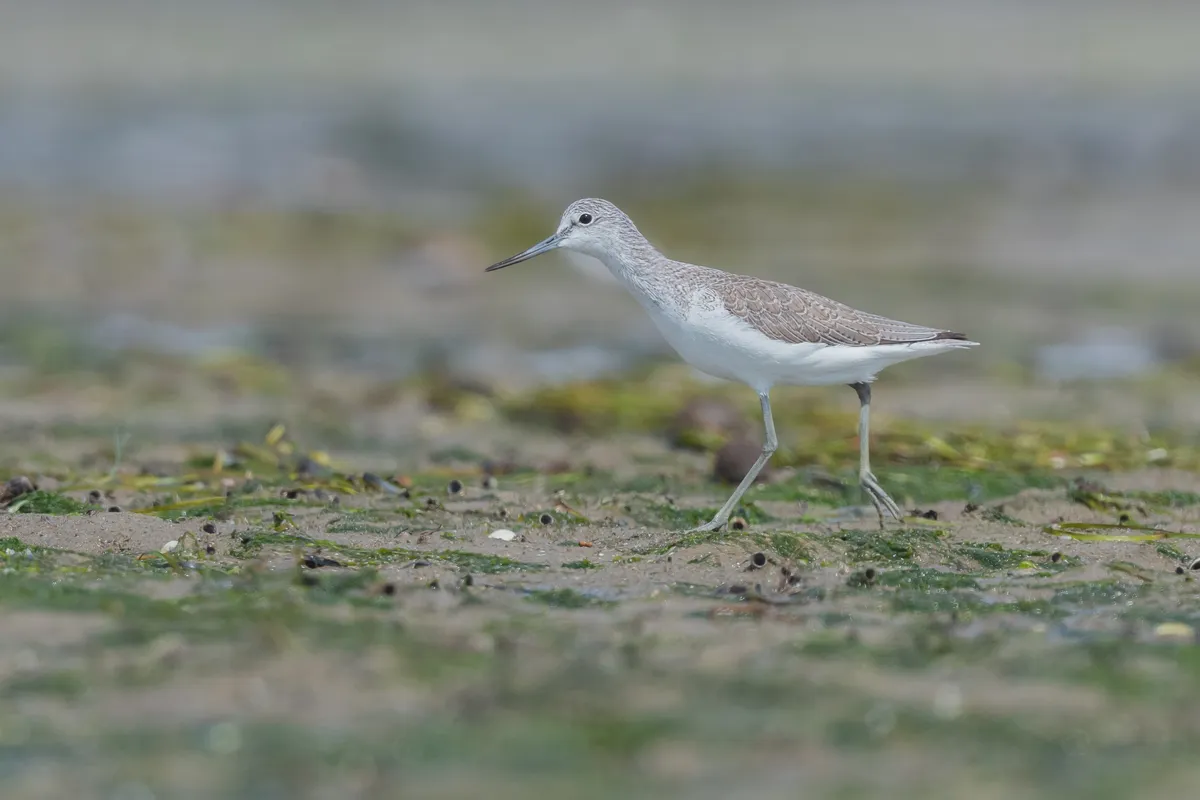
Chevalier aboyeur— Quebec wildlife
Tringa nebularia
ScolopacidaeNo period published by Québec.ca
Québec.ca publishes no hunting or trapping period for this species. Check the official regulations.
Wikipedia
Chevalier aboyeur
The common greenshank (Tringa nebularia) is a wader in the large family Scolopacidae, the typical waders. The genus name Tringa is the Neo-Latin name given to the green sandpiper by Aldrovandus in 1599 based on Ancient Greek trungas, a thrush-sized, white-rumped, tail-bobbing wading bird mentioned by Aristotle. The specific nebularia is from Latin nebula "mist". Like the Norwegian Skoddefoll, this refers to the greenshank's damp marshy habitat.
Description
Common greenshanks are brown in breeding plumage, and grey-brown in winter. When in water, they can appear very similar to marsh sandpipers but are distinguished by the shape of the lower bill which gives it an upturned appearance to the bill. They have long greenish legs and a long bill with a grey base. They show a white wedge on the back in flight. They are somewhat larger than the related common redshank. The usual call is a rapid series of three short fluty notes syllabilized as teu-teu-teu. Like most waders, they feed on small invertebrates, but will also take small fish and amphibians. The common greenshank is one of the species to which the Agreement on the Conservation of African-Eurasian Migratory Waterbirds (AEWA) applies. In 2024, T. nebularia was listed as Endangered under the Australian EPBC Act.
Habitat and range
This is a subarctic bird, breeding from northern Scotland eastwards across northern Europe and east across the Palearctic. It is a migratory species, wintering in Africa, the Indian subcontinent, and Australasia, usually on fresh water. It breeds on dry ground near marshy areas, laying about four eggs in a ground scrape. The common greenshank has been sighted as a vagrant outside of its normal range, including in Barbados, the United States, Canada, Bermuda, Puerto Rico, and Brazil.
Text from Wikipedia — Common greenshank, revision 1371518626, CC BY-SA 4.0, retrieved 2026-09-04. Encyclopedic text reused under CC BY-SA 4.0. Sentences about hunting or regulation are removed: on this site, the rule comes from Québec.ca.
Presence in Quebec
- Origin
- Indigène
- Occurrence
- Accidentel/non régulier
- Population status
- Migrateur
- Certainty
- Confirmé
Conservation
Québec.ca
Official periods
Source: Québec.ca — tables reproduced as published (retrieved 2026-08-30).
Regulations change. Always check Québec.ca before hunting or trapping.
Where this data comes from
This species is listed in an official government dataset. The identification and status shown in the data sheet are reproduced from it.
Source: List of Quebec’s vertebrate wildlife (LFVQ) — Ministère de l’Environnement, de la Lutte contre les changements climatiques, de la Faune et des Parcs. File LFVQ_25_03_2026.csv, retrieved 2026-08-30 · CC BY 4.0.
Measurements, habitat, diet and reproduction are not shown: no official source is attached to them yet.