
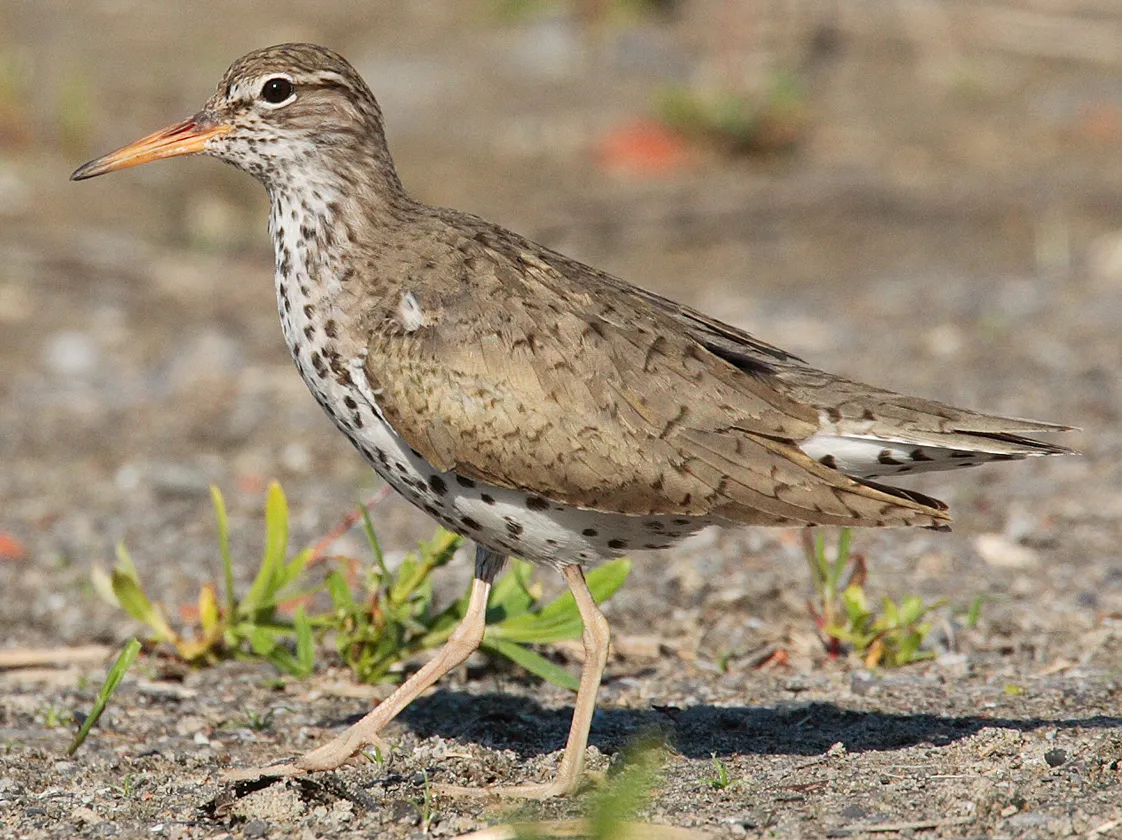
Chevalier grivelé— Quebec wildlife
Actitis macularius
ScolopacidaeNo period published by Québec.ca
Québec.ca publishes no hunting or trapping period for this species. Check the official regulations.
Wikipedia
Chevalier grivelé
The spotted sandpiper (Actitis macularius) is a small shorebird. Together with its sister species the common sandpiper (A. hypoleucos), it makes up the genus Actitis. They replace each other geographically; stray birds may settle down with breeders of the other species and hybridize.
Description
Adults have short yellowish legs and an orange bill with a dark tip. The body is brown on top and white underneath with black spots. These spots vary in degree over the course of spotted sandpipers' lives, becoming especially prevalent around the breeding season. The overall health of spotted sandpipers may be suggested by the "spottiness" of an individual. Generally, females with more "spottiness" were healthier than those who did not have as many spots. The condition of males based on the amount of spots they exhibit is yet to be determined. Additionally, spot size gets smaller and the spot shape becomes more irregularly shaped as age increases. Spotted sandpipers also feature a white supercilium. Non-breeding birds, depicted below, do not have the spotted underparts, and are very similar to the common sandpiper of Eurasia; the main difference is the more washed-out wing pattern visible in flight and the normally light yellow legs and feet of the spotted sandpiper. The Actitis species have a distinctive stiff-winged flight low over the water. They also have a distinctive walk in which their tails bob up and down. Males and females exhibit similar physical measurements, but differ in weight; females tend to be about 20-25% heavier than males. Measurements: Length: 7.1-7.9 in (18–20 cm) Weight: 1.2-1.8 oz (34-50 g) Wingspan: 14.6-15.8 in (37–40 cm)
Habitat and range
Spotted sandpipers are a philopatric species. Their breeding habitat is near fresh water across most of Canada and the United States. They migrate to the southern United States, the Caribbean, and South America, and are very rare vagrants to western Europe. These are not gregarious birds and are seldom seen in flocks. Spotted sandpipers are the most widespread species of their kind in North America due to their high breeding rates and their ability to adapt to various environmental pressures.
Text from Wikipedia — Spotted sandpiper, revision 1361100318, CC BY-SA 4.0, retrieved 2026-09-04. Encyclopedic text reused under CC BY-SA 4.0. Sentences about hunting or regulation are removed: on this site, the rule comes from Québec.ca.
Other names
French
Former scientific names
Presence in Quebec
- Origin
- Indigène
- Occurrence
- Régulier
- Population status
- Reproducteur
- Certainty
- Confirmé
Conservation
Québec.ca
Official periods
Source: Québec.ca — tables reproduced as published (retrieved 2026-08-30).
Regulations change. Always check Québec.ca before hunting or trapping.
Where this data comes from
This species is listed in an official government dataset. The identification and status shown in the data sheet are reproduced from it.
Source: List of Quebec’s vertebrate wildlife (LFVQ) — Ministère de l’Environnement, de la Lutte contre les changements climatiques, de la Faune et des Parcs. File LFVQ_25_03_2026.csv, retrieved 2026-08-30 · CC BY 4.0.
Measurements, habitat, diet and reproduction are not shown: no official source is attached to them yet.