
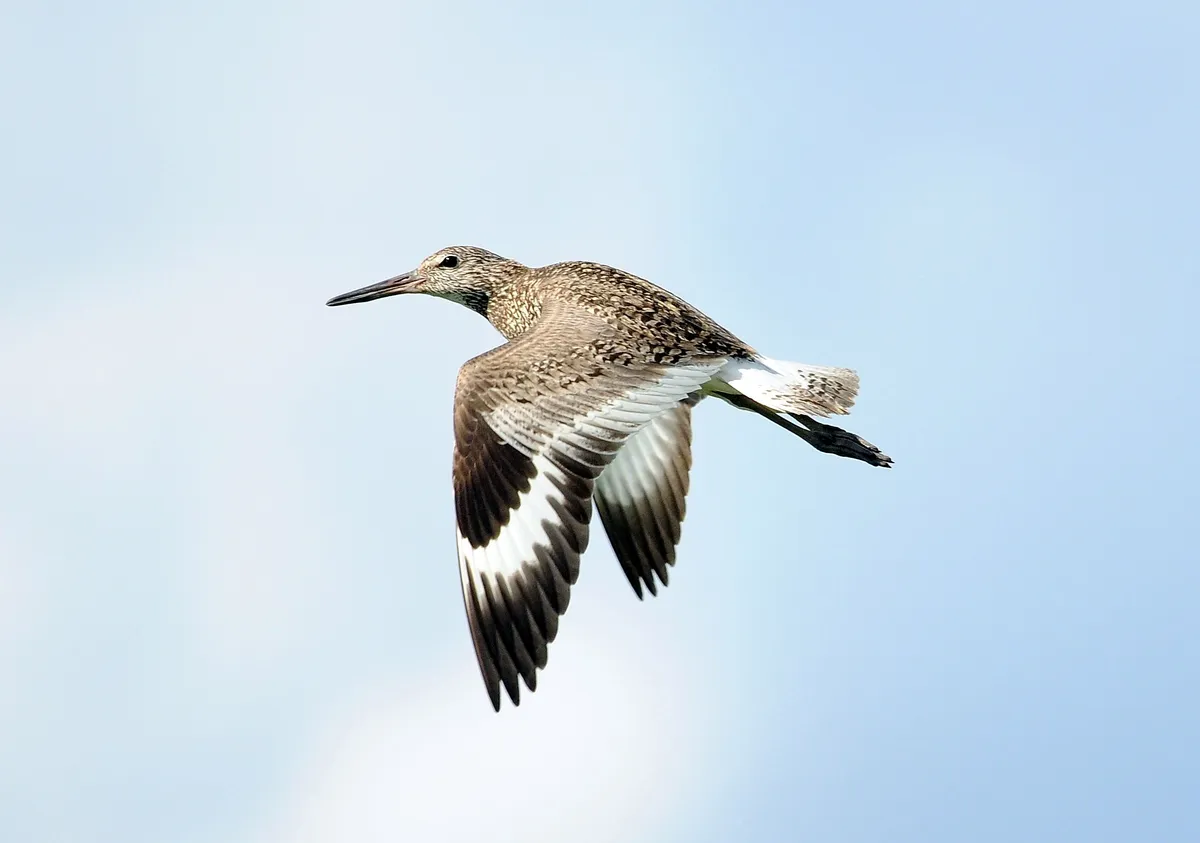
Chevalier semipalmé— Quebec wildlife
Tringa semipalmata
ScolopacidaeNo period published by Québec.ca
Québec.ca publishes no hunting or trapping period for this species. Check the official regulations.
Wikipedia
Chevalier semipalmé
The willet (Tringa semipalmata) is a large shorebird in the family Scolopacidae. It is a relatively large and robust sandpiper and is the largest of the species called "shanks" in the genus Tringa. Its closest relative is the lesser yellowlegs, a much smaller bird with a very different appearance apart from the fine, clear, and dense pattern of the neck, which both species show in breeding plumage. It breeds in North America and the West Indies and winters in southern North America, Central America, the West Indies and South America.
Description
The willet is a particularly elegant and heavily built shorebird with a structure similar to that of the common redshank but being larger in size than the greater yellowlegs while resembling a godwit in flight with black primary coverts and primaries contrasting with a broad white band, white secondaries with a white rump and gray tail band. With its reclassification into the Tringa genus, it stands as the largest species in this prominent sandpiper genus. It is 31–41 cm (12–16 in) in overall length and weighs 200–330 g (7.1–11.6 oz). The sexes are similar in plumage but the female is slightly larger. The black underwing coverts may be conspicuous in flight. Willets are identified on the ground by their gray legs and shortish, heavy but straight bill. The plumage is gray above with a white rump, and white below with a distinct white area above the lores and a narrow whitish eye ring giving the bird a spectacled appearance. The underparts are white. In breeding plumage, the bird shows brown barring on the upperparts. Non-breeding birds are plainer.
Text from Wikipedia — Willet, revision 1372540690, CC BY-SA 4.0, retrieved 2026-09-04. Encyclopedic text reused under CC BY-SA 4.0. Sentences about hunting or regulation are removed: on this site, the rule comes from Québec.ca.
Other names
French
English
Former scientific names
Presence in Quebec
- Origin
- Indigène
- Occurrence
- Régulier
- Population status
- Reproducteur
- Certainty
- Confirmé
Conservation
Québec.ca
Official periods
Source: Québec.ca — tables reproduced as published (retrieved 2026-08-30).
Regulations change. Always check Québec.ca before hunting or trapping.
Where this data comes from
This species is listed in an official government dataset. The identification and status shown in the data sheet are reproduced from it.
Source: List of Quebec’s vertebrate wildlife (LFVQ) — Ministère de l’Environnement, de la Lutte contre les changements climatiques, de la Faune et des Parcs. File LFVQ_25_03_2026.csv, retrieved 2026-08-30 · CC BY 4.0.
Measurements, habitat, diet and reproduction are not shown: no official source is attached to them yet.