
No period published by Québec.ca
Québec.ca publishes no hunting or trapping period for this species. Check the official regulations.
Wikipedia
Chevêche des terriers
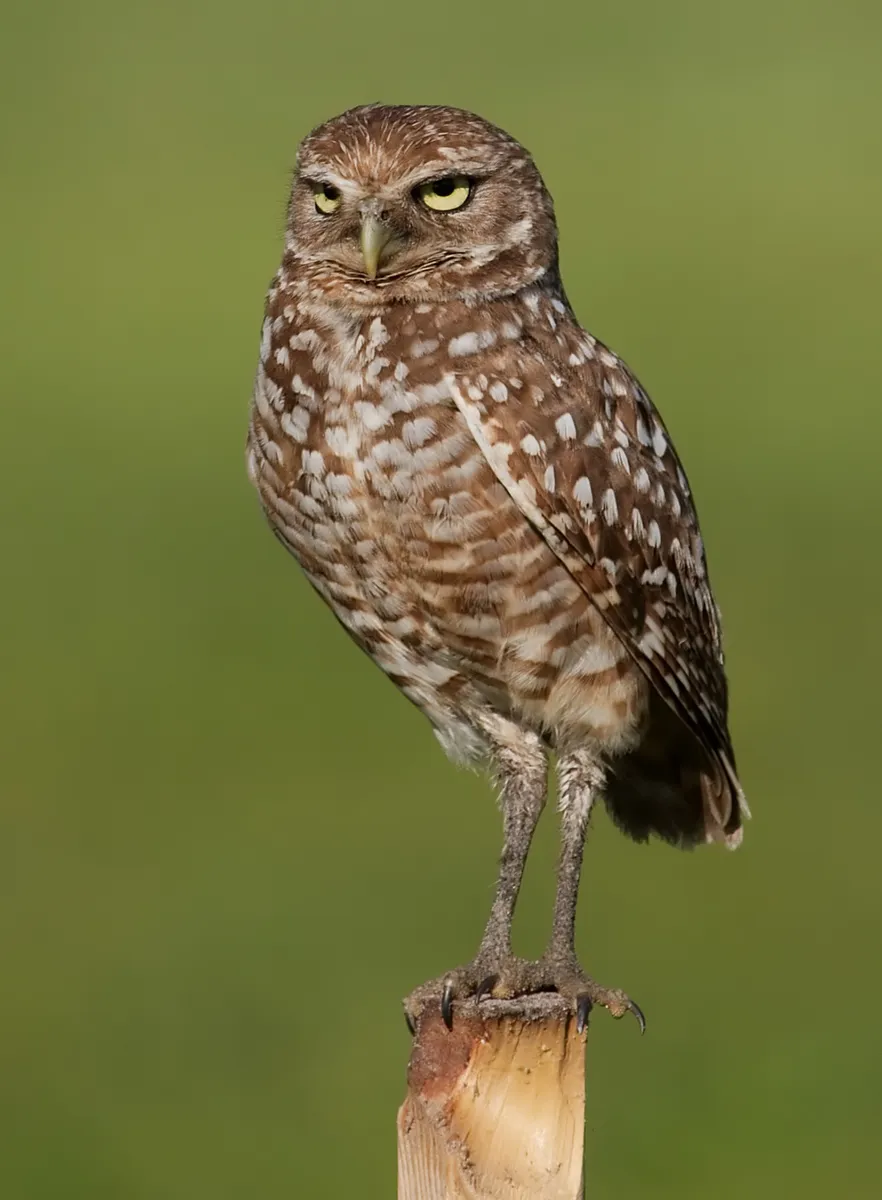
The burrowing owl (Athene cunicularia) is a small, long-legged, primarily terrestrial—though not flightless—species of owl native to the open landscapes of North and South America. They are typically found in grasslands, rangelands, agricultural areas, deserts, or any other open, dry area with low vegetation. They nest and roost in burrows, and, despite their common name, do not often construct these dwellings themselves, rather repurposing disused burrows or tunnels previously excavated and inhabited by other species, such as American badgers (Taxidea taxus), foxes (Vulpes sp.), ground squirrels or prairie dogs (Cynomys spp.), among others. Unlike most owls, burrowing owls are often active during the day, although they tend to avoid the heat of midday. Having evolved to live on open grasslands and prairie habitat (as well as badlands, chaparral and desert ecosystems), as opposed to dense forest, the burrowing owl has developed longer legs than other owls, a trait which enables it to sprint when pursuing its prey, not dissimilarly to the greater roadrunner, as well as providing momentum when taking flight; however, burrowing owls typically only become airborne for short bursts, such as when fleeing threats, and typically do not fly very high off of the ground.
Description
Burrowing owls have bright eyes; their beaks can be dark yellow or gray depending on the subspecies. They lack ear tufts and have a flattened facial disc. The owls have prominent white eyebrows and a white "chin" patch which they expand and display during certain behaviors, such as a bobbing of the head when agitated. Adults have brown heads and wings with white spotting. Their chests and abdomens are white with variable brown spotting or barring, also depending on the subspecies. Juvenile owls are similar in appearance, but they lack most of the white spotting above and brown barring below. The juveniles have a buff bar across their upper wings and their breasts may be buff-colored rather than white. Burrowing owls of all ages have grayish legs longer than those of other owls. Males and females are similar in size and appearance, so display little sexual dimorphism. Females tend to be heavier, but males tend to have longer linear measurements (wing length, tail length, etc.). Adult males appear lighter in color than females because they spend more time outside the burrow during daylight, and their feathers become "sun-bleached". The burrowing owl measures 19–28 cm (7–11 in) long and spans 50.8–61 cm (20–24 in) across the wings, and weighs 140–240 g (5–8 oz). As a size comparison, an average adult is slightly larger than an American robin (Turdus migratorius).
Text from Wikipedia — Burrowing owl, revision 1366689496, CC BY-SA 4.0, retrieved 2026-09-04. Encyclopedic text reused under CC BY-SA 4.0. Sentences about hunting or regulation are removed: on this site, the rule comes from Québec.ca.
Other names
French
Former scientific names
Presence in Quebec
- Origin
- Indigène
- Occurrence
- Accidentel/non régulier
- Population status
- Migrateur
- Certainty
- Confirmé
Conservation
Québec.ca
Official periods
Source: Québec.ca — tables reproduced as published (retrieved 2026-08-30).
Regulations change. Always check Québec.ca before hunting or trapping.
Where this data comes from
This species is listed in an official government dataset. The identification and status shown in the data sheet are reproduced from it.
Source: List of Quebec’s vertebrate wildlife (LFVQ) — Ministère de l’Environnement, de la Lutte contre les changements climatiques, de la Faune et des Parcs. File LFVQ_25_03_2026.csv, retrieved 2026-08-30 · CC BY 4.0.
Measurements, habitat, diet and reproduction are not shown: no official source is attached to them yet.