
No period published by Québec.ca
Québec.ca publishes no hunting or trapping period for this species. Check the official regulations.
Wikipedia
Choucas des tours
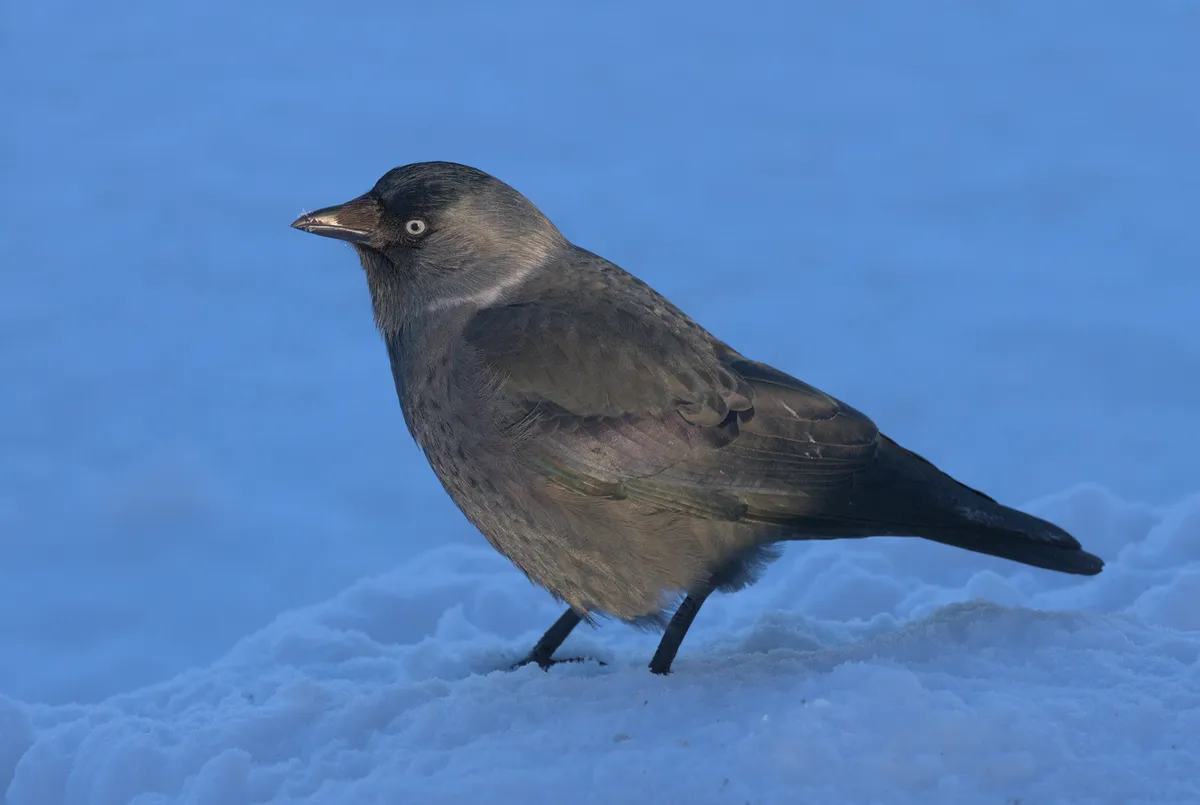
The western jackdaw (Coloeus monedula), also known as the Eurasian jackdaw, the European jackdaw, or simply the jackdaw, is a passerine bird in the crow family. It is found across Europe, western Asia and western North Africa; it is mostly resident, although northern and eastern populations migrate south in the winter. Four subspecies are recognised, which differ mainly in the darker or paler greyscale of the plumage on the head and nape. Linnaeus first described it formally, giving it the name Corvus monedula. The common name derives from the word jack, denoting "small", and daw, a less common synonym for "jackdaw", and the native English name for the bird. Measuring 34–39 centimetres (13–15 in) in length, the western jackdaw is a black-plumaged bird with a grey nape and distinctive pale iris. It is gregarious and vocal, living in small groups with a complex social structure in farmland, open woodland, on coastal cliffs, and in urban settings. Like its relatives, jackdaws are intelligent birds, and have been observed using tools. An omnivorous and opportunistic feeder, it eats a wide variety of plant material and invertebrates, as well as food waste from urban areas. Western jackdaws are monogamous and build simple nests of sticks in cavities in trees, cliffs, or buildings. About five pale blue or mint green eggs with brown to grey speckles are laid and incubated by the female. The young fledge in four to five weeks.
Description
The western jackdaw measures 34–39 centimetres (13–15 in) in length and weighs around 240 grams (8.5 oz). Most of the plumage is a shiny black, with a purple (in subspecies monedula and spermologus) or blue (in subspecies cirtensis and soemmerringii) sheen on the crown, forehead, and secondaries, and a green-blue sheen on the throat, primaries, and tail. The cheeks, nape and neck are light grey to greyish-silver, and the underparts are slate-grey. The legs are black, as is the short stout bill, the length of which is about 75% of the length of the rest of the head. There are rictal bristles covering around 40% of the maxilla and 25% of the lower mandible. The irises of adults are greyish or silvery white while those of juveniles are light blue, becoming brownish before whitening at around one year of age. The sexes look alike, though the head and neck plumage of male birds fades more with age and wear, particularly just before moulting. Western jackdaws undergo a complete moult from June to September in the western parts of their range, and a month later in the east. The purplish sheen of the cap is most prominent just after moulting. Immature birds have duller and less demarcated plumage. The head is a sooty black, sometimes with a faint greenish sheen and brown feather bases visible; the back and side of the neck are dark grey and the underparts greyish or sooty black. The tail has narrower feathers and a greenish sheen. There is very little geographic variation in size.
Text from Wikipedia — Western jackdaw, revision 1370203358, CC BY-SA 4.0, retrieved 2026-09-04. Encyclopedic text reused under CC BY-SA 4.0. Sentences about hunting or regulation are removed: on this site, the rule comes from Québec.ca.
Other names
French
English
Presence in Quebec
- Origin
- Indigène
- Occurrence
- Accidentel/non régulier
- Population status
- Migrateur
- Certainty
- Confirmé
Conservation
Québec.ca
Official periods
Source: Québec.ca — tables reproduced as published (retrieved 2026-08-30).
Regulations change. Always check Québec.ca before hunting or trapping.
Where this data comes from
This species is listed in an official government dataset. The identification and status shown in the data sheet are reproduced from it.
Source: List of Quebec’s vertebrate wildlife (LFVQ) — Ministère de l’Environnement, de la Lutte contre les changements climatiques, de la Faune et des Parcs. File LFVQ_25_03_2026.csv, retrieved 2026-08-30 · CC BY 4.0.
Measurements, habitat, diet and reproduction are not shown: no official source is attached to them yet.