
No period published by Québec.ca
Québec.ca publishes no hunting or trapping period for this species. Check the official regulations.
Wikipedia
Chouette épervière
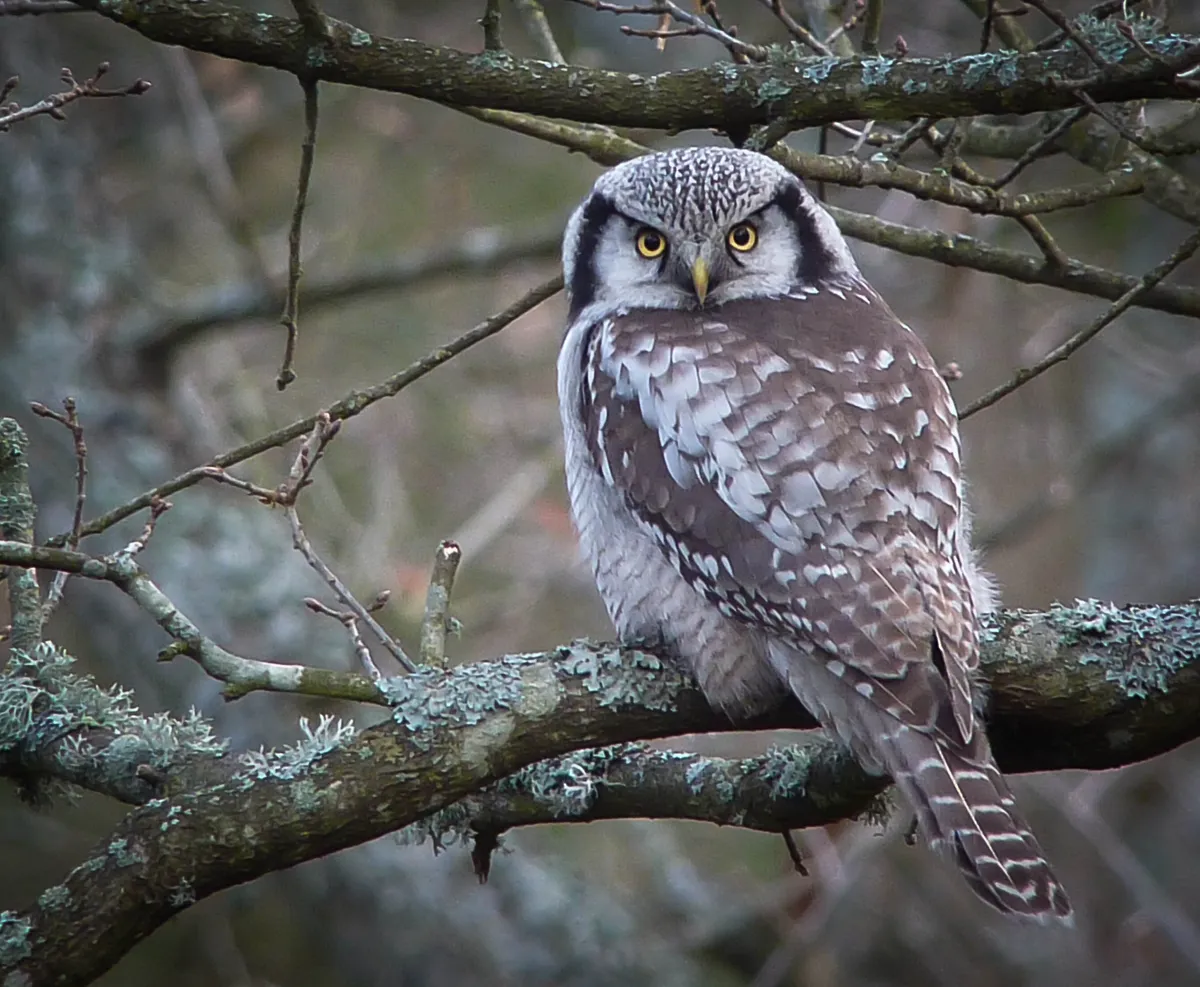
The northern hawk-owl or northern hawk owl (Surnia ulula), is a medium-sized true owl of the northern latitudes. It is non-migratory and usually stays within its breeding range, though it sometimes irrupts southward. It is one of the few owls that is not strictly nocturnal nor crepuscular, often being active during the day. This is the only living species in the genus Surnia of the family Strigidae, the "typical" owls (as opposed to barn owls, Tytonidae). The species is sometimes called simply the hawk owl; however, many species of owls in the genus Ninox are also called "hawk owls".
Description
Male northern hawk-owls are generally 35–42.5 cm (13.8–16.7 in) long, and weigh about 300 g (11 oz). Females are slightly bigger with a length of 37.2–44.7 cm (14.6–17.6 in) and a weight of about 340 g (12 oz). Both male and female have similar wingspans of about 69–82 cm (27–32 in). The plumage is relatively dark brown with an off-white spotting pattern on all dorsal parts of the body with the exception of the back of the neck which boasts a black v-shaped pattern. The underbelly is generally white or off-white which continues to the toes with brown bands on the breast and stomach. It also has a long tail with brown banding; the tail feather tips are rounded in adults, and pointed in first-year birds. The northern hawk-owl has a white face with a black border, a rounded head, yellow eyes and a curved yellow beak. The subspecies vary in size and plumage tone; S. u. ulula has paler underparts with fine bars, while S. u. caparoch is browner below with heavier barring. S. u. tianschanica is marginally the largest, and darker above than the other two, but with intermediate barring below. The northern hawk-owl resembles a hawk in appearance and in behaviour. In North America, its appearance in flight is often considered similar to a Cooper's hawk (Astur cooperii).
Text from Wikipedia — Northern hawk-owl, revision 1342925016, CC BY-SA 4.0, retrieved 2026-09-04. Encyclopedic text reused under CC BY-SA 4.0. Sentences about hunting or regulation are removed: on this site, the rule comes from Québec.ca.
Other names
French
English
Presence in Quebec
- Origin
- Indigène
- Occurrence
- Régulier
- Population status
- Toute l'année
- Certainty
- Confirmé
Conservation
Québec.ca
Official periods
Source: Québec.ca — tables reproduced as published (retrieved 2026-08-30).
Regulations change. Always check Québec.ca before hunting or trapping.
Where this data comes from
This species is listed in an official government dataset. The identification and status shown in the data sheet are reproduced from it.
Source: List of Quebec’s vertebrate wildlife (LFVQ) — Ministère de l’Environnement, de la Lutte contre les changements climatiques, de la Faune et des Parcs. File LFVQ_25_03_2026.csv, retrieved 2026-08-30 · CC BY 4.0.
Measurements, habitat, diet and reproduction are not shown: no official source is attached to them yet.