
No period published by Québec.ca
Québec.ca publishes no hunting or trapping period for this species. Check the official regulations.
Wikipedia
Chouette lapone
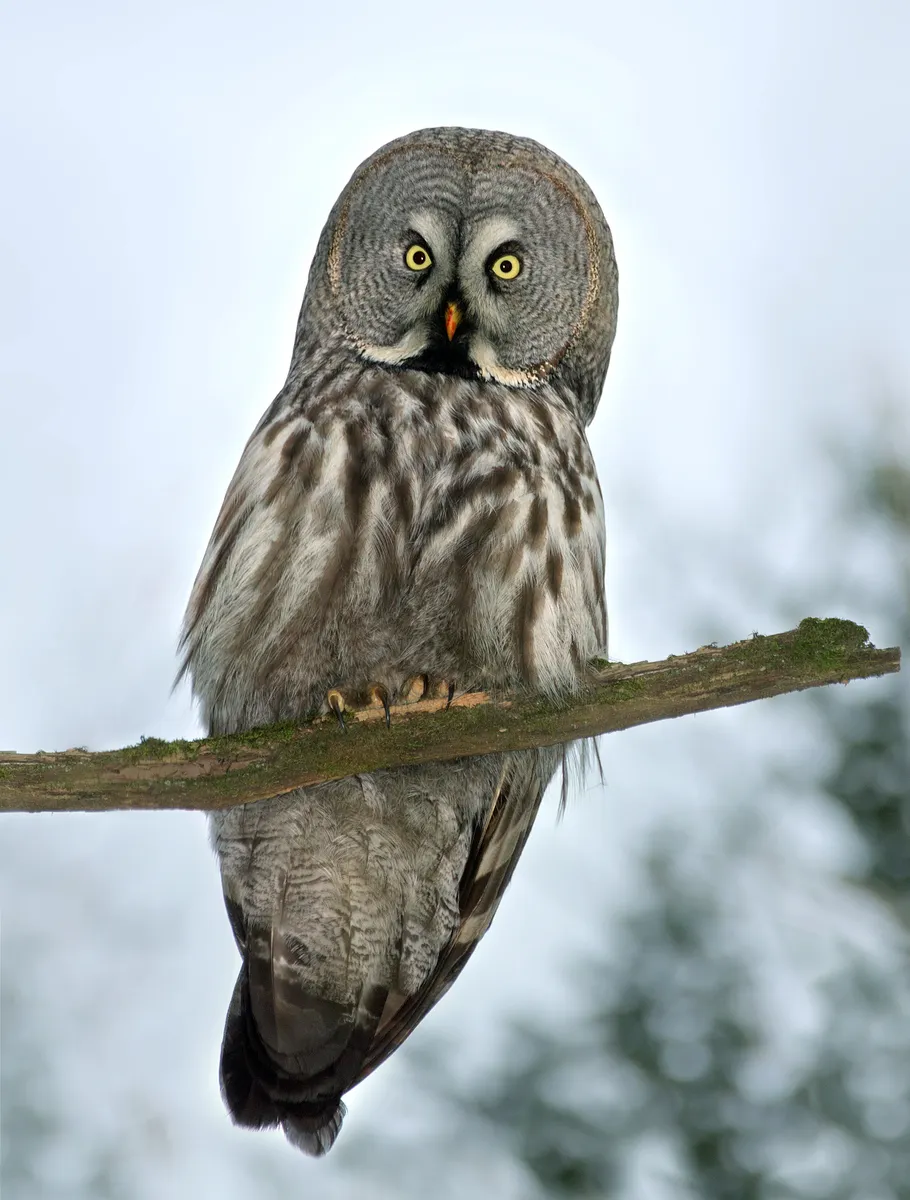
The great grey owl (Strix nebulosa) (also great gray owl in American English) is a true owl, and is the world's largest species of owl by length. It is distributed across the Northern Hemisphere and is the only species in the genus Strix found in both Eastern and Western Hemispheres.
Description
Adults have large, rounded heads with grey faces and yellow eyes with darker circles around them. The underparts are light with dark streaks; the upper parts are grey with pale bars. This owl does not have ear tufts and has the largest facial disc of any raptor. A white collar or "bow-tie" is just below the beak. The long tail tapers to a rounded end. In length, the great grey owl is believed to exceed the Eurasian eagle-owl and Blakiston's fish owl as the world's largest owl. The great grey is outweighed by those two species and several others, including most of the genus Bubo. Much of its size is deceptive, since this species' fluffy feathers, large head, and the longest tail of any extant owl obscure a body lighter than that of most other large owls. The length ranges from 61 to 84 cm (24 to 33 in), averaging 72 cm (28 in) for females and 67 cm (26 in) for males. The wingspan can exceed 152 cm (5 ft 0 in), but averages 142 cm (4 ft 8 in) for females and 140 cm (4 ft 7 in) for males. The adult weight ranges from 580 to 1,900 g (1.28 to 4.19 lb), averaging 1,290 g (2.84 lb) for females and 1,000 g (2.2 lb) for males. The males are usually smaller than females, as with most owl species. The call of the adult is a series of very deep, rhythmic 'who's, which is usually given in correlation to their territories or in interactions with their offspring. At other times, adults are normally silent. The young may chatter, shriek, or hiss. Tame owls may produce higher-pitched hoots when given food by humans.
Habitat and range
In northern areas, their breeding habitat is often the dense coniferous forests of the taiga, near open areas, such as meadows or bogs. In Oregon and California, this owl has been found nesting in mixed oak woodlands. Once believed to require a cold climate, this bird is now known to survive in a few areas where summer temperatures exceed 100 °F (38 °C).
Diet
These birds wait, listen, and watch for prey, then swoop down; they also may fly low through open areas in search of prey. They have excellent hearing, and may locate (and then capture) prey moving beneath 60 cm (2.0 ft) of snow in a series of tunnels solely with that sense. They then can crash to a snow depth roughly equal to their own body size to grab their prey.
Text from Wikipedia — Great grey owl, revision 1368372462, CC BY-SA 4.0, retrieved 2026-09-04. Encyclopedic text reused under CC BY-SA 4.0. Sentences about hunting or regulation are removed: on this site, the rule comes from Québec.ca.
Other names
French
English
Presence in Quebec
- Origin
- Indigène
- Occurrence
- Régulier
- Population status
- Toute l'année
- Certainty
- Confirmé
Conservation
Québec.ca
Official periods
Source: Québec.ca — tables reproduced as published (retrieved 2026-08-30).
Regulations change. Always check Québec.ca before hunting or trapping.
Where this data comes from
This species is listed in an official government dataset. The identification and status shown in the data sheet are reproduced from it.
Source: List of Quebec’s vertebrate wildlife (LFVQ) — Ministère de l’Environnement, de la Lutte contre les changements climatiques, de la Faune et des Parcs. File LFVQ_25_03_2026.csv, retrieved 2026-08-30 · CC BY 4.0.
Measurements, habitat, diet and reproduction are not shown: no official source is attached to them yet.