No period published by Québec.ca
Québec.ca publishes no hunting or trapping period for this species. Check the official regulations.
Wikipedia
Chouette rayée
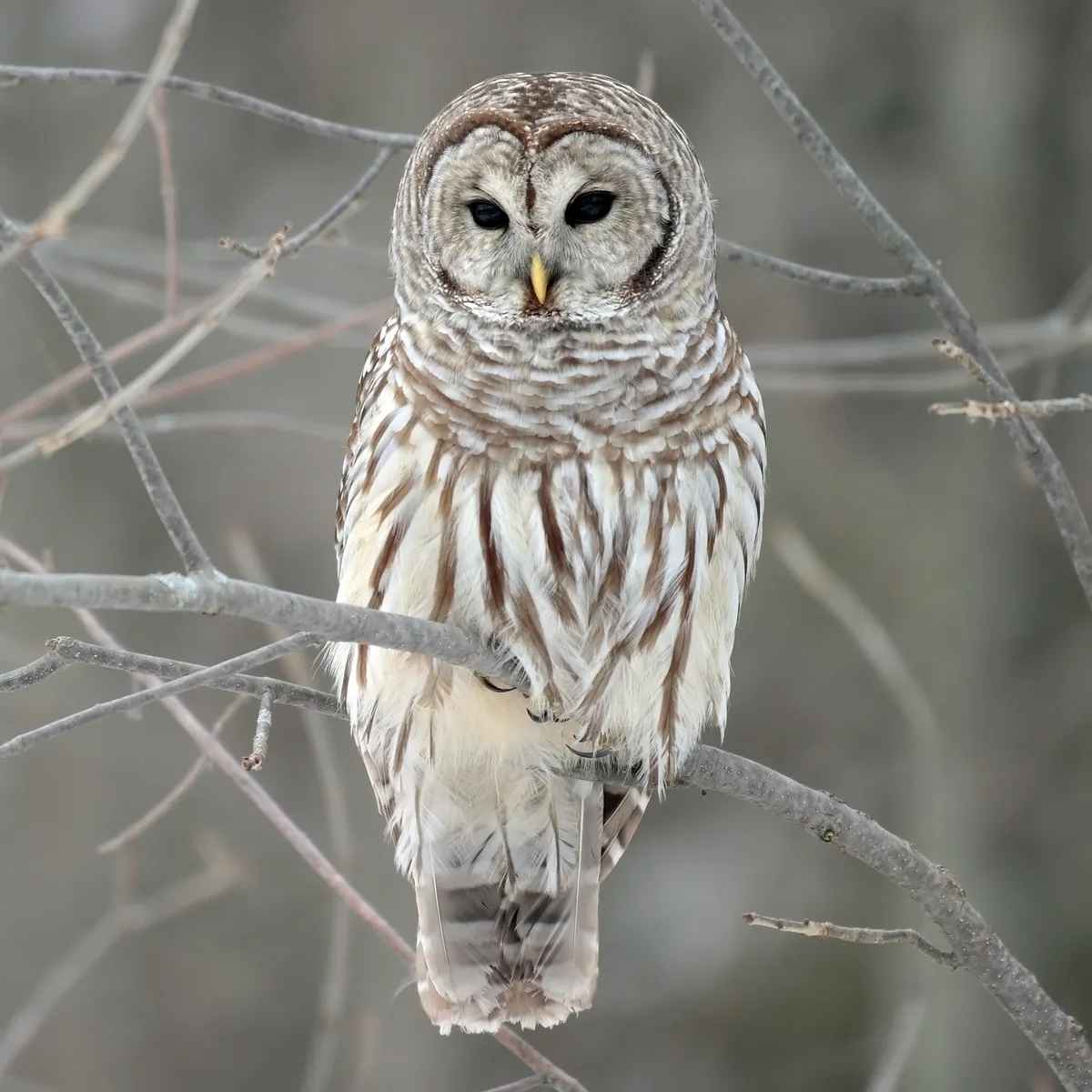
The barred owl (Strix varia), also known as the northern barred owl, striped owl or, more informally, hoot owl or eight hooter, is a North American large species of owl. A member of the true owl family, Strigidae, they belong to the genus Strix, which is also the origin of the family's name under Linnaean taxonomy. Barred owls are largely native to eastern North America, but have expanded their range to the west coast of North America where they are considered invasive. Mature forests are their preferred habitat, but they can also acclimatise to various gradients of open woodlands. Their diet consists mainly of small mammals, but this species is an opportunistic predator and is known to prey upon other small vertebrates such as birds, reptiles, and amphibians, as well as a variety of invertebrates. Barred owls are brown to gray overall, with dark striping on the underside. Barred owls have typical nesting habits for a true owl, tending to raise a relatively small brood often in a tree hollow or snag (but sometimes also in other nesting sites) in forested areas. As a result of the barred owl's westward expansion, the species has begun to encroach on the range of the related and threatened spotted owl (S. occidentalis). Evidence shows the assorted threats posed by the invading barred species are only increasing. In response, biologists have recommended culling operations to mitigate the negative effect of the barred on the spotted owl species.
Description
The barred owl is considered somewhat subdued and drab in coloration compared to the sometimes rich coloring of other sympatric owls. Overall, this owl is greyish-brown or brown. The brownish color extends from the head to the back. Barred owls are scalloped with white bars on the mantle and the back, bearing as well some whitish spotting on the wing coverts. The underside has a pale creamy gray-brown base color (ranging into dirty white in the palest individuals) overlaid about the throat and upper chest with horizontal, slightly crescent-shaped barring (hence its common name), while the belly is boldly streaked in a vertical pattern. The streaking is usually blackish, dusky brown, or sometimes rufescent- (reddish-) brown. The head is fairly large (although not especially so for a species in Strix) and rounded with no ear tufts. The facial disc is pale grayish-brown with darker yet subtle concentric lines. The bill is pale straw-yellow (occasionally showing a mild greenish tint) while the cere (a bare structure at the base of the beak) is "horn-colored". Its eyes are a dark brown color; the eyes may appear intensely black in the field and, although large, are fairly closely set. The barred owl has well-developed eye anatomy. As is typical of owls, their ocular anatomy is quite distinct from diurnal raptors especially in terms of their photoreceptor cells, as they have a very large number of rod cells in their quite sensitive retina.
Text from Wikipedia — Barred owl, revision 1371769224, CC BY-SA 4.0, retrieved 2026-09-04. Encyclopedic text reused under CC BY-SA 4.0. Sentences about hunting or regulation are removed: on this site, the rule comes from Québec.ca.
Other names
French
English
Presence in Quebec
- Origin
- Indigène
- Occurrence
- Régulier
- Population status
- Toute l'année
- Certainty
- Confirmé
Conservation
Québec.ca
Official periods
Source: Québec.ca — tables reproduced as published (retrieved 2026-08-30).
Regulations change. Always check Québec.ca before hunting or trapping.
Where this data comes from
This species is listed in an official government dataset. The identification and status shown in the data sheet are reproduced from it.
Source: List of Quebec’s vertebrate wildlife (LFVQ) — Ministère de l’Environnement, de la Lutte contre les changements climatiques, de la Faune et des Parcs. File LFVQ_25_03_2026.csv, retrieved 2026-08-30 · CC BY 4.0.
Measurements, habitat, diet and reproduction are not shown: no official source is attached to them yet.