
No period published by Québec.ca
Québec.ca publishes no hunting or trapping period for this species. Check the official regulations.
Wikipedia
Colibri d'Anna
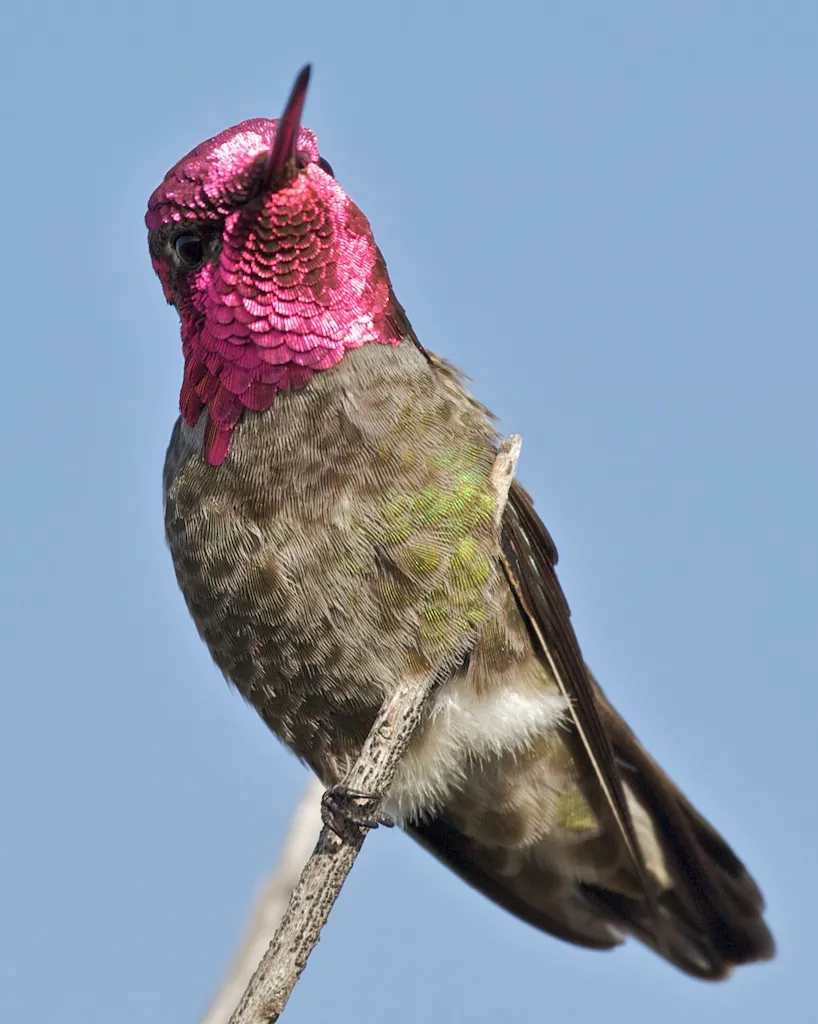
Anna's hummingbird (Calypte anna) is a North American species of hummingbird named after Anna Masséna, Duchess of Rivoli. It is native to western coastal regions of North America. Until the late 20th century, Anna's hummingbirds migrated from locations as far north as Alaska and coastal British Columbia, returning south to breed in Baja California and Southern California. Since the 1970s, ornamental plants in residential areas along the Pacific coast and inland deserts provided expanded nectar and nesting sites, allowing the species to expand its breeding range to northern coastal regions without migrating. Year-round residence of Anna's hummingbirds in the Pacific Northwest is an example of ecological release dependent on acclimation to colder winter temperatures, introduced plants, and human provision of nectar feeders during winter. These birds feed on nectar from flowers using a long extendable tongue. They also consume small insects and other arthropods caught in flight or gleaned from vegetation.
Description
Anna's hummingbirds are 3.9 to 4.3 in (9.9 to 10.9 cm) long with a wingspan of 4.7 inches (12 cm) and a weight range of 0.1 to 0.2 oz (2.8 to 5.7 g). They have an iridescent bronze-green back, a pale grey chest and belly, and green flanks. Their bills are long, straight, and slender. The adult male has an iridescent crimson-red, derived from magenta, to a reddish-pink crown and gorget, which can look dull brown or gray without direct sunlight, and a dark, slightly forked tail. Females also have iridescent red gorgets, although they are usually smaller and less brilliant than the male. The male Anna's hummingbird is the only North American hummingbird species with a red crown. Females and juvenile males have a dull green crown, a grey throat with or without some red iridescence, a grey chest and belly, and a dark, rounded tail with white tips on the outer feathers. The male has a striking reddish-pink crown and gorget, which are strongly iridescent and dependent on the angle of illumination and observation by female or male competitor birds. The iridescence results from large stacks of melanosomes in the feather barbules, occurring as layers separated by keratin. The barbules reflect incident light in the manner of partially-opened Venetian blinds, enabling the iridescence – which varies the head and gorget coloration with the changing angle of light – as a coloration advantage for courtship attraction and territory defense. Male birds with elevated levels of protein in their diet have more colorful crowns and higher iridescence in their head feathers compared with male birds with low protein intake.
Text from Wikipedia — Anna's hummingbird, revision 1371443574, CC BY-SA 4.0, retrieved 2026-09-04. Encyclopedic text reused under CC BY-SA 4.0. Sentences about hunting or regulation are removed: on this site, the rule comes from Québec.ca.
Presence in Quebec
- Origin
- Indigène
- Occurrence
- Accidentel/non régulier
- Population status
- Migrateur
- Certainty
- Confirmé
Conservation
Québec.ca
Official periods
Source: Québec.ca — tables reproduced as published (retrieved 2026-08-30).
Regulations change. Always check Québec.ca before hunting or trapping.
Where this data comes from
This species is listed in an official government dataset. The identification and status shown in the data sheet are reproduced from it.
Source: List of Quebec’s vertebrate wildlife (LFVQ) — Ministère de l’Environnement, de la Lutte contre les changements climatiques, de la Faune et des Parcs. File LFVQ_25_03_2026.csv, retrieved 2026-08-30 · CC BY 4.0.
Measurements, habitat, diet and reproduction are not shown: no official source is attached to them yet.