
No period published by Québec.ca
Québec.ca publishes no hunting or trapping period for this species. Check the official regulations.
Wikipedia
Colibri roux
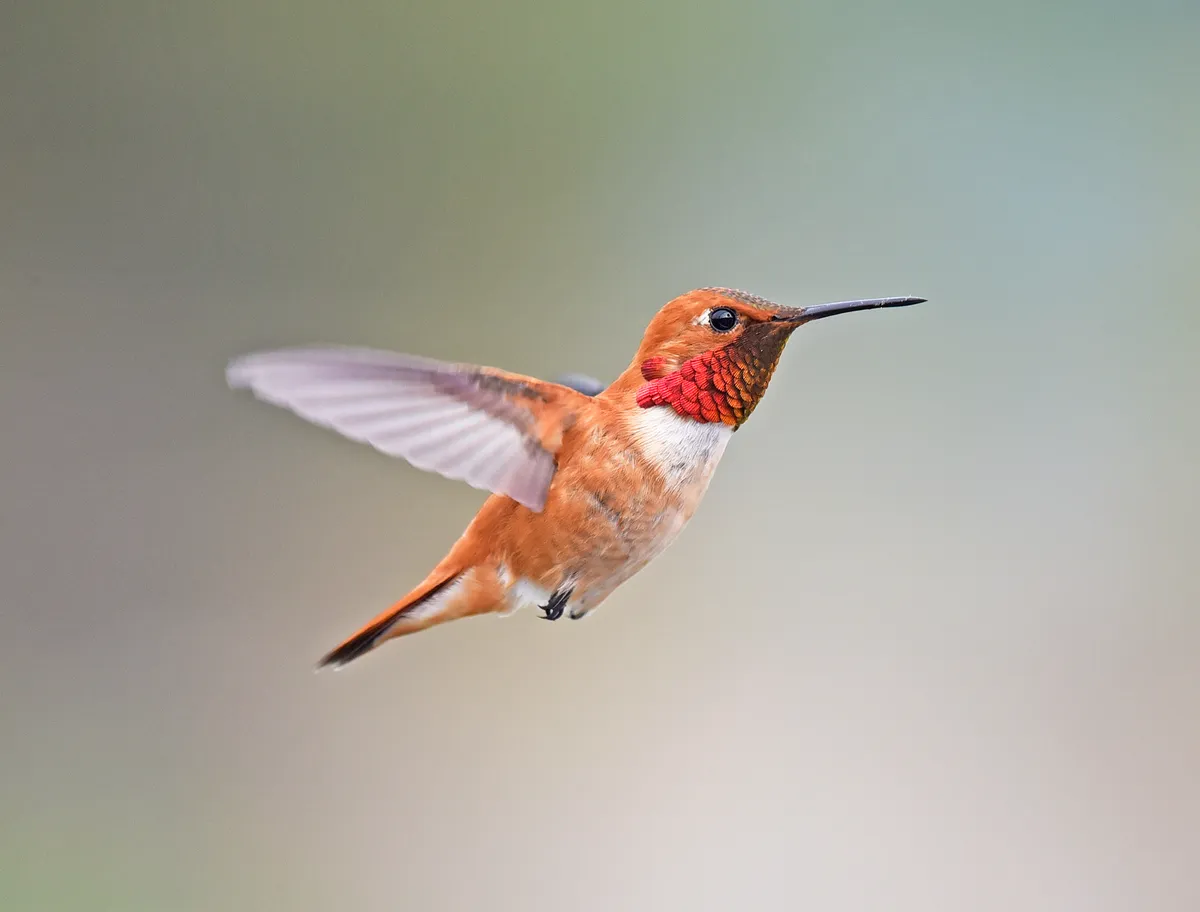
The rufous hummingbird (Selasphorus rufus) is a small hummingbird, about 8 cm (3 in) long with a long, straight and slender bill. These birds are known for their extraordinary flight skills, flying 3,200 kilometres (2,000 miles) during their migratory transits. It is one of nine species in the genus Selasphorus.
Description
The adult male has a white breast, rufous face, flanks and tail, and an iridescent orange-red throat patch or gorget. Some males have some green on their back and/or crown. The female has green, white, and some iridescent orange feathers in the center of the throat, and a dark tail with white tips and a rufous base. The female is slightly larger than the male. Females and the rare green-backed males are difficult to differentiate from Allen's hummingbird. The typical "notched" shape of the second rectrix (R2) is considered an important field mark to distinguish the adult male rufous hummingbird from the adult male Allen's hummingbird. This is a typical-sized hummingbird, being a small bird. It weighs 2–5 g (1⁄16–3⁄16 oz), measures 7–9 cm (3–3+1⁄2 in) long and spans 11 cm (4+1⁄2 in) across the wings.
Text from Wikipedia — Rufous hummingbird, revision 1354066648, CC BY-SA 4.0, retrieved 2026-09-04. Encyclopedic text reused under CC BY-SA 4.0. Sentences about hunting or regulation are removed: on this site, the rule comes from Québec.ca.
Presence in Quebec
- Origin
- Indigène
- Occurrence
- Accidentel/non régulier
- Population status
- Migrateur
- Certainty
- Confirmé
Conservation
Québec.ca
Official periods
Source: Québec.ca — tables reproduced as published (retrieved 2026-08-30).
Regulations change. Always check Québec.ca before hunting or trapping.
Where this data comes from
This species is listed in an official government dataset. The identification and status shown in the data sheet are reproduced from it.
Source: List of Quebec’s vertebrate wildlife (LFVQ) — Ministère de l’Environnement, de la Lutte contre les changements climatiques, de la Faune et des Parcs. File LFVQ_25_03_2026.csv, retrieved 2026-08-30 · CC BY 4.0.
Measurements, habitat, diet and reproduction are not shown: no official source is attached to them yet.