
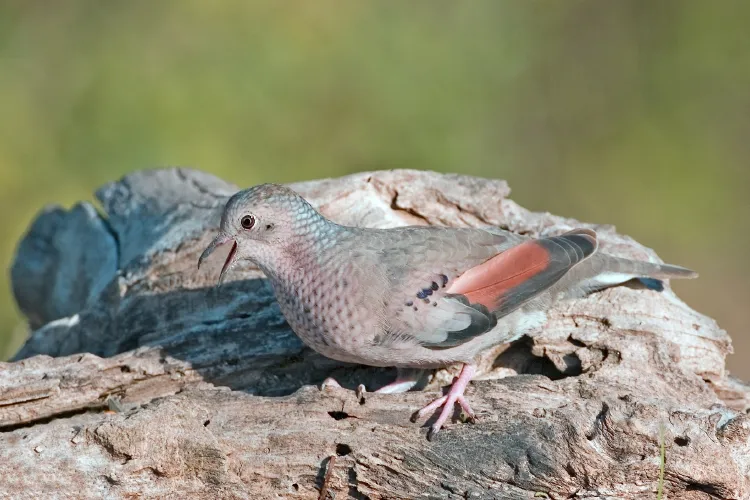
Colombe à queue noire— Quebec wildlife
Columbina passerina
ColumbidaeNo period published by Québec.ca
Québec.ca publishes no hunting or trapping period for this species. Check the official regulations.
Wikipedia
Colombe à queue noire
The common ground dove (Columbina passerina) is a small bird that inhabits the southern United States, parts of Central America, the Caribbean and northern South America. It is considered to be the smallest dove that inhabits the United States. As its name suggests, the bird spends the majority of its time on the ground, but can still fly.
Description
The common ground dove is North America's smallest and one of the world's smallest by mass. This species ranges from 15–18 cm (5.9–7.1 in) in length, spans 27 cm (11 in) across the wings, and weighs 26–40 g (0.92–1.41 oz). The common ground dove has a yellow beak with a black tip. Feathers surrounding the beak are pink in colour. The feathers on the head and the upper breast have a scale-like appearance. The tail feathers are very short and similar colour to the back. The plumage on the back of the bird is brown. The coverts and wing feathers are also brown but have black spotting on them. The common ground dove has chestnut primaries and wing borders, which can only be seen when the bird is flying. The common ground dove shows some sexual dimorphism in their plumage. The males have slate-gray feathers on the top of their heads and pink-gray colouration on their bellies. Females, on the other hand, are grayer than their male counterparts and are more evenly coloured. The common ground dove's call can be described as soft whoops that increase in pitch. Often the call is heard in repetition and is quite distinct. To hear the call of the common ground dove, see the external links for a link to a website.
Text from Wikipedia — Common ground dove, revision 1364540486, CC BY-SA 4.0, retrieved 2026-09-04. Encyclopedic text reused under CC BY-SA 4.0. Sentences about hunting or regulation are removed: on this site, the rule comes from Québec.ca.
Presence in Quebec
- Origin
- Indigène
- Occurrence
- Accidentel/non régulier
- Population status
- Migrateur
- Certainty
- Confirmé
Conservation
Official remark
Présence de l'espèce plutôt imprévisible; elle peut ne pas être observée pendant de longues périodes. Une mention confirmée en 2017.
Québec.ca
Official periods
Source: Québec.ca — tables reproduced as published (retrieved 2026-08-30).
Regulations change. Always check Québec.ca before hunting or trapping.
Where this data comes from
This species is listed in an official government dataset. The identification and status shown in the data sheet are reproduced from it.
Source: List of Quebec’s vertebrate wildlife (LFVQ) — Ministère de l’Environnement, de la Lutte contre les changements climatiques, de la Faune et des Parcs. File LFVQ_25_03_2026.csv, retrieved 2026-08-30 · CC BY 4.0.
Measurements, habitat, diet and reproduction are not shown: no official source is attached to them yet.