
No period published by Québec.ca
Québec.ca publishes no hunting or trapping period for this species. Check the official regulations.
Wikipedia
Combattant varié
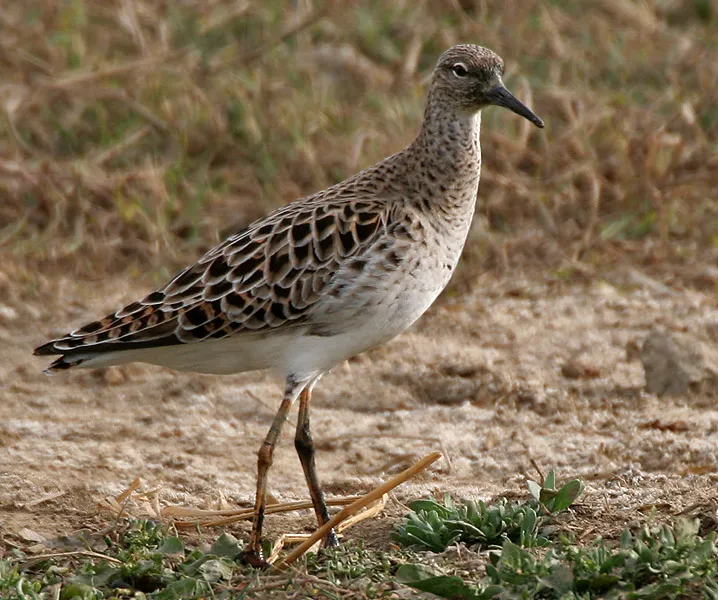
The ruff (Calidris pugnax) is a medium-sized wading bird that breeds in marshes and wet meadows across northern Eurasia. This highly gregarious sandpiper is migratory and sometimes forms huge flocks in its winter grounds, which include southern and western Europe, Africa, southern Asia and Australia. The ruff is a long-necked, pot-bellied bird. This species shows marked sexual dimorphism; the male is much larger than the female (the reeve), and has a breeding plumage that includes brightly coloured head tufts, bare orange facial skin, extensive black on the breast, and the large collar of ornamental feathers that inspired this bird's English name. The female and the non-breeding male have grey-brown upperparts and mainly white underparts. Three differently plumaged types of male, including a rare form that mimics the female, use a variety of strategies to obtain mating opportunities at a lek, and the colourful head and neck feathers are erected as part of the elaborate main courting display. The female has one brood per year and lays four eggs in a well-hidden ground nest, incubating the eggs and rearing the chicks, which are mobile soon after hatching, on her own. Predators of wader chicks and eggs include mammals such as foxes, feral cats and stoats, and birds such as large gulls, crows and skuas. The ruff forages in wet grassland and soft mud, probing or searching by sight for edible items. It primarily feeds on insects, especially in the breeding season, but it will consume plant material, including rice and maize, on migration and in winter. Classified as "least concern" on the IUCN Red List criteria, the global conservation concerns are relatively low because of the large numbers that breed in Scandinavia and the Arctic. This decline has seen it listed in the Agreement on the Conservation of African-Eurasian Migratory Waterbirds (AEWA).
Description
The ruff has a distinctive pot-bellied appearance, with a small head, medium-length bill, longish neck and heavy body. It has long legs that are variable in colour, being dark greenish in juveniles, pink to orange in adults with some males having reddish orange legs only during the breeding season. In flight, it has a deeper, slower wing stroke than other waders of a similar size, and displays a thin, indistinct white bar on the wing, and white ovals on the sides of the tail. The species shows sexual dimorphism. Although a small percentage of males resemble females, the typical male is much larger than the female and has an elaborate breeding plumage. Males are 29–32 cm (11–13 in) long with a 54–60 cm (21–24 in) wingspan, and weigh from 130–254 g (4.6–9.0 oz), the largest species in the genus Calidris. In the May-to-June breeding season, the male's legs, bill and warty bare facial skin are orange, and he has distinctive head tufts and a neck ruff. These ornaments vary on individual birds, being black, chestnut or white, with the colouring solid, barred or irregular.
Text from Wikipedia — Ruff (bird), revision 1369029058, CC BY-SA 4.0, retrieved 2026-09-04. Encyclopedic text reused under CC BY-SA 4.0. Sentences about hunting or regulation are removed: on this site, the rule comes from Québec.ca.
Other names
French
English
Presence in Quebec
- Origin
- Indigène
- Occurrence
- Régulier
- Population status
- Migrateur
- Certainty
- Confirmé
Conservation
Québec.ca
Official periods
Source: Québec.ca — tables reproduced as published (retrieved 2026-08-30).
Regulations change. Always check Québec.ca before hunting or trapping.
SIT Québec register
Outfitters hunting this species
82 outfitters list this species among the game they hunt.
Where this data comes from
This species is listed in an official government dataset. The identification and status shown in the data sheet are reproduced from it.
Source: List of Quebec’s vertebrate wildlife (LFVQ) — Ministère de l’Environnement, de la Lutte contre les changements climatiques, de la Faune et des Parcs. File LFVQ_25_03_2026.csv, retrieved 2026-08-30 · CC BY 4.0.
Measurements, habitat, diet and reproduction are not shown: no official source is attached to them yet.