
Condylure à nez étoilé— Quebec wildlife
Condylura cristata
TalpidaeNo period published by Québec.ca
Québec.ca publishes no hunting or trapping period for this species. Check the official regulations.
Wikipedia
Condylure à nez étoilé
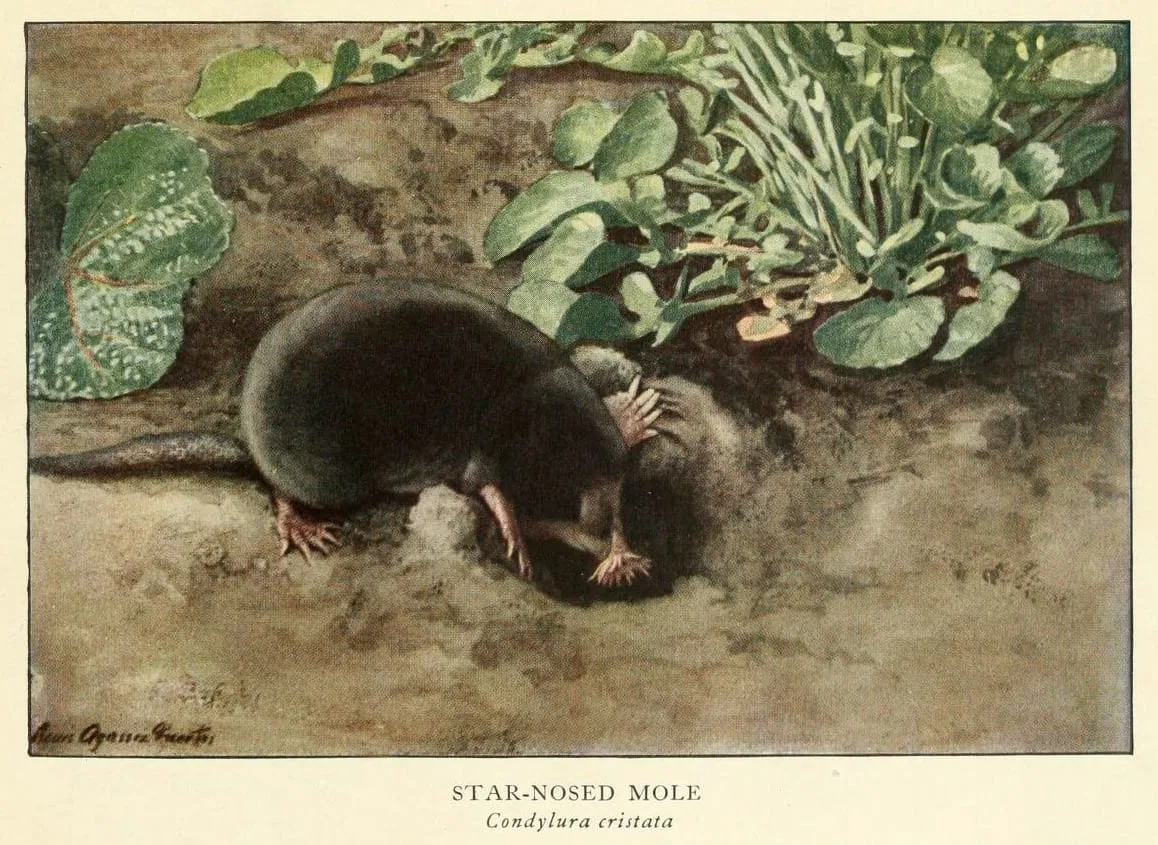
The star-nosed mole (Condylura cristata) is a small semiaquatic mole found in moist, low elevation areas in the northeastern parts of North America. It is the only extant member of the tribe Condylurini and genus Condylura. It has more than 25,000 minute sensory receptors in touch organs, known as Eimer's organs, with which this hamster-sized mole feels its way around. With the help of its Eimer's organs, it may be perfectly poised to detect seismic wave vibrations. The nose is about 1.5 cm (0.59 in) in diameter with its Eimer's organs distributed on 22 appendages. Eimer's organs were first described in the European mole in 1872 by German zoologist Theodor Eimer. Other mole species also possess Eimer's organs, though they are not as specialized or numerous as in the star-nosed mole. Because the star-nosed mole is functionally blind, the snout was long suspected to be used to detect electrical activity in prey animals, though little, if any, empirical support has been found for this hypothesis. The nasal star and dentition of this species appear to be primarily adapted to exploit extremely small prey. A report in the journal Nature gives this animal the title of fastest-eating mammal, taking as little as 120 milliseconds (average: 227 ms) to identify and consume individual food items. Its brain decides in approximately eight milliseconds if prey is edible or not. This speed is at the limit of the speed of neurons. These moles are also able to smell underwater, accomplished by exhaling air bubbles onto objects or scent trails and then inhaling the bubbles to carry scents back through the nose.
Text from Wikipedia — Star-nosed mole, revision 1372911201, CC BY-SA 4.0, retrieved 2026-09-04. Encyclopedic text reused under CC BY-SA 4.0. Sentences about hunting or regulation are removed: on this site, the rule comes from Québec.ca.
Other names
French
Presence in Quebec
- Origin
- Indigène
- Occurrence
- Régulier
- Population status
- Toute l'année
- Certainty
- Confirmé
Conservation
Québec.ca
Official periods
Source: Québec.ca — tables reproduced as published (retrieved 2026-08-30).
Regulations change. Always check Québec.ca before hunting or trapping.
Where this data comes from
This species is listed in an official government dataset. The identification and status shown in the data sheet are reproduced from it.
Source: List of Quebec’s vertebrate wildlife (LFVQ) — Ministère de l’Environnement, de la Lutte contre les changements climatiques, de la Faune et des Parcs. File LFVQ_25_03_2026.csv, retrieved 2026-08-30 · CC BY 4.0.
Measurements, habitat, diet and reproduction are not shown: no official source is attached to them yet.