
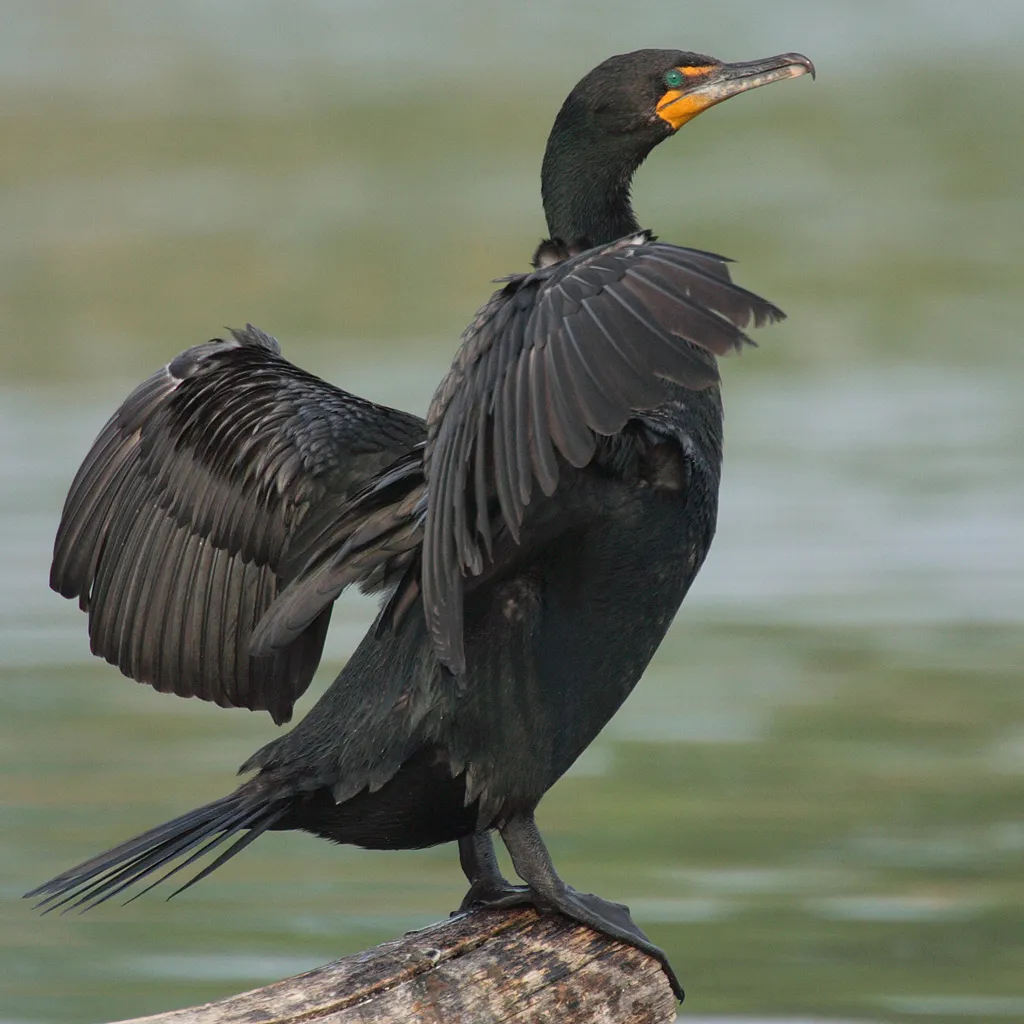
Cormoran à aigrettes— Quebec wildlife
Phalacrocorax auritus
PhalacrocoracidaeNo period published by Québec.ca
Québec.ca publishes no hunting or trapping period for this species. Check the official regulations.
Wikipedia
Cormoran à aigrettes
The double-crested cormorant (Nannopterum auritum) is a member of the cormorant family of water birds. It is found near rivers and lakes and in coastal areas and is widely distributed across North America, from the Aleutian Islands in Alaska down to Florida and Mexico. Measuring 70–90 cm (28–35 in) in length, it is entirely black except for a bare patch of orange-yellow facial skin and some extra plumage that it exhibits in the breeding season when it grows a double crest in which black feathers are mingled with white. Five subspecies are recognized. Its feathers, like all cormorants, are not waterproof, and it must dry them out after spending time in the water. Once threatened by the use of DDT, the numbers of this bird have increased markedly in recent years.
Description
The double-crested cormorant is a large waterbird with a stocky body, long neck, medium-sized tail, webbed feet, and a medium-sized hooked bill. It has a body length of between 70 and 90 cm (28 and 35 in) long, with a wingspan of between 114 and 123 cm (45 and 48 in). Double-crested cormorants weigh between 1.2 and 2.5 kg (2.6 and 5.5 lb). Males and females do not display sexual dimorphism. This species has dark-colored plumage with bare supra-loreal skin and gular skin that is yellow or orange. An adult in breeding plumage will be mostly black with the back and coverts being a dark grayish towards the center. Nuptial crests, for which the species is named, are either white, black or a mix of the two. These are located just above the eyes with the bare skin on the face of a breeding adult being orange. A non-breeding adult will lack the crests and have more yellowish skin around the face. The bill of the adult is dark-colored. The double-crested cormorant is very similar in appearance to the larger great cormorant, which has a more restricted distribution in North America, mainly on the Canadian maritime provinces; it can, however, be separated by having more yellow on the throat and the bill. The neotropic cormorant also looks very similar, and the two species can sometimes be found together where their ranges meet. The plumage of juvenile double-crested cormorants is more dark gray or brownish. The underparts of a juvenile are lighter than the back with a pale throat and breast that darkens towards the belly. As a bird ages, its plumage will grow darker. The bill of a juvenile will be mostly orange or yellowish.
Text from Wikipedia — Double-crested cormorant, revision 1362562364, CC BY-SA 4.0, retrieved 2026-09-04. Encyclopedic text reused under CC BY-SA 4.0. Sentences about hunting or regulation are removed: on this site, the rule comes from Québec.ca.
Other names
French
English
Presence in Quebec
- Origin
- Indigène
- Occurrence
- Régulier
- Population status
- Reproducteur
- Certainty
- Confirmé
Conservation
Québec.ca
Official periods
Source: Québec.ca — tables reproduced as published (retrieved 2026-08-30).
Regulations change. Always check Québec.ca before hunting or trapping.
Where this data comes from
This species is listed in an official government dataset. The identification and status shown in the data sheet are reproduced from it.
Source: List of Quebec’s vertebrate wildlife (LFVQ) — Ministère de l’Environnement, de la Lutte contre les changements climatiques, de la Faune et des Parcs. File LFVQ_25_03_2026.csv, retrieved 2026-08-30 · CC BY 4.0.
Measurements, habitat, diet and reproduction are not shown: no official source is attached to them yet.