
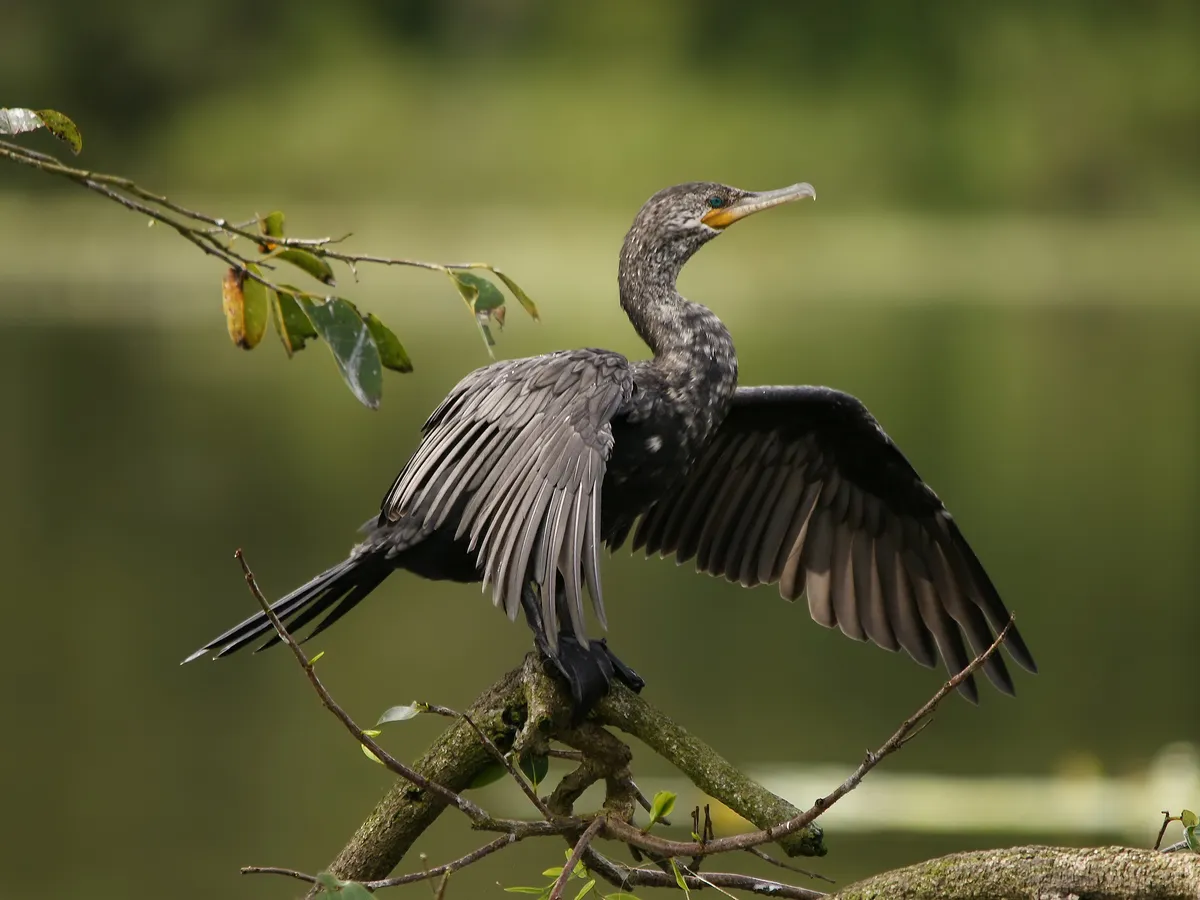
Cormoran vigua— Quebec wildlife
Phalacrocorax brasilianus
PhalacrocoracidaeNo period published by Québec.ca
Québec.ca publishes no hunting or trapping period for this species. Check the official regulations.
Wikipedia
Cormoran vigua
The neotropic cormorant or olivaceous cormorant (Nannopterum brasilianum) is a medium-sized cormorant found throughout the American tropics and subtropics, from the middle Rio Grande and the Gulf and Californian coasts of the United States south through Mexico and Central America to southern South America, where it is called by the indigenous name of biguá. It also breeds in the Bahamas, Cuba, and Trinidad. It can be found both on coasts (including some mangrove areas) and in inland waters. There are at least two subspecies: N. b. mexicanum from Nicaragua northwards and N. b. brasilianum further south. In Peru, the neotropic cormorant is used by the Uru people for fishing.
Description
This bird is 64 cm (25 in) long with a 100 cm (39 in) wingspan. Adult males weigh from 1.1 to 1.5 kg (2.4 to 3.3 lb), adult females 50 to 100 g (1.8 to 3.5 oz) less. Birds of the southern populations tend to be bigger than the more northerly birds. It is small and slender, especially compared to the larger, heavier-looking double-crested cormorant. It has a long tail and frequently holds its neck in an S-shape. Adult plumage is mainly black, with a yellow-brown throat patch. During breeding, white tufts appear on the sides of the head, there are scattered white filoplumes on the side of the head and the neck, and the throat patch develops a white edge. The upper wings are somewhat grayer than the rest of the body. Juveniles are brownish in color.
Text from Wikipedia — Neotropic cormorant, revision 1335015744, CC BY-SA 4.0, retrieved 2026-09-04. Encyclopedic text reused under CC BY-SA 4.0. Sentences about hunting or regulation are removed: on this site, the rule comes from Québec.ca.
Presence in Quebec
- Origin
- Indigène
- Occurrence
- Accidentel/non régulier
- Population status
- Migrateur
- Certainty
- Confirmé
Conservation
Québec.ca
Official periods
Source: Québec.ca — tables reproduced as published (retrieved 2026-08-30).
Regulations change. Always check Québec.ca before hunting or trapping.
Where this data comes from
This species is listed in an official government dataset. The identification and status shown in the data sheet are reproduced from it.
Source: List of Quebec’s vertebrate wildlife (LFVQ) — Ministère de l’Environnement, de la Lutte contre les changements climatiques, de la Faune et des Parcs. File LFVQ_25_03_2026.csv, retrieved 2026-08-30 · CC BY 4.0.
Measurements, habitat, diet and reproduction are not shown: no official source is attached to them yet.