
No period published by Québec.ca
Québec.ca publishes no hunting or trapping period for this species. Check the official regulations.
Wikipedia
Corneille de rivage
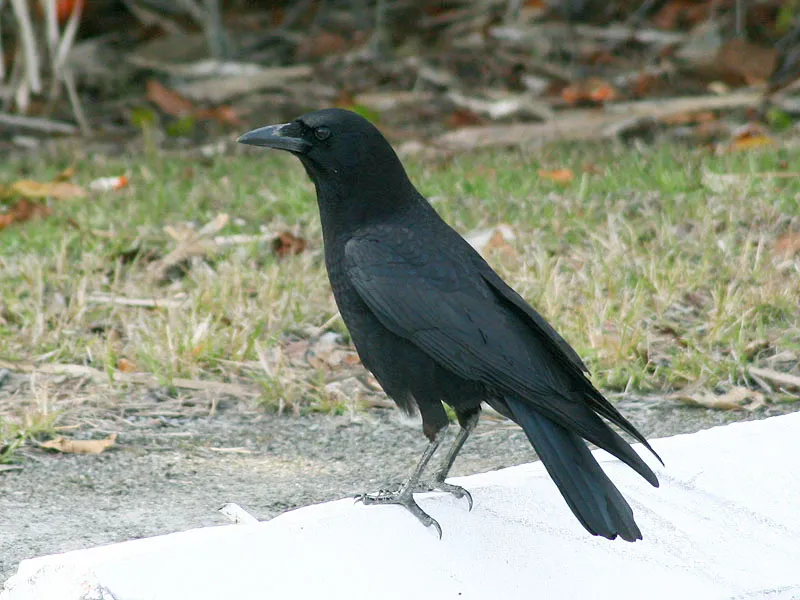
The fish crow (Corvus ossifragus) is a species of crow associated with wetland habitats in the eastern and southeastern United States.
Description
The fish crow is a medium-large bird, with an average adult weight of 280–320 grams (9.9–11.3 oz) in males and 247–293 grams (8.7–10.3 oz) in females. The wingspan is approximately 36 inches (90 cm), while the total body length is between 36–40 centimetres (14–16 in). The fish crow is superficially similar to the American crow, but is smaller and has a silkier, smoother plumage by comparison, and the bill is usually somewhat slimmer. The upperparts have a blue or blue-green sheen, while the underparts have a more greenish tint to the black. The eyes are dark brown. The differences are often only really apparent between the two species when seen side by side or when heard calling. Visual differentiation from the American crow is extremely difficult and often inaccurate. Nonetheless, differences apart from size do exist. Fish crows tend to have more slender bills and feet. There may also be a small sharp hook at the end of the upper bill. Fish crows also appear as if they have shorter legs when walking. More dramatically, when calling, fish crows tend to hunch and fluff their throat feathers. The voice is the most outwardly differing characteristic for this species and other American crow species. The call of the fish crow has been described as a nasal "ark-ark-ark" or a begging "waw-waw". Birders often distinguish the two species (in areas where their range overlaps) with the mnemonic aid "Just ask him if he is an American crow. If he says 'no', he is a fish crow", referring to the fact that the most common call of the American crow is a distinct "caw caw", while that of the fish crow is a nasal "nyuh unh". The fish crow also has a single call sounding like "cahrrr".
Text from Wikipedia — Fish crow, revision 1371085676, CC BY-SA 4.0, retrieved 2026-09-04. Encyclopedic text reused under CC BY-SA 4.0. Sentences about hunting or regulation are removed: on this site, the rule comes from Québec.ca.
Presence in Quebec
- Origin
- Indigène
- Occurrence
- Accidentel/non régulier
- Population status
- Migrateur
- Certainty
- Confirmé
Conservation
Québec.ca
Official periods
Source: Québec.ca — tables reproduced as published (retrieved 2026-08-30).
Regulations change. Always check Québec.ca before hunting or trapping.
Where this data comes from
This species is listed in an official government dataset. The identification and status shown in the data sheet are reproduced from it.
Source: List of Quebec’s vertebrate wildlife (LFVQ) — Ministère de l’Environnement, de la Lutte contre les changements climatiques, de la Faune et des Parcs. File LFVQ_25_03_2026.csv, retrieved 2026-08-30 · CC BY 4.0.
Measurements, habitat, diet and reproduction are not shown: no official source is attached to them yet.