
No period published by Québec.ca
Québec.ca publishes no hunting or trapping period for this species. Check the official regulations.
Wikipedia
Coucou gris
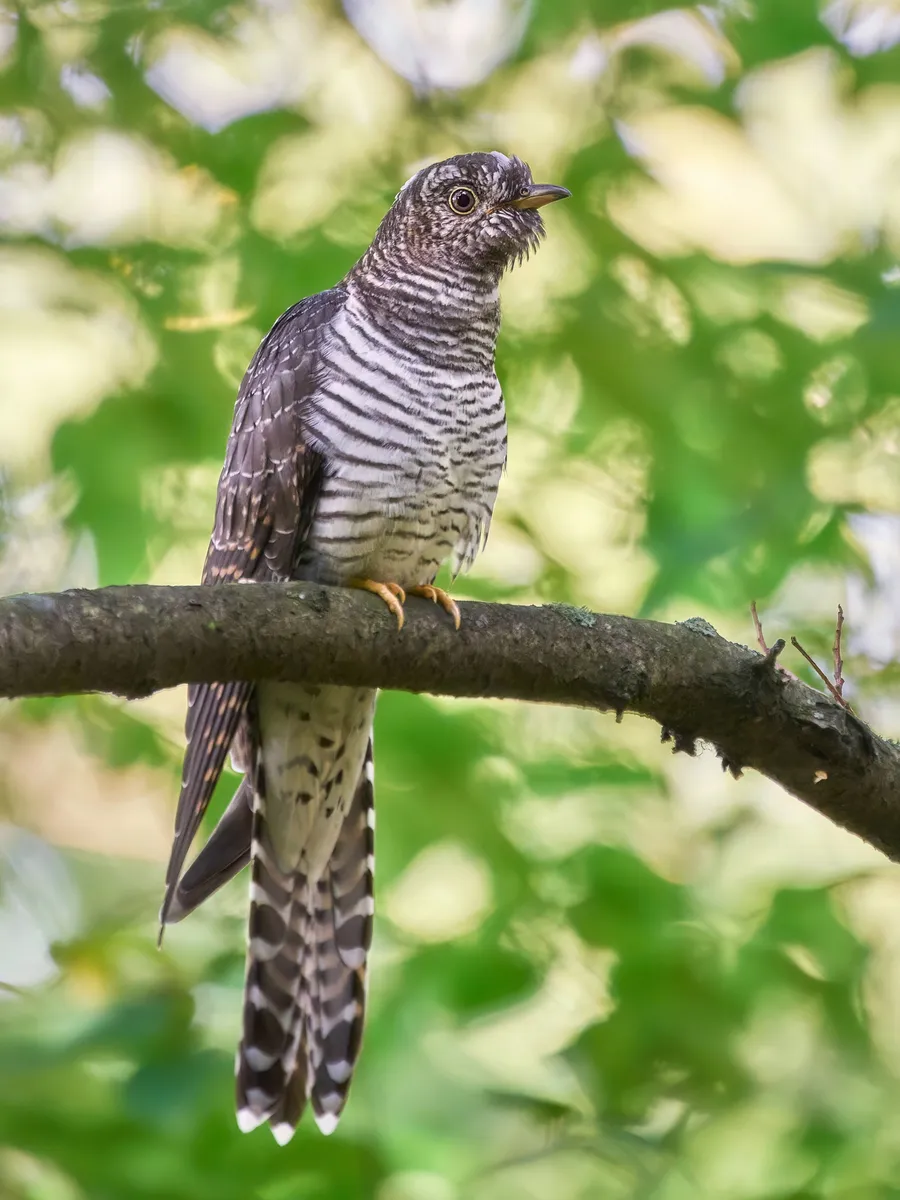
The cuckoo, common cuckoo, European cuckoo or Eurasian cuckoo (Cuculus canorus) is a member of the cuckoo order of birds, Cuculiformes, which includes the roadrunners, the anis and the coucals. This species is a widespread summer migrant to Europe and Asia, and winters in Africa. It is a brood parasite, which means it lays eggs in the nests of other bird species, particularly of dunnocks, meadow pipits, and reed warblers. Although its eggs are larger than those of its hosts, the eggs in each type of host nest resemble the host's eggs. The adult too is a mimic, in its case of the sparrowhawk; since that species is a predator, the mimicry gives the female time to lay her eggs without being attacked.
Description
The common cuckoo is 32–34 centimetres (13–13 in) long from bill to tail, with a tail of 13–15 centimetres (5.1–5.9 in) and a wingspan of 55–60 centimetres (22–24 in). The legs are short. It has a greyish, slender body and long tail, similar to a sparrowhawk in flight, where the wingbeats are regular. During the breeding season, common cuckoos often settle on an open perch with drooped wings and raised tail. There is a rufous colour morph, which occurs occasionally in adult females but more often in juveniles. It has been hypothesized to have evolved as a deterrence to male harassment or host species mobbing. All adult males are slate-grey; the grey throat extends well down the bird's breast with a sharp demarcation to the barred underparts. The iris, orbital ring, the base of the bill and feet are yellow. Grey adult females have a pinkish-buff or buff background to the barring and neck sides, and sometimes small rufous spots on the median and greater coverts and the outer webs of the secondary feathers. Rufous morph adult females have reddish-brown upperparts with dark grey or black bars. The black upperpart bars are narrower than the rufous bars, as opposed to rufous juvenile birds, where the black bars are broader. Common cuckoos in their first autumn have variable plumage. Some have strongly-barred chestnut-brown upperparts, while others are plain grey. Rufous-brown birds have heavily barred upperparts with some feathers edged with creamy-white. All have whitish edges to the upper wing-coverts and primaries. The secondaries and greater coverts have chestnut bars or spots. In spring, birds hatched in the previous year may retain some barred secondaries and wing-coverts. The most obvious identification features of juvenile common cuckoos are the white nape patch and white feather fringes. Common cuckoos moult twice a year: a partial moult in summer and a complete moult in winter. Males weigh around 130 grams (4.6 oz) and females 110 grams (3.9 oz). The common cuckoo looks very similar to the Oriental cuckoo, which is slightly shorter-winged on average. This resemblance extends even to the rufous morphs, which are also present in Oriental cuckoos. The presence of rufous morphs may well be ancestral to both Oriental cuckoos and common cuckoos.
Text from Wikipedia — Common cuckoo, revision 1359813015, CC BY-SA 4.0, retrieved 2026-09-04. Encyclopedic text reused under CC BY-SA 4.0. Sentences about hunting or regulation are removed: on this site, the rule comes from Québec.ca.
Presence in Quebec
- Origin
- Indigène
- Occurrence
- Accidentel/non régulier
- Population status
- Migrateur
- Certainty
- Confirmé
Conservation
Official remark
Présence de l'espèce plutôt imprévisible; elle peut ne pas être observée pendant de longues périodes. Une mention confirmée en 2013.
Québec.ca
Official periods
Source: Québec.ca — tables reproduced as published (retrieved 2026-08-30).
Regulations change. Always check Québec.ca before hunting or trapping.
Where this data comes from
This species is listed in an official government dataset. The identification and status shown in the data sheet are reproduced from it.
Source: List of Quebec’s vertebrate wildlife (LFVQ) — Ministère de l’Environnement, de la Lutte contre les changements climatiques, de la Faune et des Parcs. File LFVQ_25_03_2026.csv, retrieved 2026-08-30 · CC BY 4.0.
Measurements, habitat, diet and reproduction are not shown: no official source is attached to them yet.