
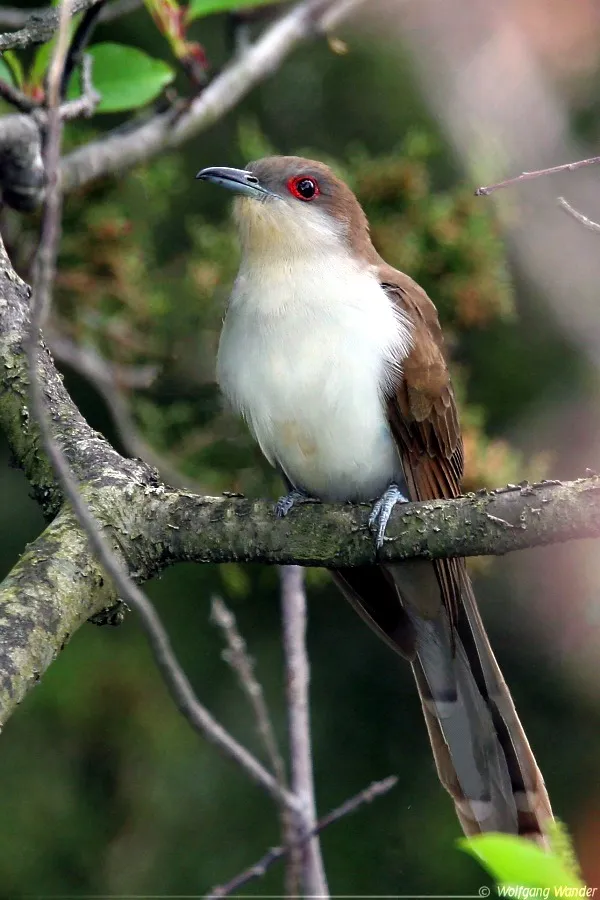
Coulicou à bec noir— Quebec wildlife
Coccyzus erythropthalmus
CuculidaeNo period published by Québec.ca
Québec.ca publishes no hunting or trapping period for this species. Check the official regulations.
Wikipedia
Coulicou à bec noir
The black-billed cuckoo (Coccyzus erythropthalmus) is a New World species in the Cuculidae (cuckoo) family. The scientific name is from Ancient Greek. The genus name, kokkuzo, means to call like a common cuckoo, and erythropthalmus is from eruthros, "red" and ophthalmos, "eye". It is very similar to, and overlaps in range with, the closely related yellow-billed cuckoo. A distinguishing characteristic of the family Cuculidae is laying eggs in the nests of other birds. Although many cuckoos are obligate brood parasites, C. erythropthalmus often incubate their own chicks.
Description
Adults have a long, graduated brown tail and a black, slightly downcurved bill. The head and upper parts are brown and the underparts are white. The feet are zygodactylous. Juveniles are drabber and may contain some rufous coloration on the wing. The adults have a narrow, red orbital ring while the juveniles' is yellow. Black-billed cuckoo chicks have white, sparsely distributed, sheath-like down that contrasts heavily with their black skin. They also have complex, creamy-colored structures on their mouth and tongue, which may appear like warts or some type of parasitic infection however they are normal for the species.
Habitat and range
C. erythropthalmus may be found in a variety of habitats. They are most commonly found around the edges of mature deciduous or mixed forests and much less frequently in coniferous forests. They can also be found in much younger-growth forests with a lot of shrubs and thickets. Wetlands with a lot of alder and willow are another prime location to see them. Lastly, they can also inhabit more open areas such as abandoned farmland, golf courses, and residential parks. Whatever the habitat may be, they are usually quite well hidden and tend to stick to the edges of these habitats. The chosen habitat must also have a water source nearby such as a lake, river, marsh, or pond. On their wintering grounds in South America, they can inhabit tropical rainforests, deciduous or semi open woodlands as well as scrub forests.
Text from Wikipedia — Black-billed cuckoo, revision 1371958838, CC BY-SA 4.0, retrieved 2026-09-04. Encyclopedic text reused under CC BY-SA 4.0. Sentences about hunting or regulation are removed: on this site, the rule comes from Québec.ca.
Other names
French
English
Presence in Quebec
- Origin
- Indigène
- Occurrence
- Régulier
- Population status
- Reproducteur
- Certainty
- Confirmé
Conservation
Québec.ca
Official periods
Source: Québec.ca — tables reproduced as published (retrieved 2026-08-30).
Regulations change. Always check Québec.ca before hunting or trapping.
Where this data comes from
This species is listed in an official government dataset. The identification and status shown in the data sheet are reproduced from it.
Source: List of Quebec’s vertebrate wildlife (LFVQ) — Ministère de l’Environnement, de la Lutte contre les changements climatiques, de la Faune et des Parcs. File LFVQ_25_03_2026.csv, retrieved 2026-08-30 · CC BY 4.0.
Measurements, habitat, diet and reproduction are not shown: no official source is attached to them yet.