
No period published by Québec.ca
Québec.ca publishes no hunting or trapping period for this species. Check the official regulations.
Wikipedia
Coulis hudsonien
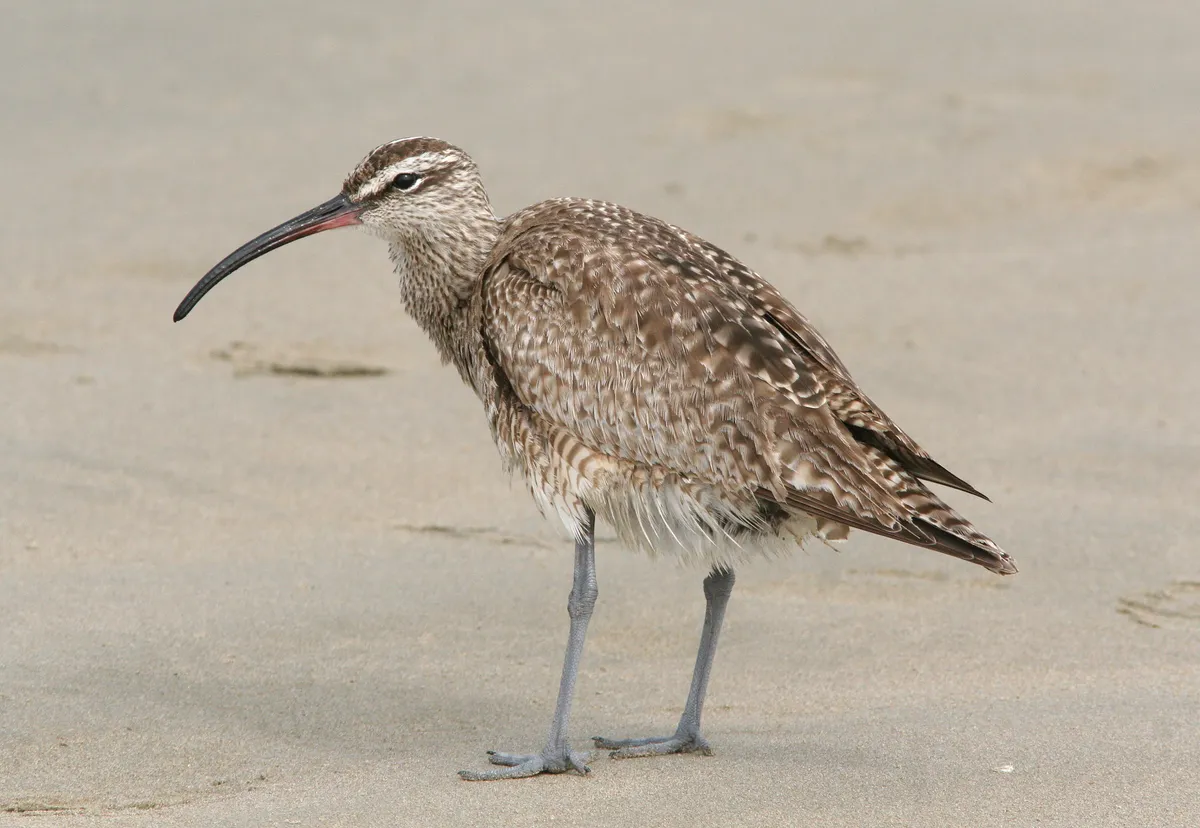
The Hudsonian whimbrel or Hudsonian curlew (Numenius hudsonicus) is a wader in the large family Scolopacidae. It is one of the most widespread of the curlews, breeding across much of subarctic North America.
Description
This is a fairly large wader, though mid-sized as a member of the curlew genus. The English name is imitative of the bird's call. The genus name Numenius is from Ancient Greek noumenios, a bird mentioned by Hesychius. It is associated with the curlews because it appears to be derived from neos, "new" and mene, "moon", referring to the crescent-shaped bill. It is 37–47 cm (15–19 in) in length, 75–90 cm (30–35 in) in wingspan, and 270–493 g (9.5–17.4 oz; 0.595–1.087 lb) in weight. It is mainly greyish brown, with a rump pattern uniform with upperparts, and a long curved bill (longest in the adult female) with a kink rather than a smooth curve. The usual call is a rippling whistle, prolonged into a trill for the song. The only similar common species over most of this bird's range are larger curlews. The whimbrel is smaller, has a shorter, decurved bill and has a central crown stripe and strong supercilia.
Text from Wikipedia — Hudsonian whimbrel, revision 1348856739, CC BY-SA 4.0, retrieved 2026-09-04. Encyclopedic text reused under CC BY-SA 4.0. Sentences about hunting or regulation are removed: on this site, the rule comes from Québec.ca.
Presence in Quebec
- Origin
- Indigène
- Occurrence
- Régulier
- Population status
- Migrateur
- Certainty
- Confirmé
Conservation
Québec.ca
Official periods
Source: Québec.ca — tables reproduced as published (retrieved 2026-08-30).
Regulations change. Always check Québec.ca before hunting or trapping.
Where this data comes from
This species is listed in an official government dataset. The identification and status shown in the data sheet are reproduced from it.
Source: List of Quebec’s vertebrate wildlife (LFVQ) — Ministère de l’Environnement, de la Lutte contre les changements climatiques, de la Faune et des Parcs. File LFVQ_25_03_2026.csv, retrieved 2026-08-30 · CC BY 4.0.
Measurements, habitat, diet and reproduction are not shown: no official source is attached to them yet.