
No period published by Québec.ca
Québec.ca publishes no hunting or trapping period for this species. Check the official regulations.
Wikipedia
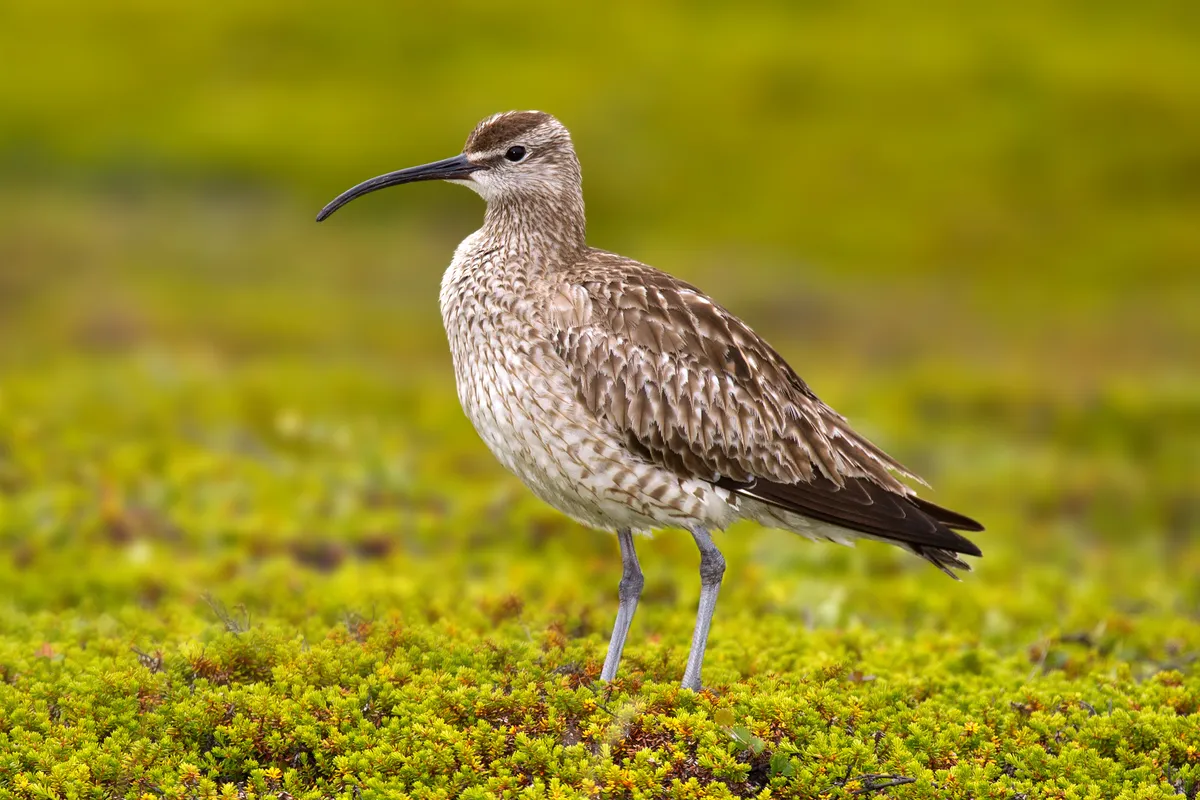
Courlis corlieu
The Eurasian whimbrel (Numenius phaeopus), historically known as the white-rumped whimbrel in North America, is a wader in the large family Scolopacidae. It is one of the most widespread of the curlews, breeding across much of subarctic Palearctic region and Europe as far south as Scotland. This species and the Hudsonian whimbrel were split in 2019, although some taxonomic authorities still consider them to be conspecific.
Description
The Eurasian whimbrel is a fairly large wader, though mid-sized as a member of the curlew genus. It is 37–47 cm (15–19 in) in length, 75–90 cm (30–35 in) in wingspan, and 270–493 g (9.5–17.4 oz; 0.595–1.087 lb) in weight. It is mainly greyish brown, with a white back and rump (subspecies N. p. phaeopus and N. p. alboaxillaris only), and a long curved beak with a kink rather than a smooth curve. The usual call is a rippling whistle, prolonged into a trill for the song.
Text from Wikipedia — Eurasian whimbrel, revision 1369638710, CC BY-SA 4.0, retrieved 2026-09-04. Encyclopedic text reused under CC BY-SA 4.0. Sentences about hunting or regulation are removed: on this site, the rule comes from Québec.ca.
Other names
French
English
Presence in Quebec
- Origin
- Indigène
- Occurrence
- Accidentel/non régulier
- Population status
- Migrateur
- Certainty
- Confirmé
Conservation
Québec.ca
Official periods
Source: Québec.ca — tables reproduced as published (retrieved 2026-08-30).
Regulations change. Always check Québec.ca before hunting or trapping.
Where this data comes from
This species is listed in an official government dataset. The identification and status shown in the data sheet are reproduced from it.
Source: List of Quebec’s vertebrate wildlife (LFVQ) — Ministère de l’Environnement, de la Lutte contre les changements climatiques, de la Faune et des Parcs. File LFVQ_25_03_2026.csv, retrieved 2026-08-30 · CC BY 4.0.
Measurements, habitat, diet and reproduction are not shown: no official source is attached to them yet.