
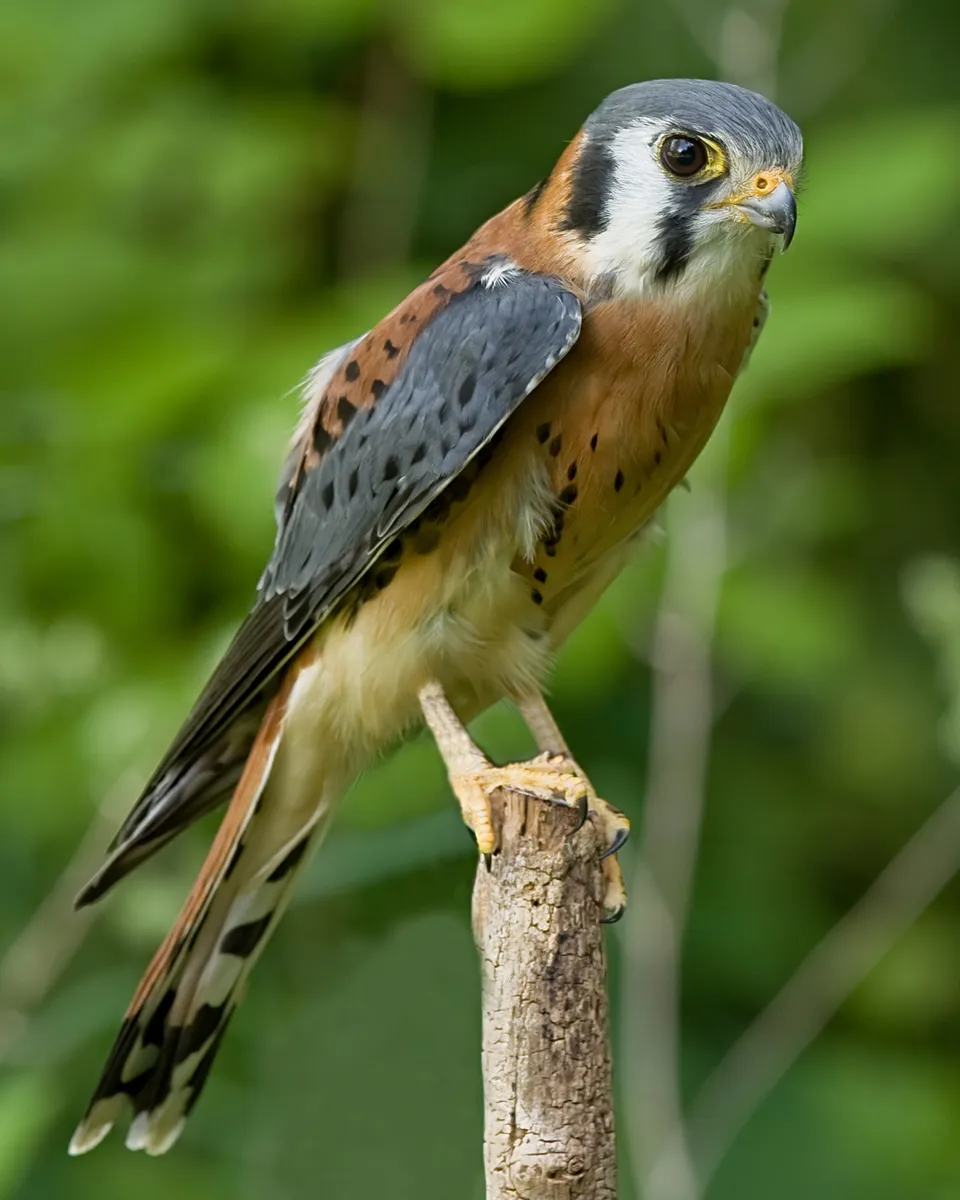
Crécerelle d'Amérique— Quebec wildlife
Falco sparverius
FalconidaeNo period published by Québec.ca
Québec.ca publishes no hunting or trapping period for this species. Check the official regulations.
Wikipedia
Crécerelle d'Amérique
The American kestrel (Falco sparverius) is the smallest and most common falcon in the Americas. Though it has been called the American "sparrow hawk", this now obsolete vernacular name is a misnomer; the American kestrel is a true falcon, while neither the Eurasian sparrowhawk nor the other species called sparrowhawks are in the family Falconidae, hence only very distantly related to the American kestrel. It has a roughly two-to-one range in size over subspecies and sex, varying in size from about the weight of a blue jay to a mourning dove. It is a very successful species, occurring almost throughout North and South America except for the Arctic fringes of North America, and the densest tropical Amazon rainforest areas; it has evolved into 17 subspecies adapted to different environments and habitats throughout the region. It exhibits sexual dimorphism in size (females being moderately larger) and plumage, although both sexes have a rufous back with noticeable barring. Its plumage is colorful, and juveniles are similar in plumage to adults. It sometimes hovers in the air with rapid wing beats while homing in on prey. Its diet typically consists of grasshoppers and other insects, lizards, mice, and small birds (e.g. sparrows). This broad diet has contributed to its wide success as a species. It nests in cavities in trees, cliffs, buildings, and other structures. The female lays three to seven eggs, which both sexes help to incubate. Its breeding range extends from central and western Alaska across northern Canada to Nova Scotia, and south throughout North America, into central Mexico and the Caribbean. It is a local breeder in Central America and is widely distributed throughout South America. Most birds breeding in Canada and the northern United States migrate south in the winter. It is an occasional vagrant to Western Europe. The American kestrel is often used in falconry, especially by beginners.
Description
Under traditional terminology, the American kestrel is the smallest raptor in the Americas, though the South American spot-winged falconet is almost as small. The American kestrel is sexually dimorphic, although there is some overlap in plumage coloration between the sexes. The bird ranges from 22 to 31 cm (8.7 to 12.2 in) in length with a wingspan of 51–61 cm (20–24 in). The female kestrel is larger than the male, though less so than larger falcons, being typically about 10% to 15% larger within a subspecies.
Text from Wikipedia — American kestrel, revision 1359422245, CC BY-SA 4.0, retrieved 2026-09-04. Encyclopedic text reused under CC BY-SA 4.0. Sentences about hunting or regulation are removed: on this site, the rule comes from Québec.ca.
Other names
French
English
Presence in Quebec
- Origin
- Indigène
- Occurrence
- Régulier
- Population status
- Reproducteur
- Certainty
- Confirmé
Conservation
Québec.ca
Official periods
Source: Québec.ca — tables reproduced as published (retrieved 2026-08-30).
Regulations change. Always check Québec.ca before hunting or trapping.
Where this data comes from
This species is listed in an official government dataset. The identification and status shown in the data sheet are reproduced from it.
Source: List of Quebec’s vertebrate wildlife (LFVQ) — Ministère de l’Environnement, de la Lutte contre les changements climatiques, de la Faune et des Parcs. File LFVQ_25_03_2026.csv, retrieved 2026-08-30 · CC BY 4.0.
Measurements, habitat, diet and reproduction are not shown: no official source is attached to them yet.