
No period published by Québec.ca
Québec.ca publishes no hunting or trapping period for this species. Check the official regulations.
Wikipedia
Cygne siffleur
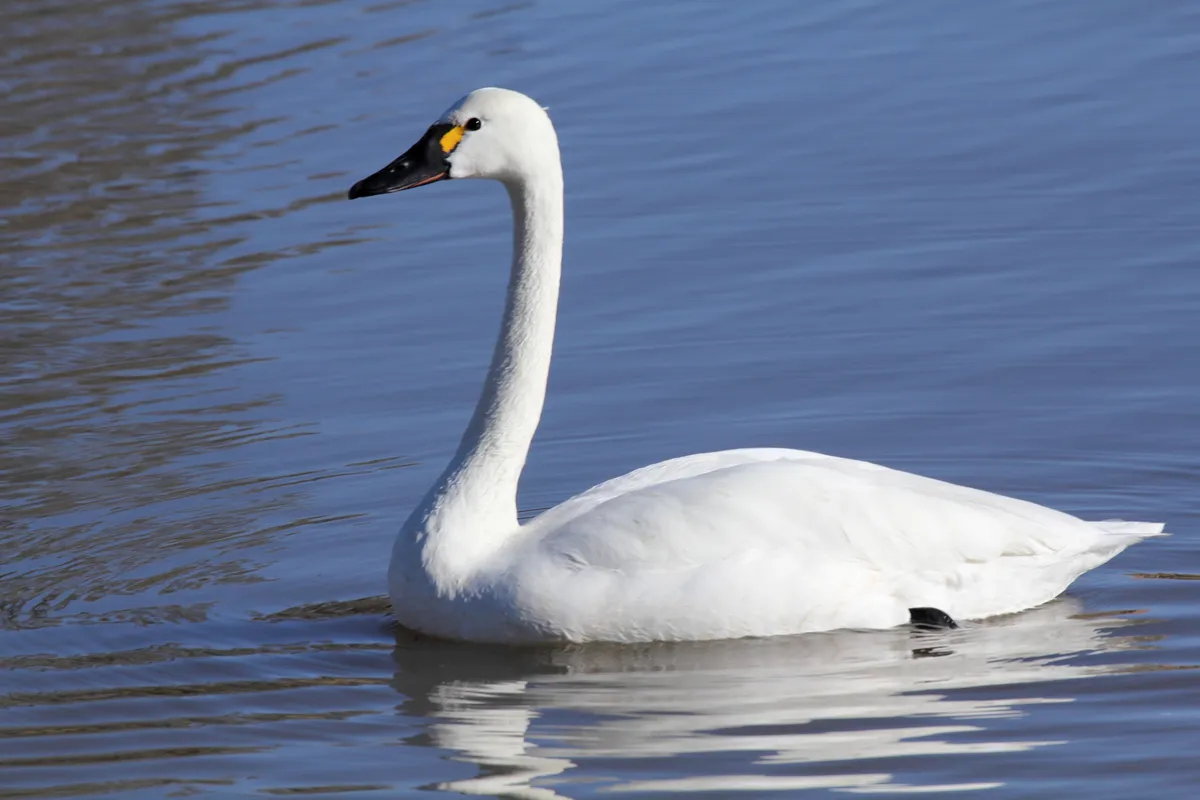
The tundra swan (Cygnus columbianus) is a species of swan which breeds in the arctic, and overwinters in North America, Europe, and Asia. It is the smallest of the Holarctic swans, at 115–150 cm (45–59 in) in length, 168–211 cm (66–83 in) in wingspan and 3.4–9.6 kg (7.5–21.2 lb) in weight. Typically, the plumage of adults is entirely white, with solid black feet, a black beak that has varying amounts of yellow, and a thin streak of pink along the mouthline, although colour variation is common. In the summer, they mainly eat aquatic vegetation, while at other times of year they often eat leftover crops, such as potatoes. They have few natural predators, although sometimes Arctic foxes, parasitic jaegers, and glaucous gulls will prey upon their eggs and chicks. During the breeding season, tundra swans become aggressive, and may attack passing animals and other tundra swans; outside of the breeding season, they can form groups. They make a high-pitched honk, similar to a black goose. Tundra swans live for an average of 10 years in the wild. They mate in spring, and are monogamous, mating for life. In May, they build a nest beside water using plant material, and lay 2–7 eggs, which incubate for about 30 days. The young fledge quickly after 60–75 days, twice as fast as the young of mute swans. They remain with their parents for their first winter migration. Sometimes, in their winter grounds, the families are joined offspring from previous breeding seasons.
Description
C. columbianus is the smallest of the Holarctic swans, at 115–150 cm (45–59 in) in length, 168–211 cm (66–83 in) in wingspan and a weight range of 3.4–9.6 kg (7.5–21.2 lb). In adult birds, the plumage of both subspecies is entirely white, with black feet, and a bill that is mostly black, with a thin salmon-pink streak running along the mouthline and – depending on the subspecies – more or less yellow in the proximal part. The iris is dark brown. In birds living in waters that contains large amounts of iron ions (e.g. bog lakes), the head and neck plumage acquires a golden or rusty hue. Pens (females) are slightly smaller than cobs (males), but do not differ in appearance otherwise. Immatures of both subspecies are white mixed with some dull grey feathering, mainly on the head and upper neck, which are often entirely light grey; their first-summer plumage is quite white already, and in their second winter they moult into the adult plumage. Their bills are black with a large dirty-pink patch taking up most of the proximal half and often black nostrils, and their feet are dark grey with a pinkish hue. Downy young are silvery grey above and white below. Bewick's swans are the smaller subspecies. There is a slight size cline, with the eastern birds being slightly larger; good measurement data only exists for the western populations however. These weigh 3.4–7.8 kg (7.5–17.2 lb), 6.4 kg (14 lb) on average in males and 5.7 kg (13 lb) in females.
Text from Wikipedia — Tundra swan, revision 1366596778, CC BY-SA 4.0, retrieved 2026-09-04. Encyclopedic text reused under CC BY-SA 4.0. Sentences about hunting or regulation are removed: on this site, the rule comes from Québec.ca.
Other names
French
English
Presence in Quebec
- Origin
- Indigène
- Occurrence
- Régulier
- Population status
- Reproducteur
- Certainty
- Confirmé
Conservation
Québec.ca
Official periods
Source: Québec.ca — tables reproduced as published (retrieved 2026-08-30).
Regulations change. Always check Québec.ca before hunting or trapping.
Where this data comes from
This species is listed in an official government dataset. The identification and status shown in the data sheet are reproduced from it.
Source: List of Quebec’s vertebrate wildlife (LFVQ) — Ministère de l’Environnement, de la Lutte contre les changements climatiques, de la Faune et des Parcs. File LFVQ_25_03_2026.csv, retrieved 2026-08-30 · CC BY 4.0.
Measurements, habitat, diet and reproduction are not shown: no official source is attached to them yet.