
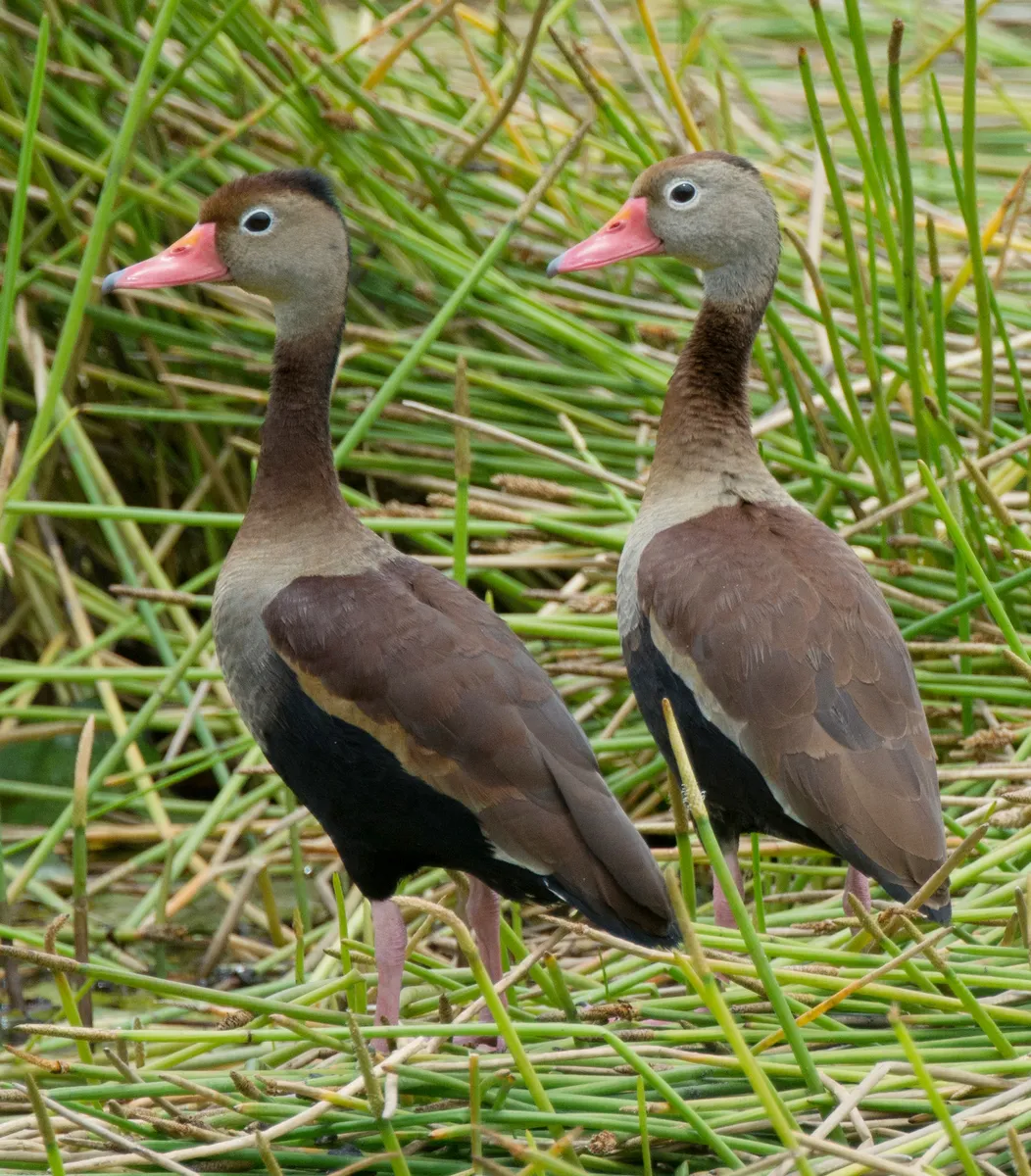
Dendrocygne à ventre noir— Quebec wildlife
Dendrocygna autumnalis
AnatidaeNo period published by Québec.ca
Québec.ca publishes no hunting or trapping period for this species. Check the official regulations.
Wikipedia
Dendrocygne à ventre noir
The black-bellied whistling duck (Dendrocygna autumnalis) or black-bellied tree duck, is a whistling duck that before 2000 bred mainly from the southernmost United States to south-central South America. It can be found year-round in much of the United States. It has been recorded in every eastern state and adjacent Canadian province. Since it is one of only two whistling duck species native to North America, it is occasionally just known as the "whistling duck" or "Mexican squealer" in the southern USA.
Description
The black-bellied whistling duck is a mid-sized waterfowl species. Length ranges from 47 to 56 cm (19 to 22 in), body mass from 652 to 1,020 g (1.437 to 2.249 lb), and wingspan ranges from 76 to 94 cm (30 to 37 in). It has a long pink bill, long head and longish legs, pale gray head and mostly gray-brown plumage. The belly and tail are black, and the body plumage, back of the neck and cap are a rich chestnut brown. The face and upper neck are gray, and they sport a thin but distinct white eye-ring. The extensive white in the wings is obvious in flight, less so on the ground; it is formed by the secondary remiges while the primaries are black; the wing coverts are brown. Males and females look alike; juveniles are similar but have a gray bill and less contrasting belly. The wing bar is unique among whistling ducks. When on the ground, it may be hard to discern the light flanks present in many of these waterfowl. The fulvous whistling duck (D. bicolor) is the only sympatric whistling duck that shows such a whitish flank stripe, and it differs from the black-bellied by having dark wings and a lighter belly rather than the other way around. Juvenile D. autumnalis are quite similar to the young of the white-faced whistling duck (D. viduata), which have a darker bill and no white wing patch; even when sitting they never seem to show white along the sides, as their thin white vertical barring on the black flanks is very indistinct. As the name implies, these are noisy birds with a clear whistling waa-chooo call.
Text from Wikipedia — Black-bellied whistling duck, revision 1366968675, CC BY-SA 4.0, retrieved 2026-09-04. Encyclopedic text reused under CC BY-SA 4.0. Sentences about hunting or regulation are removed: on this site, the rule comes from Québec.ca.
Presence in Quebec
- Origin
- Indigène
- Occurrence
- Accidentel/non régulier
- Population status
- Migrateur
- Certainty
- Confirmé
Conservation
Québec.ca
Official periods
Source: Québec.ca — tables reproduced as published (retrieved 2026-08-30).
Regulations change. Always check Québec.ca before hunting or trapping.
Where this data comes from
This species is listed in an official government dataset. The identification and status shown in the data sheet are reproduced from it.
Source: List of Quebec’s vertebrate wildlife (LFVQ) — Ministère de l’Environnement, de la Lutte contre les changements climatiques, de la Faune et des Parcs. File LFVQ_25_03_2026.csv, retrieved 2026-08-30 · CC BY 4.0.
Measurements, habitat, diet and reproduction are not shown: no official source is attached to them yet.