
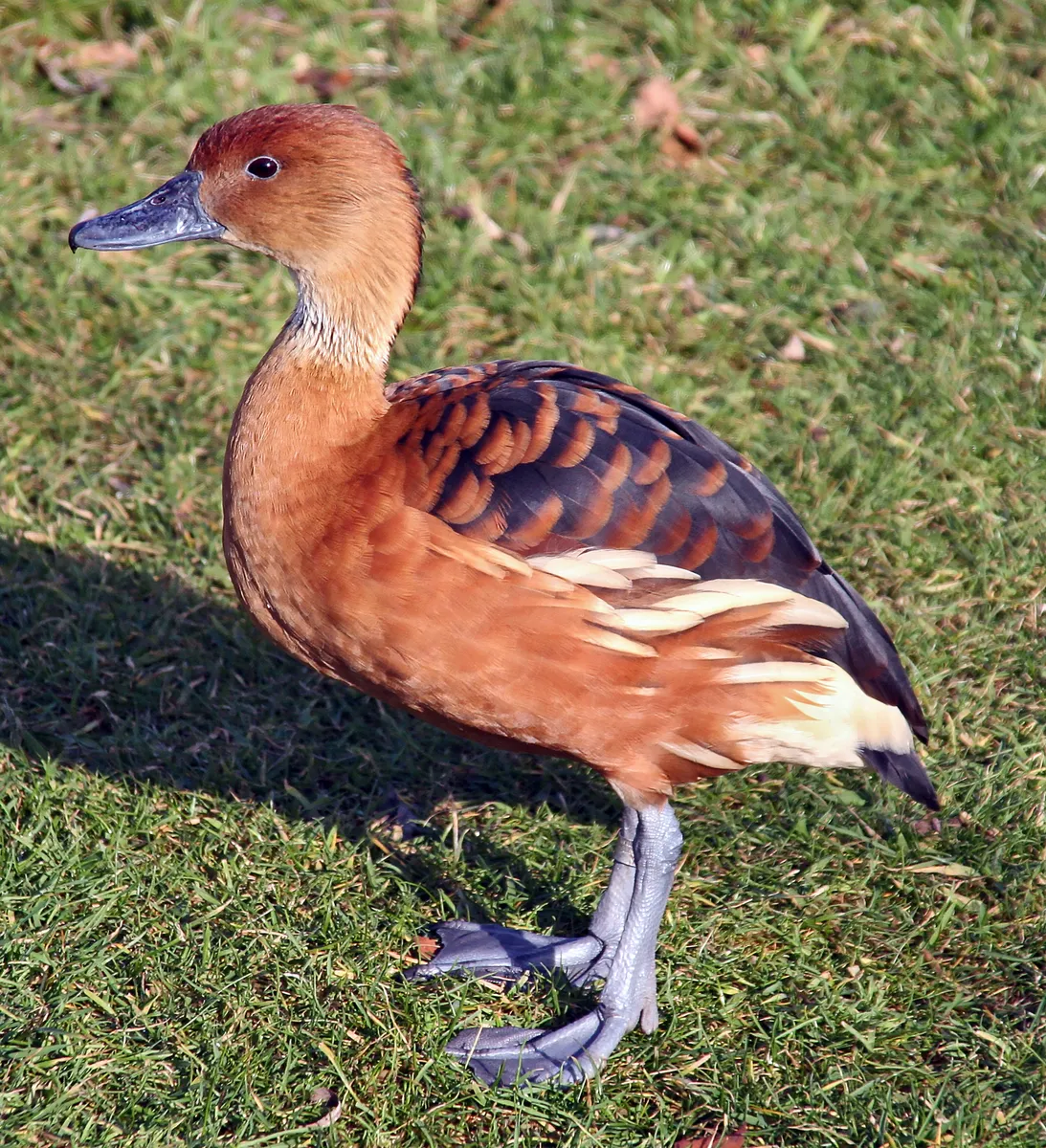
Dendrocygne fauve— Quebec wildlife
Dendrocygna bicolor
AnatidaeNo period published by Québec.ca
Québec.ca publishes no hunting or trapping period for this species. Check the official regulations.
Wikipedia
Dendrocygne fauve
The fulvous whistling duck or fulvous tree duck (Dendrocygna bicolor) is a species of whistling duck that breeds across the world's tropical regions in much of Mexico and South America, the West Indies, the southern United States, sub-Saharan Africa and the Indian subcontinent. It has plumage that is mainly reddish brown, long legs and a long grey bill, and shows a distinctive white band across its black tail in flight. Like other members of its ancient lineage, it has a whistling call which is given in flight or on the ground. Its preferred habitat consists of wetlands with plentiful vegetation, including shallow lakes and paddy fields. The nest, built from plant material and unlined, is placed among dense vegetation or in a tree hole. The typical clutch is around ten whitish eggs. The breeding adults, which pair for life, take turns to incubate, and the eggs hatch in 24–29 days. The downy grey ducklings leave the nest within a day or so of hatching, but the parents continue to protect them until they fledge around nine weeks later. The fulvous whistling duck feeds in wetlands by day or night on seeds and other parts of plants. It is sometimes regarded as a pest of rice cultivation, and is also shot for food in parts of its range.
Description
The fulvous whistling duck is 45–53 cm (18–21 in) long; the male weighs 748–1,050 g (26.4–37.0 oz), and the female averages marginally lighter at 712–1,000 g (25.1–35.3 oz). The wingspan ranges from 85 to 93 cm. It is a long-legged duck, mainly different shades of brown; head, neck and breast are particularly rich buff (fulvous) with a darker back. The mantle is more darker shade of brown with buff-tipped feathers, the flight feathers and tail are dark brown, and a dark brown to black stripe runs through the center of the crown down the back of the neck to the base of the mantle. It has whitish stripes on its flanks, a long grey bill and grey legs. In flight, the wings are brown above and black below, with no white markings, and a white crescent on the rump contrasts with the black tail. All plumages are fairly similar, but the female is slightly smaller and duller-plumaged than the male. The juvenile has paler underparts, and appears generally duller, especially on the flanks. There is a complete wing moult after breeding, and birds then seek the cover of dense wetland vegetation while they are flightless. Body feathers may be moulted throughout the year; each feather is replaced only once annually. These are noisy birds with a clear whistling kee-wee-ooo call given on the ground or in flight, frequently heard at night. Quarrelling birds also have a harsh repeated kee. In flight, the beating wings produce a dull sound. The calls of males and females show differences in structure and an acoustic analysis on 59 captive birds demonstrated 100% accuracy in sexing when compared with molecular methods.
Diet
The fulvous whistling duck feeds in wetlands by day or night, often in mixed flocks with relatives such as white-faced or bla
Text from Wikipedia — Fulvous whistling duck, revision 1342665190, CC BY-SA 4.0, retrieved 2026-09-04. Encyclopedic text reused under CC BY-SA 4.0. Sentences about hunting or regulation are removed: on this site, the rule comes from Québec.ca.
Other names
French
English
Presence in Quebec
- Origin
- Indigène
- Occurrence
- Accidentel/non régulier
- Population status
- Migrateur
- Certainty
- Confirmé
Conservation
Québec.ca
Official periods
Source: Québec.ca — tables reproduced as published (retrieved 2026-08-30).
Regulations change. Always check Québec.ca before hunting or trapping.
SIT Québec register
Outfitters hunting this species
90 outfitters list this species among the game they hunt.
Where this data comes from
This species is listed in an official government dataset. The identification and status shown in the data sheet are reproduced from it.
Source: List of Quebec’s vertebrate wildlife (LFVQ) — Ministère de l’Environnement, de la Lutte contre les changements climatiques, de la Faune et des Parcs. File LFVQ_25_03_2026.csv, retrieved 2026-08-30 · CC BY 4.0.
Measurements, habitat, diet and reproduction are not shown: no official source is attached to them yet.