
No period published by Québec.ca
Québec.ca publishes no hunting or trapping period for this species. Check the official regulations.
Wikipedia
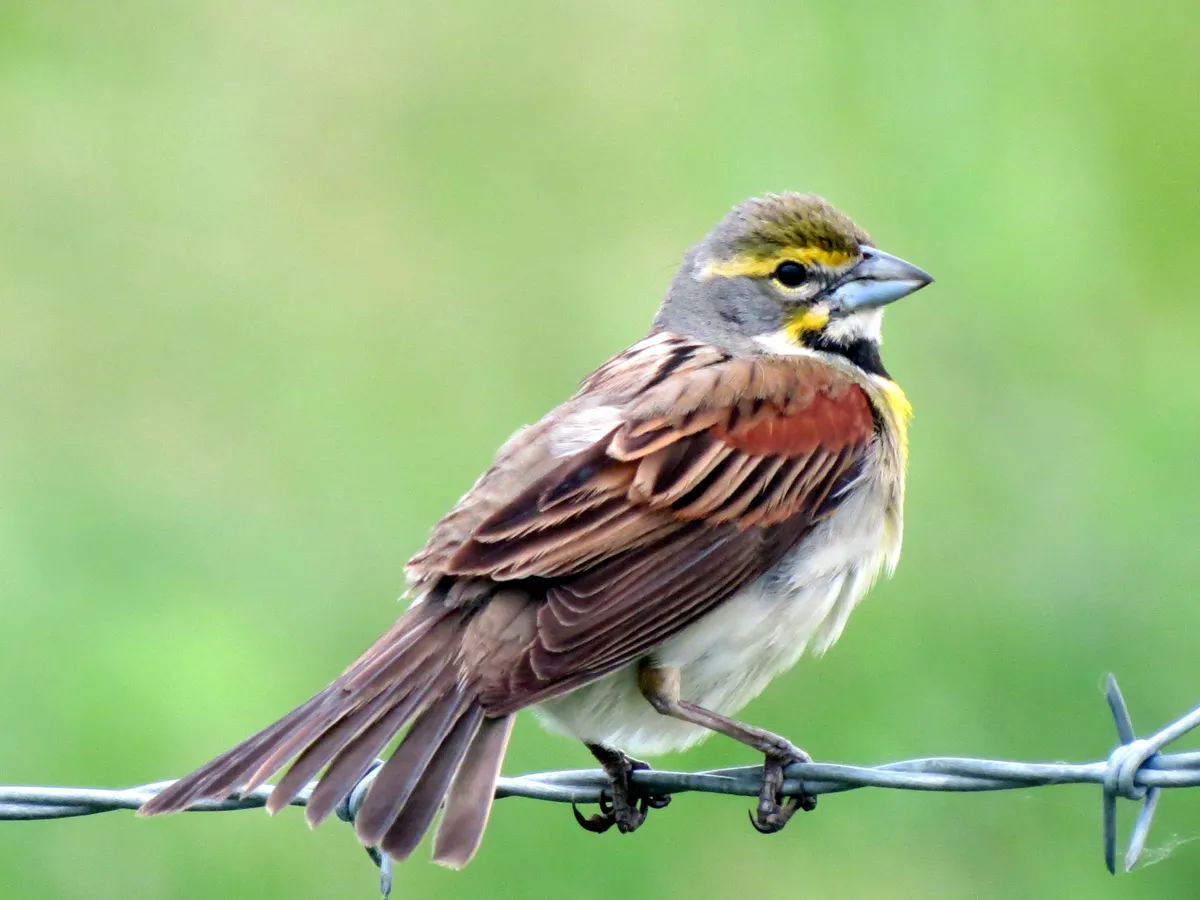
Dickcissel d'Amérique
The dickcissel (Spiza americana) is a small seed-eating migratory bird in the family Cardinalidae. It breeds on the prairie grasslands of the Midwestern United States and winters in Central America, northern Colombia, and northern Venezuela. It is the only member of the genus Spiza, though some sources list another supposedly extinct species.
Description
Their length is 5.5–6.3 in (140–160 mm), wingspan is 9.8–10.2 in (250–260 mm), and weight is0.9–1.4 oz (26–40 g). Dickcissels have a large, pale bill, a yellow line over the eyes, brownish upperparts with black streaks on the back, dark wings, a rust patch on the shoulders, and light underparts. Adult males have a black throat patch, a yellow breast, and grey cheeks and crown. This head and breast pattern is especially brilliant in the breeding plumage, making it resemble an eastern meadowlark. Females and juveniles are brownish on the cheeks and crown, and are somewhat similar in appearance to house sparrows; they have streaked flanks. In flight, they make a low, "electric", buzzing fpppt. From an open perch in a field, this bird's song is a sharp dick dick followed by a buzzed cissel, also transcribed as skee-dlees chis chis chis or dick dick ciss ciss ciss.
Text from Wikipedia — Dickcissel, revision 1361409777, CC BY-SA 4.0, retrieved 2026-09-04. Encyclopedic text reused under CC BY-SA 4.0. Sentences about hunting or regulation are removed: on this site, the rule comes from Québec.ca.
Other names
French
English
Presence in Quebec
- Origin
- Indigène
- Occurrence
- Accidentel/non régulier
- Population status
- Migrateur
- Certainty
- Confirmé
Conservation
Québec.ca
Official periods
Source: Québec.ca — tables reproduced as published (retrieved 2026-08-30).
Regulations change. Always check Québec.ca before hunting or trapping.
Where this data comes from
This species is listed in an official government dataset. The identification and status shown in the data sheet are reproduced from it.
Source: List of Quebec’s vertebrate wildlife (LFVQ) — Ministère de l’Environnement, de la Lutte contre les changements climatiques, de la Faune et des Parcs. File LFVQ_25_03_2026.csv, retrieved 2026-08-30 · CC BY 4.0.
Measurements, habitat, diet and reproduction are not shown: no official source is attached to them yet.