
No period published by Québec.ca
Québec.ca publishes no hunting or trapping period for this species. Check the official regulations.
Wikipedia
Durbec des sapins
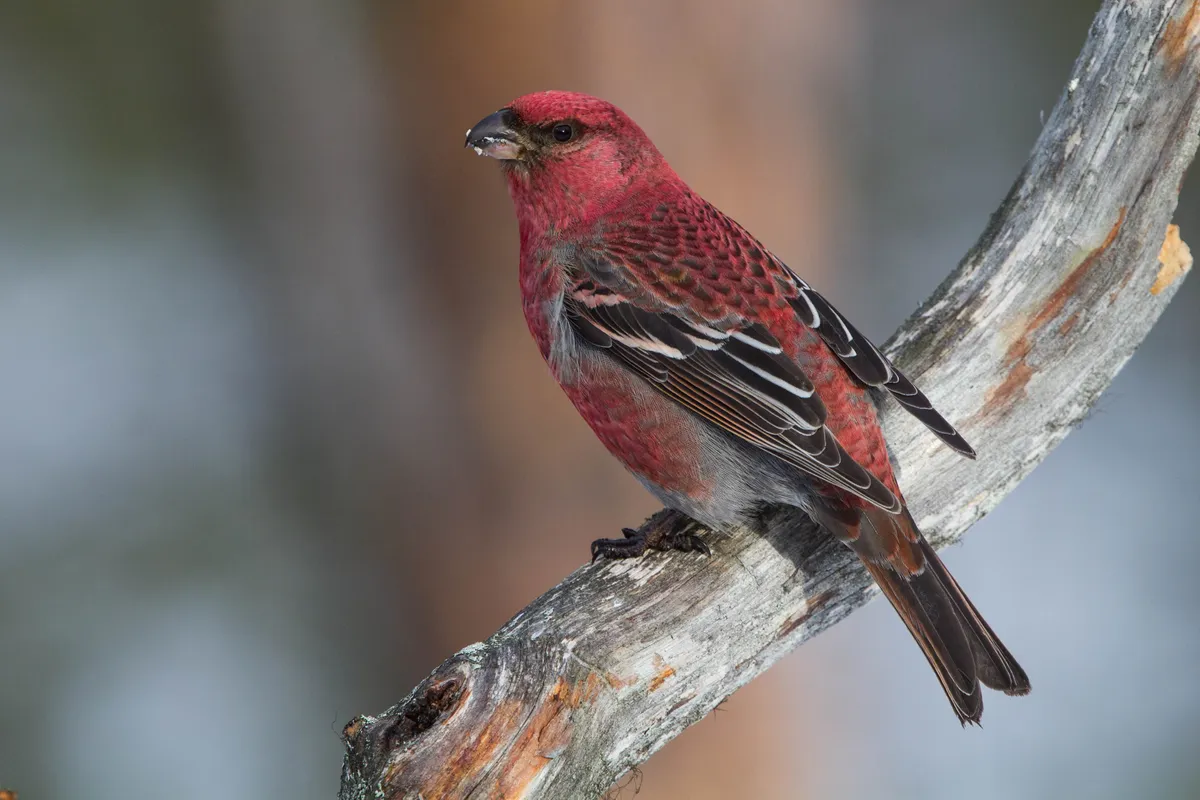
The pine grosbeak (Pinicola enucleator) is a large member of the true finch family, Fringillidae. It is the only species in the genus Pinicola. It is found in coniferous woods across Alaska, the western mountains of the United States, Canada, and in subarctic Fennoscandia and across the Palearctic to Siberia. The species is a frugivore, especially in winter, favoring small fruits, such as rowans (mountain-ashes in the New World). With fruit-crop abundance varying from year to year, pine grosbeak is one of many subarctic-resident bird species that exhibit irruptive behavior. In irruption years, individuals can move long distances in search of suitable food supplies, bringing them farther south and/or downslope than is typical of years with large fruit crops.
Description
This species is one of the largest species in the true finch family. It measures from 20 to 25.5 cm (7.9 to 10.0 in) in length and weighs from 52 to 78 g (1.8 to 2.8 oz), with an average mass of 56.4 g (1.99 oz). The pine grosbeak's wingspan is 13.0 in (33 cm). Among standard measurements, the wing chord is 10.2 to 11.6 cm (4.0 to 4.6 in), the tail is 7.8 to 9.5 cm (3.1 to 3.7 in), the bill is 1.4 to 1.65 cm (0.55 to 0.65 in) and the tarsus is 1.9 to 2.3 cm (0.75 to 0.91 in). Adults have a long forked black tail, black wings with white wing bars and a large bill. Adult males have a rose-red head, back and rump, They also possess black wings and tail, with a conical beak. Adult females are olive-yellow on the head and rump and grey on the back and underparts. Young birds have a less contrasting plumage overall, appearing shaggy when they moult their colored head plumage. Its voice is geographically variable, and includes a whistled pui pui pui or chii-vli. The song is a short musical warble.
Text from Wikipedia — Pine grosbeak, revision 1354935504, CC BY-SA 4.0, retrieved 2026-09-04. Encyclopedic text reused under CC BY-SA 4.0. Sentences about hunting or regulation are removed: on this site, the rule comes from Québec.ca.
Other names
French
Presence in Quebec
- Origin
- Indigène
- Occurrence
- Régulier
- Population status
- Toute l'année
- Certainty
- Confirmé
Conservation
Québec.ca
Official periods
Source: Québec.ca — tables reproduced as published (retrieved 2026-08-30).
Regulations change. Always check Québec.ca before hunting or trapping.
Where this data comes from
This species is listed in an official government dataset. The identification and status shown in the data sheet are reproduced from it.
Source: List of Quebec’s vertebrate wildlife (LFVQ) — Ministère de l’Environnement, de la Lutte contre les changements climatiques, de la Faune et des Parcs. File LFVQ_25_03_2026.csv, retrieved 2026-08-30 · CC BY 4.0.
Measurements, habitat, diet and reproduction are not shown: no official source is attached to them yet.