
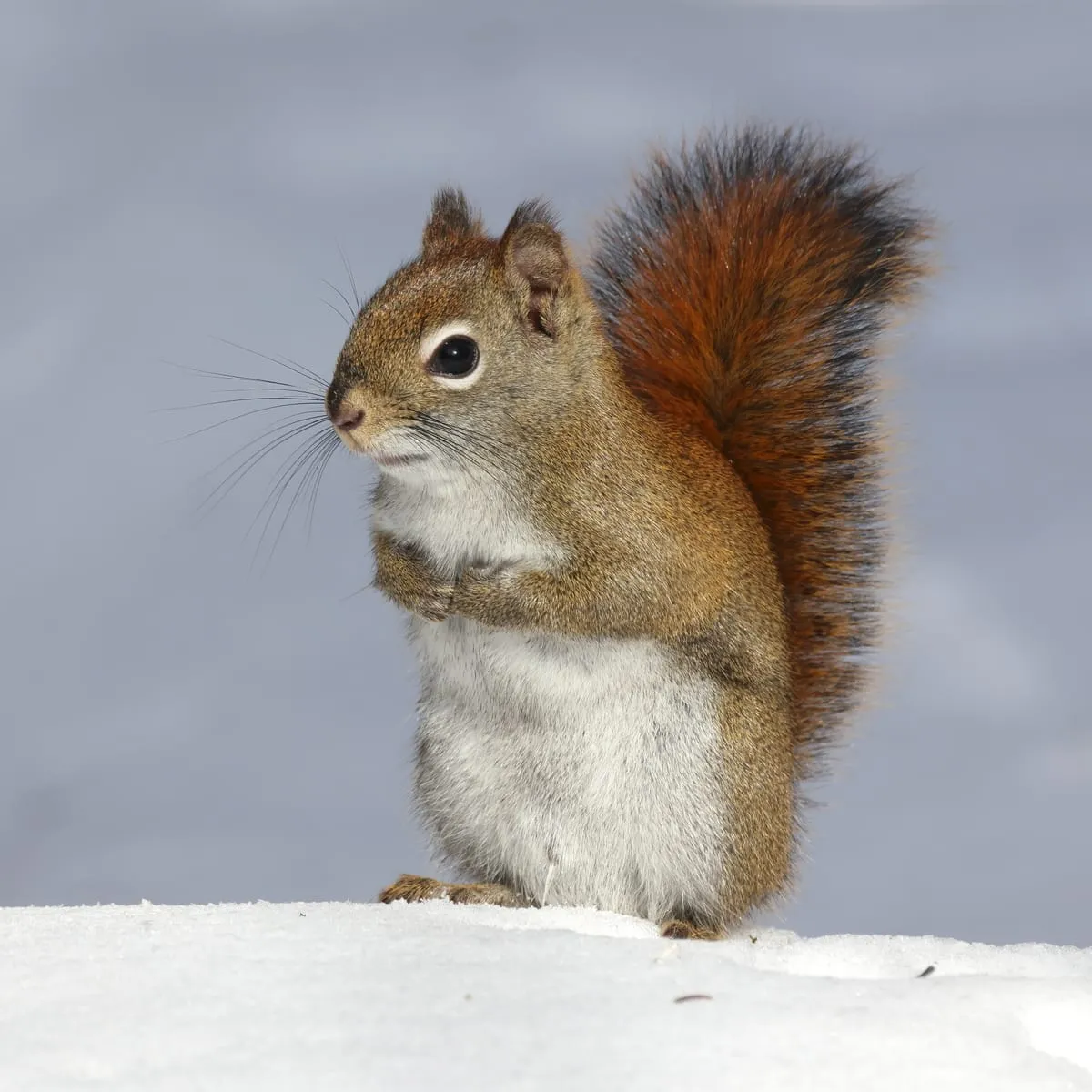
Écureuil roux— species and hunting in Quebec
Tamiasciurus hudsonicus
SciuridaeTrapping periods published by Québec.ca
Official tables below — trapping units (UGAF) and dates.
Wikipedia
Écureuil roux
The American red squirrel (Tamiasciurus hudsonicus) is one of three species of tree squirrels currently classified in the genus Tamiasciurus, known as the pine squirrels (the others are the Douglas squirrel, T. douglasii, and the southwestern red squirrel, T. fremonti). The American red squirrel is variously known as the pine squirrel or piney squirrel, North American red squirrel, chickaree, boomer, or simply red squirrel. The squirrel is a small, 200–250 g (7.1–8.8 oz), diurnal mammal that defends a year-round exclusive territory. It feeds primarily on the seeds of conifer cones, and is widely distributed across much of the United States and Canada wherever conifers are common, except in the southwestern United States, where it is replaced by the formerly conspecific southwestern red squirrel, and along the Pacific coast of the United States, where its cousin the Douglas squirrel is found instead. The squirrel has been expanding its range into hardwood forests.
Description
Red squirrels can be easily distinguished from other North American tree squirrels by their smaller size, 28–35 cm (11–14 in) total length (including tail), territorial behavior, and reddish fur with a white venter (underbelly). Red squirrels are somewhat larger than chipmunks. The Douglas squirrel is morphologically similar to the American red squirrels, but has a rust-colored venter and is restricted to the southwestern coast of British Columbia and in the Pacific Northwest of the United States. The ranges of the American red squirrel and the Douglas squirrel overlap in southern British Columbia, northwestern Washington and eastern Oregon.
Habitat and range
American red squirrels are widely distributed across the North American continent. Their range includes: most of Canada, excluding northern areas with no tree cover, the southern half of Alberta and the southwestern coast of British Columbia; the southern half of Alaska; the Rocky Mountains area of the United States, and northern half of the eastern United States. American red squirrels are abundant and not of conservation concern throughout much of their range. American red squirrels were introduced on Newfoundland and have lived there in abundance for decades. The endangered subspecies T. h. grahamensis, found only on Mt. Graham, Arizona, was formerly considered a member of this species, but is now considered a subspecies of the southwestern red squirrel (Tamiasciurus fremonti).
Text from Wikipedia — American red squirrel, revision 1368650174, CC BY-SA 4.0, retrieved 2026-09-04. Encyclopedic text reused under CC BY-SA 4.0. Sentences about hunting or regulation are removed: on this site, the rule comes from Québec.ca.
Presence in Quebec
- Origin
- Indigène
- Occurrence
- Régulier
- Population status
- Toute l'année
- Certainty
- Confirmé
Conservation
Québec.ca
Official periods
Source: Québec.ca — tables reproduced as published (retrieved 2026-08-30).
Trapping
Long-tailed weasel, least weasel, Eastern grey squirrel, red squirrel, ermine, American marten and fisher
| UGAF | Periods |
|---|---|
| 1, 2, 3, 4, 5, 6, 7, 11, 13, 17, 31, 32, 39, 41, 42, 43, 44, 45, 46, 47, 48, 49, 50, 51, 52, 53 | From October 18 to March 1 |
| 8, 9, 10, 12, 14, 15, 18, 19, 20, 21, 22, 23, 26, 27, 28, 29, 30, 33, 34, 35, 36, 37, 38, 40 | From October 25 to February 15 |
| 16, 70, 71, 72, 73, 74, 75, 76, 77, 78, 79, 80, 81, 82 | From October 25 to February 1 |
| 24, 25, 83, 84, 85, 86 | From October 25 to March 1 |
| 54, 55, 56, 57, 58, 59, 60, 61, 62, 63, 64, 65, 66 | From October 18 to March 15 |
Regulations change. Always check Québec.ca before hunting or trapping.
Where this data comes from
This species is listed in an official government dataset. The identification and status shown in the data sheet are reproduced from it.
Source: List of Quebec’s vertebrate wildlife (LFVQ) — Ministère de l’Environnement, de la Lutte contre les changements climatiques, de la Faune et des Parcs. File LFVQ_25_03_2026.csv, retrieved 2026-08-30 · CC BY 4.0.
Measurements, habitat, diet and reproduction are not shown: no official source is attached to them yet.