
No period published by Québec.ca
Québec.ca publishes no hunting or trapping period for this species. Check the official regulations.
Wikipedia
Eider à duvet
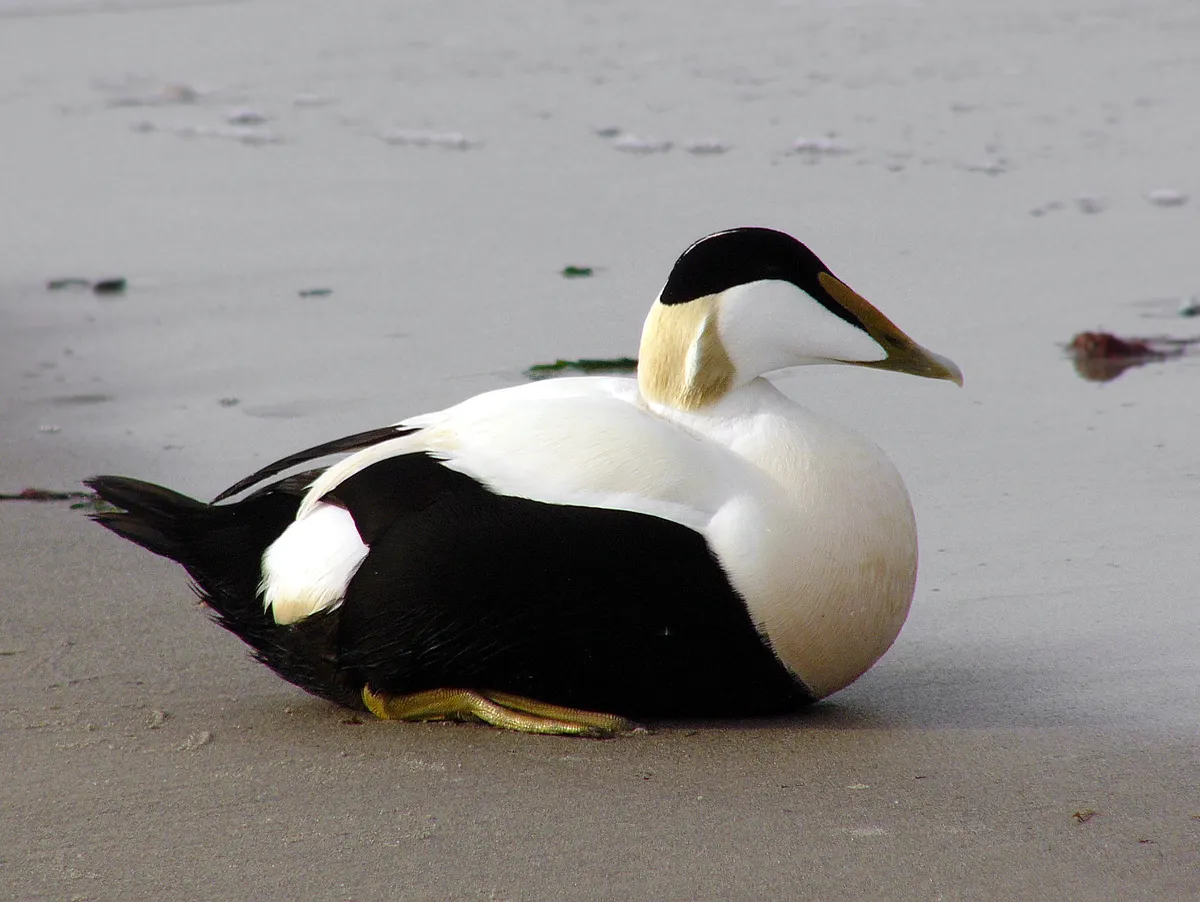
The common eider (pronounced ) (Somateria mollissima), also called St. Cuthbert's duck or Cuddy's duck, is a large (50–71 cm (20–28 in) in body length) sea-duck that is distributed over the northern coasts of Europe, North America and eastern Siberia. It breeds in Arctic and some northern temperate regions, but winters somewhat farther south in temperate zones, when it can form large flocks on coastal waters. It can fly at speeds up to 113 km/h (70 mph). The eider's nest is built close to the sea and is lined with eiderdown, plucked from the female's breast. This soft and warm lining has long been harvested for filling pillows and quilts, but in more recent years has been largely replaced by down from domestic farm-geese and synthetic alternatives. Although eiderdown pillows or quilts are now a rarity, typically being marketed as luxury goods, eiderdown harvesting continues and is sustainable, as it can be done after the ducklings leave the nest with no harm to the birds.
Description
The common eider is the largest of the four eider species, measuring 50 to 71 cm (19+1⁄2 to 28 in) in length, weighs 0.81 to 3.04 kg (1 lb 12+1⁄2 oz to 6 lb 11 oz) and spans 80–110 cm (31–43 in) across the wings. The average weight of 22 males in the North Atlantic was 2.21 kg (4 lb 14 oz) while 32 females weighed an average of 1.92 kg (4 lb 3+1⁄2 oz). It is distinguished by its bulky shape and large, wedge-shaped bill. The male is distinct, with its black and white plumage and green nape. The female is a brown bird, but can still be readily distinguished from all ducks, except other eider species, on the basis of size and head shape. The drake's display call is a strange almost human-like "ah-ooo", while the duck utters hoarse quacks. The species is often readily approachable. Drakes of the European, Asian, and eastern and western North American subspecies can be distinguished by small differences in plumage and bill colour. Nominate S. m. mollissima has a yellowish-green bill, while S. m. dresseri has a greenish-grey bill, as does the slightly smaller S. m. faeroeensis. The Arctic Atlantic S. m. borealis and the Arctic Pacific S. m. v-nigrum have bright orange-yellow bills.
Text from Wikipedia — Common eider, revision 1366477457, CC BY-SA 4.0, retrieved 2026-09-04. Encyclopedic text reused under CC BY-SA 4.0. Sentences about hunting or regulation are removed: on this site, the rule comes from Québec.ca.
Other names
French
English
Presence in Quebec
- Origin
- Indigène
- Occurrence
- Régulier
- Population status
- Toute l'année
- Certainty
- Confirmé
Conservation
Québec.ca
Official periods
Source: Québec.ca — tables reproduced as published (retrieved 2026-08-30).
Regulations change. Always check Québec.ca before hunting or trapping.
Where this data comes from
This species is listed in an official government dataset. The identification and status shown in the data sheet are reproduced from it.
Source: List of Quebec’s vertebrate wildlife (LFVQ) — Ministère de l’Environnement, de la Lutte contre les changements climatiques, de la Faune et des Parcs. File LFVQ_25_03_2026.csv, retrieved 2026-08-30 · CC BY 4.0.
Measurements, habitat, diet and reproduction are not shown: no official source is attached to them yet.