
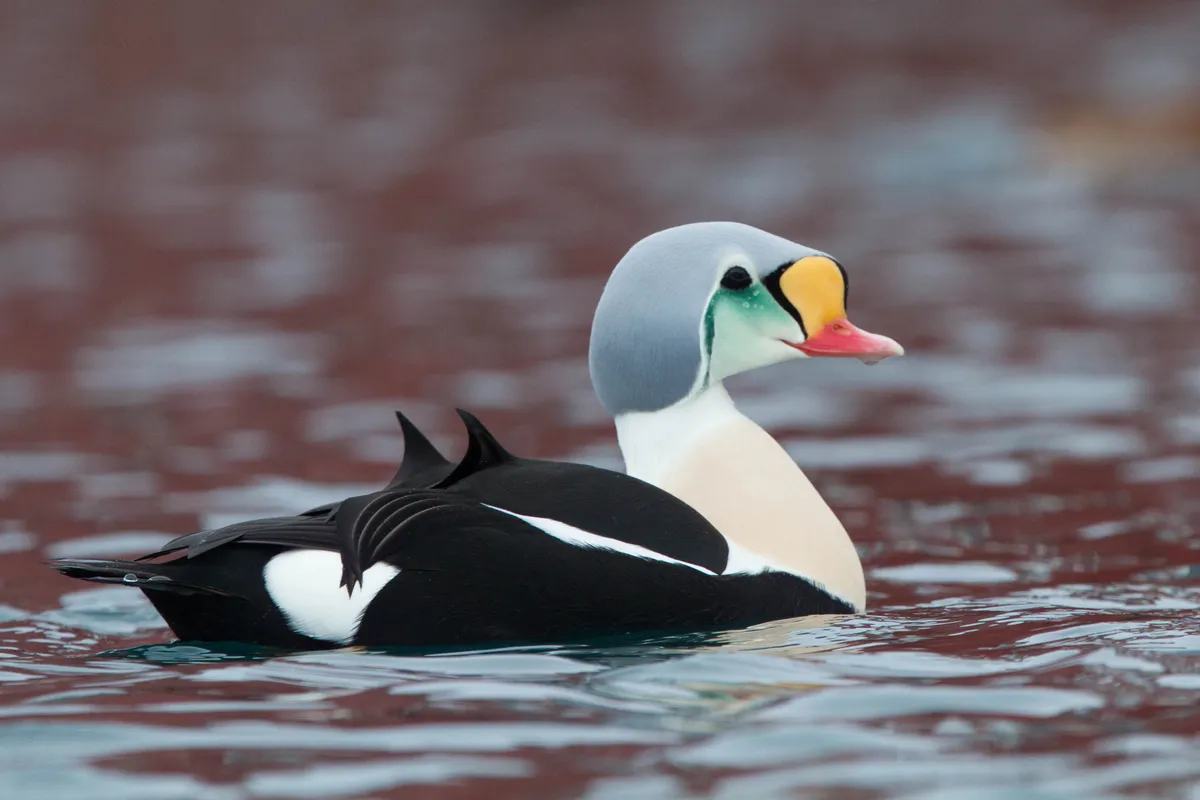
Eider à tête grise— Quebec wildlife
Somateria spectabilis
AnatidaeNo period published by Québec.ca
Québec.ca publishes no hunting or trapping period for this species. Check the official regulations.
Wikipedia
Eider à tête grise
The king eider (pronounced ) (Somateria spectabilis) is a large sea duck that breeds along Northern Hemisphere Arctic coasts of northeast Europe, North America and Asia. The birds spend most of the year in coastal marine ecosystems at high latitudes, and migrate to Arctic tundra to breed in June and July. They lay four to seven eggs in a scrape on the ground lined with grass and down.
Description
The king eider is a large sea duck, measuring 50–70 cm (20–28 in) in length with a wingspan of 86–102 cm (34–40 in). Males are, on average, heavier than females, with a mean weight of 1.668 kg (3.68 lb) for males and 1.567 kg (3.45 lb) for females. An individual bird's mass can vary considerably from season to season—from as little as 0.9 kg (2.0 lb) to as much as 2.2 kg (4.9 lb). Like all eiders, the species is sexually dimorphic; the male is slightly larger and, in breeding plumage, much more colourful than the female. The male is unmistakable with its mostly black body, buff-tinged white breast and multicoloured head. The head, nape and neck are a pale bluish grey. The cheek is pale green. The bill, separated from the face by a thin black line, is red with a white nail and a large, distinctive yellow knob. Some tertials are curved up and form "spurs" along the back. The female (occasionally colloquially referred to as a "queen eider") is a warm brown colour overall, slightly paler on the head and neck. The feathers on her upperparts and flanks are marked with blackish chevrons, while those on her neck and head bear fine black streaks. She has a buffy spot at the base of her bill and a buffy eye ring which extends into a downward curving stripe behind her eye. Her bill is variously described as black or grey, and her legs and feet are greenish grey. Juvenile birds are greyish brown. Late in their first autumn, young males moult into a darker plumage, with white on the breast and rump; it takes them three years to achieve full adult plumage.
Text from Wikipedia — King eider, revision 1324269629, CC BY-SA 4.0, retrieved 2026-09-04. Encyclopedic text reused under CC BY-SA 4.0. Sentences about hunting or regulation are removed: on this site, the rule comes from Québec.ca.
Other names
French
English
Presence in Quebec
- Origin
- Indigène
- Occurrence
- Régulier
- Population status
- Reproducteur
- Certainty
- Confirmé
Conservation
Québec.ca
Official periods
Source: Québec.ca — tables reproduced as published (retrieved 2026-08-30).
Regulations change. Always check Québec.ca before hunting or trapping.
Where this data comes from
This species is listed in an official government dataset. The identification and status shown in the data sheet are reproduced from it.
Source: List of Quebec’s vertebrate wildlife (LFVQ) — Ministère de l’Environnement, de la Lutte contre les changements climatiques, de la Faune et des Parcs. File LFVQ_25_03_2026.csv, retrieved 2026-08-30 · CC BY 4.0.
Measurements, habitat, diet and reproduction are not shown: no official source is attached to them yet.