
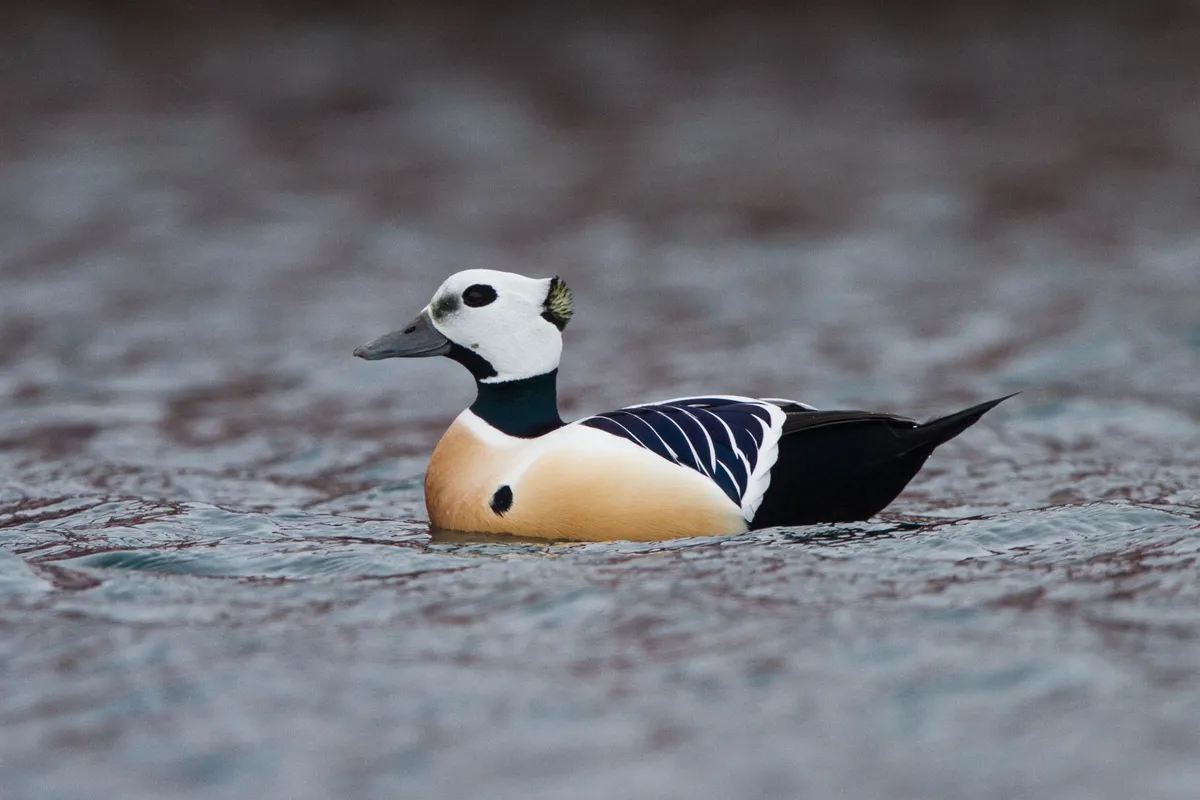
Eider de Steller— Quebec wildlife
Polysticta stelleri
AnatidaeNo period published by Québec.ca
Québec.ca publishes no hunting or trapping period for this species. Check the official regulations.
Wikipedia
Eider de Steller
Steller's eider (Polysticta stelleri) is a migratory Arctic sea duck that breeds along the coastlines of Russia and Alaska, as well as in the Baltic Sea. It is the smallest, and fastest flying of the duck species known as eiders; it is closely related to the other species of eider in the genus Somateria, but sufficiently distinct to be given separate recognition as the only member of the genus Polysticta. Due to the extensive contraction of its breeding range, the Alaska-breeding population of Steller's eider was listed as vulnerable in 1997 by the International Union for the Conservation of Nature (IUCN). The species is protected in Estonia, Finland, Norway, Russia and the United States, and is the subject of an ongoing recovery plan by the European Union and U.S. Fish and Wildlife Service.
Description
Steller's eider is the smallest of the four eiders, with both females and males weighing 860 g (30 oz) on average. They have a compact body with a relatively large head with a flat crown and an angled nape, and a long, thick bill; the tail is relatively longer than other eiders. The males assume their breeding plumage from early winter to midsummer with a black cap, chin, collar, eye-ring, and rump, with a white head and shoulders, light green patches behind the head and in front of the eye, and the cinnamon breast and shoulders marked with a prominent black spot. The tertial feathers are long, draped over the folded wing, dark purple-black, with a while stripe along each. In mid-summer to autumn, males assume their 'eclipse' (non-breeding) plumage, which is primarily dark brown like females, but retaining the white inner forewing, conspicuous in flight. Both sexes have an iridescent bluish-purple speculum on the secondary feathers on their wing, with white borders running the entire length of the secondaries. Females are dark to cinnamon brown, with a pale-white eye-ring; the juveniles are similar, but lighter brown, and with only narrow white edges to the speculum and short tertial feathers. The feet are palmate, with three fully webbed toes, dark bluish-grey, with the legs the same colour.
Text from Wikipedia — Steller's eider, revision 1362094827, CC BY-SA 4.0, retrieved 2026-09-04. Encyclopedic text reused under CC BY-SA 4.0. Sentences about hunting or regulation are removed: on this site, the rule comes from Québec.ca.
Other names
French
English
Presence in Quebec
- Origin
- Indigène
- Occurrence
- Accidentel/non régulier
- Population status
- Migrateur
- Certainty
- Confirmé
Conservation
Québec.ca
Official periods
Source: Québec.ca — tables reproduced as published (retrieved 2026-08-30).
Regulations change. Always check Québec.ca before hunting or trapping.
Where this data comes from
This species is listed in an official government dataset. The identification and status shown in the data sheet are reproduced from it.
Source: List of Quebec’s vertebrate wildlife (LFVQ) — Ministère de l’Environnement, de la Lutte contre les changements climatiques, de la Faune et des Parcs. File LFVQ_25_03_2026.csv, retrieved 2026-08-30 · CC BY 4.0.
Measurements, habitat, diet and reproduction are not shown: no official source is attached to them yet.