
Engoulevent bois-pourri— Quebec wildlife
Antrostomus vociferus
CaprimulgidaeNo period published by Québec.ca
Québec.ca publishes no hunting or trapping period for this species. Check the official regulations.
Wikipedia
Engoulevent bois-pourri
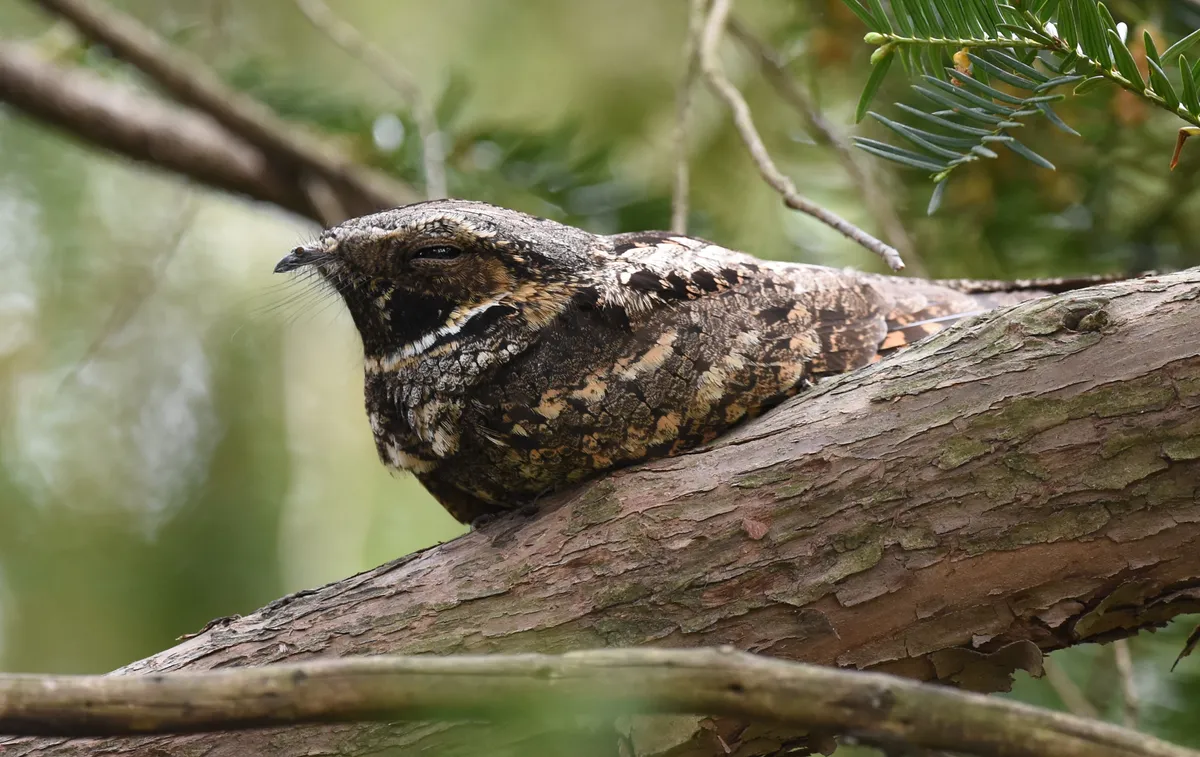
The eastern whip-poor-will (Antrostomus vociferus; also called "whip-o-will", "whip o' will", etc.) is a medium-sized (22–27 cm or 8.7–10.6 in) bird within the nightjar family, Caprimulgidae, from North America. The whip-poor-will is commonly heard within its range, but less often seen because of its camouflage. It is named onomatopoeically after its song.
Description
This medium-sized nightjar measures 22–27 cm (8+1⁄2–10+1⁄2 in) in length, spans 45–50 cm (17+1⁄2–19+1⁄2 in) across the wings and weighs 42–69 g (1+1⁄2–2+7⁄16 oz). Further standard measurements are a wing chord of 14.7 to 16.9 cm (5+13⁄16 to 6+5⁄8 in), a tail of 10.5 to 12.8 cm (4+1⁄8 to 5+1⁄16 in), a bill of 1 to 1.4 cm (3⁄8 to 9⁄16 in) and a tarsus of 1.5 to 1.8 cm (9⁄16 to 11⁄16 in). Adults have mottled plumage: the upperparts are grey, black and brown; the lower parts are grey and black. They have a very short bill and a black throat. Males have a white patch below the throat and white tips on the outer tail feathers; in the female, these parts are light brown. This bird is sometimes confused with the related chuck-will's-widow (Antrostomus carolinensis) which has a similar but lower-pitched and slower call.
Diet
The diet of an Eastern whip-poor-will mostly consists of insects, especially moths, also beetles, mosquitoes, and many others.
Text from Wikipedia — Eastern whip-poor-will, revision 1371926001, CC BY-SA 4.0, retrieved 2026-09-04. Encyclopedic text reused under CC BY-SA 4.0. Sentences about hunting or regulation are removed: on this site, the rule comes from Québec.ca.
Other names
French
English
Former scientific names
Presence in Quebec
- Origin
- Indigène
- Occurrence
- Régulier
- Population status
- Reproducteur
- Certainty
- Confirmé
Conservation
Québec.ca
Official periods
Source: Québec.ca — tables reproduced as published (retrieved 2026-08-30).
Regulations change. Always check Québec.ca before hunting or trapping.
Where this data comes from
This species is listed in an official government dataset. The identification and status shown in the data sheet are reproduced from it.
Source: List of Quebec’s vertebrate wildlife (LFVQ) — Ministère de l’Environnement, de la Lutte contre les changements climatiques, de la Faune et des Parcs. File LFVQ_25_03_2026.csv, retrieved 2026-08-30 · CC BY 4.0.
Measurements, habitat, diet and reproduction are not shown: no official source is attached to them yet.