
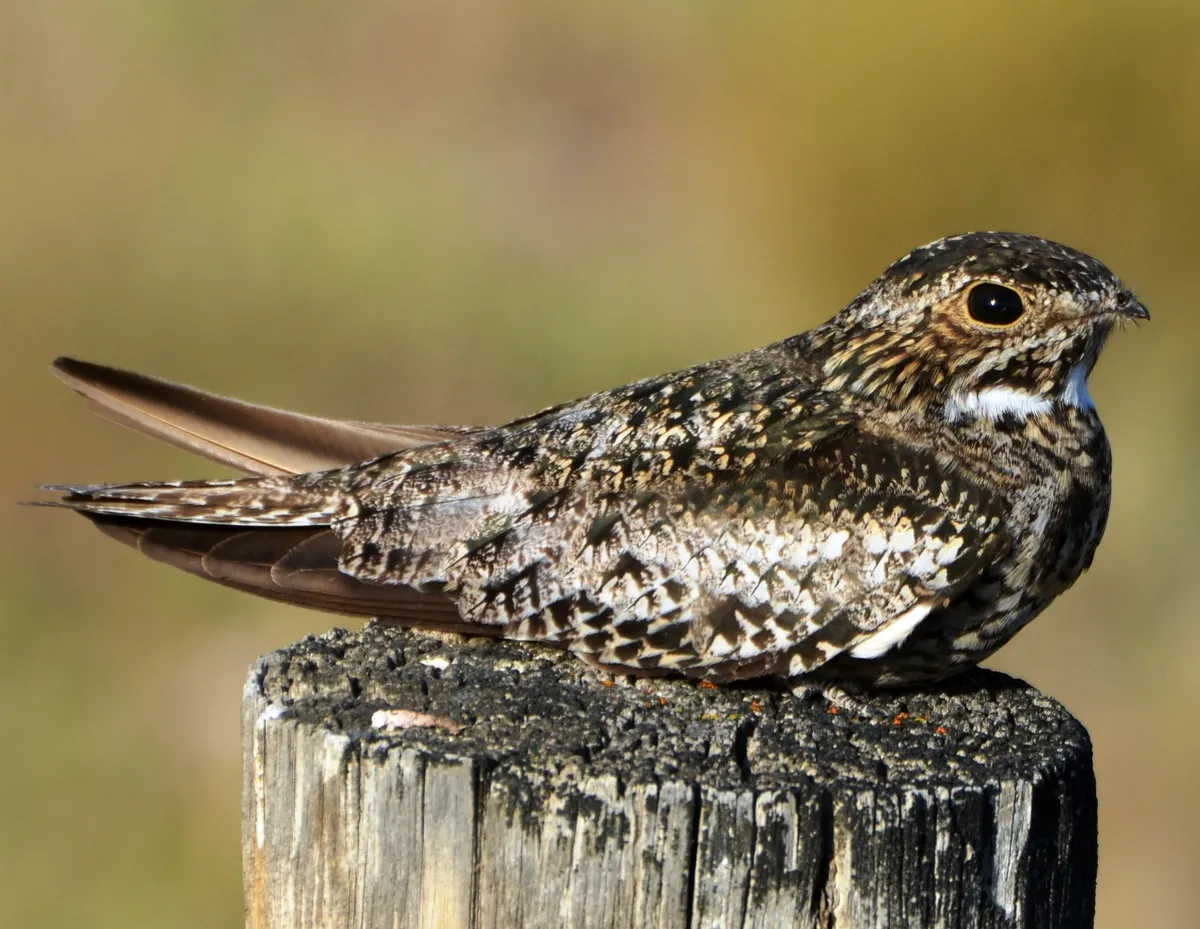
Engoulevent d'Amérique— Quebec wildlife
Chordeiles minor
CaprimulgidaeNo period published by Québec.ca
Québec.ca publishes no hunting or trapping period for this species. Check the official regulations.
Wikipedia
Engoulevent d'Amérique
The common nighthawk or bullbat (Chordeiles minor) is a medium-sized crepuscular or nocturnal bird of the Americas within the nightjar (Caprimulgidae) family, whose presence and identity are best revealed by its vocalization. Typically dark (gray, black and brown), displaying cryptic colouration and intricate patterns, this bird is difficult to spot with the naked eye during the day. This bird is most conspicuous when in its buoyant and erratic flight. The most remarkable feature of this aerial insectivore is its small beak that belies the massiveness of its mouth. Some claim appearance similarities to owls. With its horizontal stance and short legs, the common nighthawk does not travel frequently on the ground, instead preferring to perch horizontally, parallel to branches, on posts, on the ground or on a roof. The males of this species may roost together but the bird is primarily solitary. The common nighthawk shows variability in territory size. This caprimulgid has a large, flattened head with large eyes; facially it lacks rictal bristles. The common nighthawk has long slender wings that at rest extend beyond a notched tail. There is noticeable barring on the sides and abdomen, also white wing-patches. The common nighthawk measures 22 to 25 cm (8.7 to 9.8 in) long, displays a wing span of 51 to 61 cm (20 to 24 in) weighs 55 to 98 g (1.9 to 3.5 oz), and has a life span of 4 to 5 years.
Description
The common nighthawk is distinguished from other caprimulguids by its forked tail (includes a white bar in males); its long, unbarred, pointed wings with distinctive white patches; its lack of rictal bristles, and the key identifier – their unmistakable calls. These birds range from 21 to 25 cm (8.3 to 9.8 in) in total length and from 51 to 61 cm (20 to 24 in) in wingspan. Body mass can vary from 55 to 98 g (1.9 to 3.5 oz). Among standard measurements, the wing chord is 17.2 to 21.3 cm (6.8 to 8.4 in), the tail is 13 to 15.1 cm (5.1 to 5.9 in), the bill is 0.5 to 0.8 cm (0.20 to 0.31 in) and the tarsus is 1.2 to 1.6 cm (0.47 to 0.63 in). The common nighthawk resembles both the Antillean nighthawk and the lesser nighthawk and occurs at least seasonally in the entire North American range of both of these species. The lesser nighthawk is a smaller bird and displays more buffy on the undertail coverts, where the common nighthawk shows white. Common nighthawks and Antillean nighthawks exhibit entirely dark on the basal portion of the primary feathers, whereas lesser nighthawks have bands of buffy spots. Common and Antillean nighthawks have a longer outermost primary conveying a pointier wing tip than the lesser nighthawk. The common nighthawk forages higher above ground than the lesser nighthawk and has a different call. The only reliable way to distinguish Antillean nighthawk without disturbance is also by the differences in their calls. Visually, they may only be distinguished as different from the common nighthawk once in the hand.
Text from Wikipedia — Common nighthawk, revision 1371764559, CC BY-SA 4.0, retrieved 2026-09-04. Encyclopedic text reused under CC BY-SA 4.0. Sentences about hunting or regulation are removed: on this site, the rule comes from Québec.ca.
Other names
French
English
Presence in Quebec
- Origin
- Indigène
- Occurrence
- Régulier
- Population status
- Reproducteur
- Certainty
- Confirmé
Conservation
Québec.ca
Official periods
Source: Québec.ca — tables reproduced as published (retrieved 2026-08-30).
Regulations change. Always check Québec.ca before hunting or trapping.
Where this data comes from
This species is listed in an official government dataset. The identification and status shown in the data sheet are reproduced from it.
Source: List of Quebec’s vertebrate wildlife (LFVQ) — Ministère de l’Environnement, de la Lutte contre les changements climatiques, de la Faune et des Parcs. File LFVQ_25_03_2026.csv, retrieved 2026-08-30 · CC BY 4.0.
Measurements, habitat, diet and reproduction are not shown: no official source is attached to them yet.