
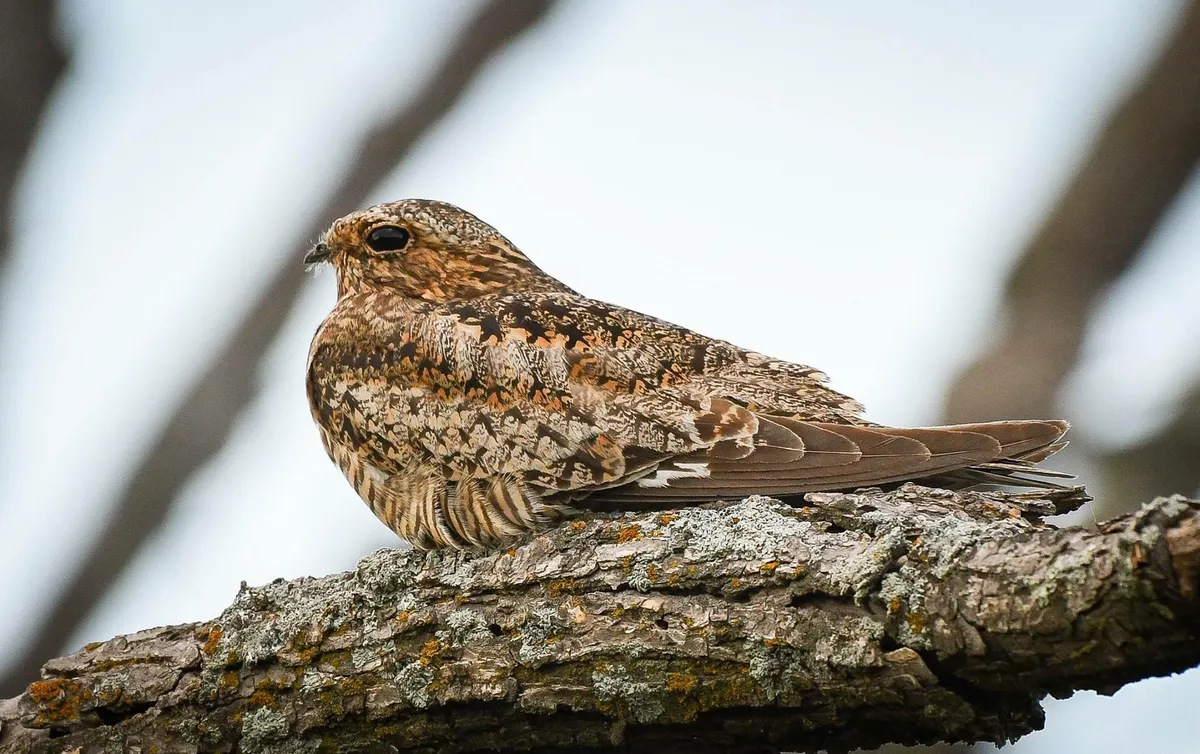
Engoulevent de Caroline— Quebec wildlife
Antrostomus carolinensis
CaprimulgidaeNo period published by Québec.ca
Québec.ca publishes no hunting or trapping period for this species. Check the official regulations.
Wikipedia
Engoulevent de Caroline
The chuck-will's-widow (Antrostomus carolinensis) is a nocturnal bird of the nightjar family Caprimulgidae. It is mostly found in the southeastern United States (with disjunct populations in Long Island, New York; Ontario, Canada; and Cape Cod, Massachusetts) near swamps, rocky uplands, and pine woods. It migrates to the West Indies, Central America, and northwestern South America.
Description
The chuck-will's-widow has a short bill and a long tail typical of the nightjars. It has mottled brownish underparts, a buff throat, reddish-brown feathers lined with black, and brown and white patterning on head and chest. Males have patches of white on their outer tail feathers. It is the largest nightjar in North America. In length, it ranges from 28 to 33 cm (11 to 13 in). The wingspan can range from 58 to 66 cm (23 to 26 in). The body mass of the species is from 66 to 188 g (2.3 to 6.6 oz). Among standard measurements, the wing chord is 20.1 to 22.5 cm (7.9 to 8.9 in), the tail is 13 to 15.1 cm (5.1 to 5.9 in), the bill is 1.1 to 1.4 cm (0.43 to 0.55 in) and the tarsus is 1.5 to 1.9 cm (0.59 to 0.75 in). The repetitive song is often heard at night. It consists of a series of calls with a vibrating middle note between two shorter notes, not much shifting in pitch. It is slower, lower-pitched and less piercing than the song of the whip-poor-will.
Text from Wikipedia — Chuck-will's-widow, revision 1360622342, CC BY-SA 4.0, retrieved 2026-09-04. Encyclopedic text reused under CC BY-SA 4.0. Sentences about hunting or regulation are removed: on this site, the rule comes from Québec.ca.
Other names
French
English
Presence in Quebec
- Origin
- Indigène
- Occurrence
- Accidentel/non régulier
- Population status
- Migrateur
- Certainty
- Confirmé
Conservation
Québec.ca
Official periods
Source: Québec.ca — tables reproduced as published (retrieved 2026-08-30).
Regulations change. Always check Québec.ca before hunting or trapping.
Where this data comes from
This species is listed in an official government dataset. The identification and status shown in the data sheet are reproduced from it.
Source: List of Quebec’s vertebrate wildlife (LFVQ) — Ministère de l’Environnement, de la Lutte contre les changements climatiques, de la Faune et des Parcs. File LFVQ_25_03_2026.csv, retrieved 2026-08-30 · CC BY 4.0.
Measurements, habitat, diet and reproduction are not shown: no official source is attached to them yet.