
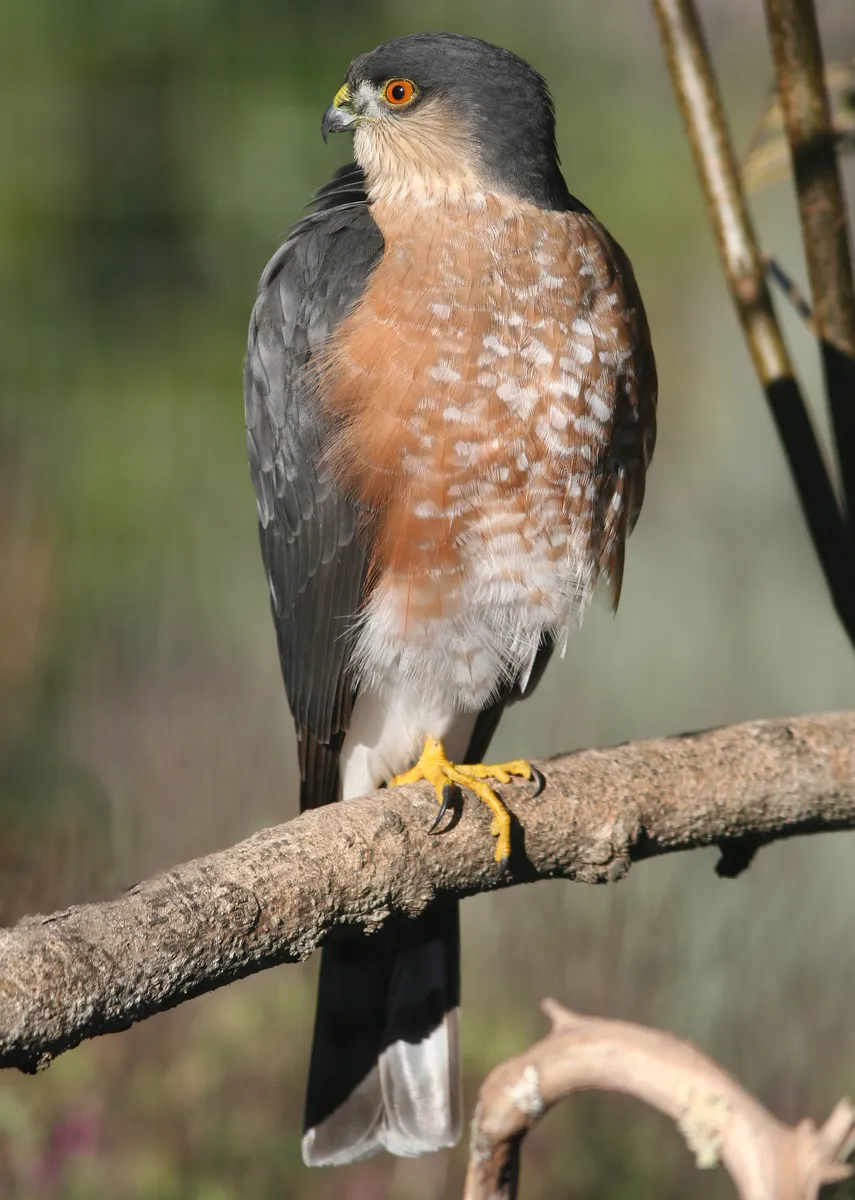
Épervier brun— Quebec wildlife
Accipiter striatus
AccipitridaeNo period published by Québec.ca
Québec.ca publishes no hunting or trapping period for this species. Check the official regulations.
Wikipedia
Épervier brun
The sharp-shinned hawk (Accipiter striatus) or northern sharp-shinned hawk, colloquially often nicknamed sharpie, is a small hawk, with males being the smallest hawks in the United States and Canada, but with the species averaging larger than some Neotropical species, such as the tiny hawk. The taxonomy is far from resolved, with some authorities considering the southern taxa to represent three separate species, white-breasted hawk (A. chionogaster), plain-breasted hawk (A. ventralis), and rufous-thighed hawk (A. erythronemius). The American Ornithological Society and some other checklists keep all four species conspecific. A recent genetic study additionally recommended splitting the three Caribbean island populations as three additional separate species, though this has not yet been adopted by any of the ornithological authorities.
Description
This is a small Accipiter hawk, with males 23 to 30 cm (9.1 to 11.8 in) long, with a wingspan of 42 to 58 cm (17 to 23 in) and weight from 82–115 g (2.9–4.1 oz). As common in Accipiter hawks, females are distinctly larger in size, averaging some 30% longer, and with a weight advantage of more than 50% being common. The female measures 29 to 37 cm (11 to 15 in) in length, has a wingspan of 58 to 68 cm (23 to 27 in) and weighs 150 to 219 g (5.3 to 7.7 oz). The wings measure 14.1–22.9 cm (5.6–9.0 in) each, the tail is 12–19 cm (4.7–7.5 in) long and the tarsus is 4.5–5.9 cm (1.8–2.3 in). Measurements given here are for the northern group, but they are comparable for the remaining subspecies. Adults have short broad wings and a medium-length tail banded in blackish and gray with the tip varying among individuals from slightly notched through square to slightly rounded (often narrowly tipped white). The remiges (typically only visible in flight) are whitish barred blackish. The legs are long and very slender (hence the common name) and yellow. The hooked bill is black and the cere is yellowish. The remaining plumage varies depending on group: Nominate group: Cap dark and upperparts blue-grey (the former darker). Often, a few more-or-less random white spots can be seen on the scapulars (feathers attached to the wing that cover the meeting of wing and body). Underparts white with rufous or tawny bars. The crissum (the undertail coverts surrounding the cloaca) is white. Thighs rufous, but often barred white. The cheeks are tinged rufous (sometimes faint, but generally very distinct in taxa from the Greater Antilles). The irides are dark orange to red, but these are yellowish to pale orange in juveniles. Juveniles have dark brownish upperparts, each feather edged rufous, giving a rather scaly appearance. The brown head is streaked whitish, and the whitish underparts are extensively streaked brown or reddish and usually with reddish barring on the sides. A.
Habitat and range
This species is widespread in North America, Central America, South America and the Greater Antilles.Below, the distributions of the four groups (see Taxonomy) are described
Text from Wikipedia — Sharp-shinned hawk, revision 1354911704, CC BY-SA 4.0, retrieved 2026-09-04. Encyclopedic text reused under CC BY-SA 4.0. Sentences about hunting or regulation are removed: on this site, the rule comes from Québec.ca.
Other names
French
English
Presence in Quebec
- Origin
- Indigène
- Occurrence
- Régulier
- Population status
- Reproducteur
- Certainty
- Confirmé
Conservation
Québec.ca
Official periods
Source: Québec.ca — tables reproduced as published (retrieved 2026-08-30).
Regulations change. Always check Québec.ca before hunting or trapping.
Where this data comes from
This species is listed in an official government dataset. The identification and status shown in the data sheet are reproduced from it.
Source: List of Quebec’s vertebrate wildlife (LFVQ) — Ministère de l’Environnement, de la Lutte contre les changements climatiques, de la Faune et des Parcs. File LFVQ_25_03_2026.csv, retrieved 2026-08-30 · CC BY 4.0.
Measurements, habitat, diet and reproduction are not shown: no official source is attached to them yet.