
No period published by Québec.ca
Québec.ca publishes no hunting or trapping period for this species. Check the official regulations.
Wikipedia
Épervier de Cooper
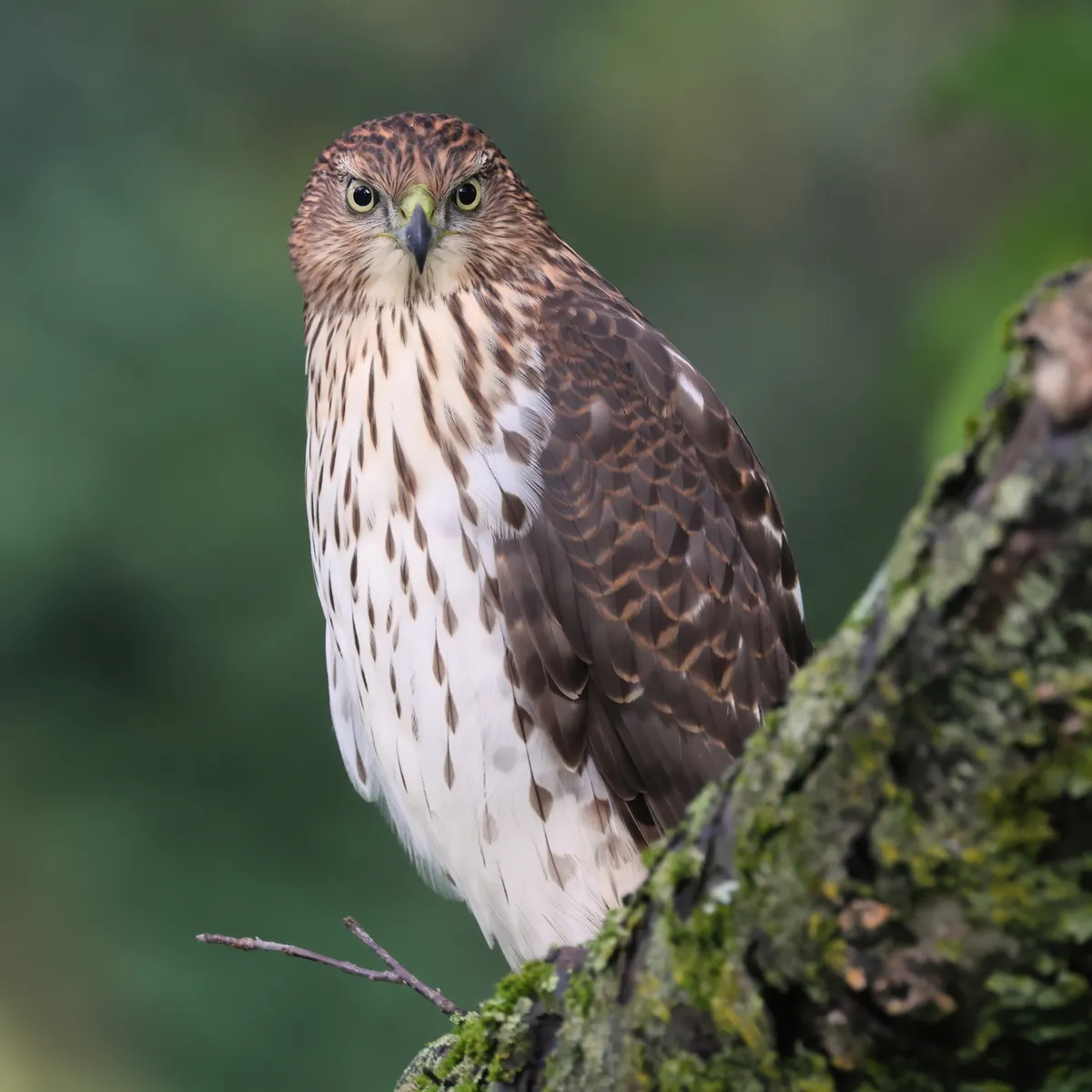
Cooper's hawk (Astur cooperii) is a medium-sized hawk native to the North American continent and found from southern Canada to Mexico. This species was formerly placed in the genus Accipiter. As in many birds of prey, the male is smaller than the female. The birds found east of the Mississippi River tend to be larger on average than the birds found to the west. It is easily confused with the smaller but similar sharp-shinned hawk (Accipiter striatus). The species was named in 1828 by Charles Lucien Bonaparte in honor of his friend and fellow ornithologist, William Cooper. Other common names for Cooper's hawk include: big blue darter, chicken hawk, flying cross, hen hawk, quail hawk, striker, and swift hawk. Like most related hawks, Cooper's hawks prefer to nest in tall trees with extensive canopy cover and can commonly produce up to two to four fledglings depending on conditions. Breeding attempts may be compromised by poor weather, predators, and anthropogenic causes, in particular the use of industrial pesticides and other chemical pollution in the 20th century. Despite historic declines due to anthropogenic causes, the bird's population is increasing as of 2024.
Description
Cooper's hawk is a medium-sized hawk, but roughly average to small-sized for an Astur species. Compared to related species, it tends to have moderate-length wings, a long, often graduated or even wedge-shaped tail, and long though moderately thick legs and toes. Its eyes tend to be set well forward in the sides of the relatively large and squarish-looking head (though the head can look somewhat rounded if the feathers on the nape are held flush) and a relatively short but robust bill. It has a hooked bill well-adapted for tearing the flesh of prey, as is typical of raptors. Generally, Cooper's hawks can be considered secretive, often perching within the canopy, but uses more open perches, especially in the western part of the range or in winter, when they may use leafless or isolated trees, utility poles, or exposed stumps. On perched hawks, the wing tips tend to appear to cover less than one-third of the tail, sometimes seeming to barely cover the covert feathers. As adults, they may be a solid blue-gray or brown-gray color above. Adults usually have a well-defined crown of blackish-brown feathers above a paler nape and hind neck offset against their streaked, rufous cheeks. Their tails are blue-gray on top and pale underneath, barred with three black bands in a rather even pattern and ending in a rather conspicuous white tip. The adult's underside shows a whitish base color overlaid heavily with coarse, irregular rufous to cinnamon bands, though these narrow into marginal shaft streaks around the throat.
Text from Wikipedia — Cooper's hawk, revision 1371669808, CC BY-SA 4.0, retrieved 2026-09-04. Encyclopedic text reused under CC BY-SA 4.0. Sentences about hunting or regulation are removed: on this site, the rule comes from Québec.ca.
Other names
French
English
Presence in Quebec
- Origin
- Indigène
- Occurrence
- Régulier
- Population status
- Reproducteur
- Certainty
- Confirmé
Conservation
Québec.ca
Official periods
Source: Québec.ca — tables reproduced as published (retrieved 2026-08-30).
Regulations change. Always check Québec.ca before hunting or trapping.
Where this data comes from
This species is listed in an official government dataset. The identification and status shown in the data sheet are reproduced from it.
Source: List of Quebec’s vertebrate wildlife (LFVQ) — Ministère de l’Environnement, de la Lutte contre les changements climatiques, de la Faune et des Parcs. File LFVQ_25_03_2026.csv, retrieved 2026-08-30 · CC BY 4.0.
Measurements, habitat, diet and reproduction are not shown: no official source is attached to them yet.