
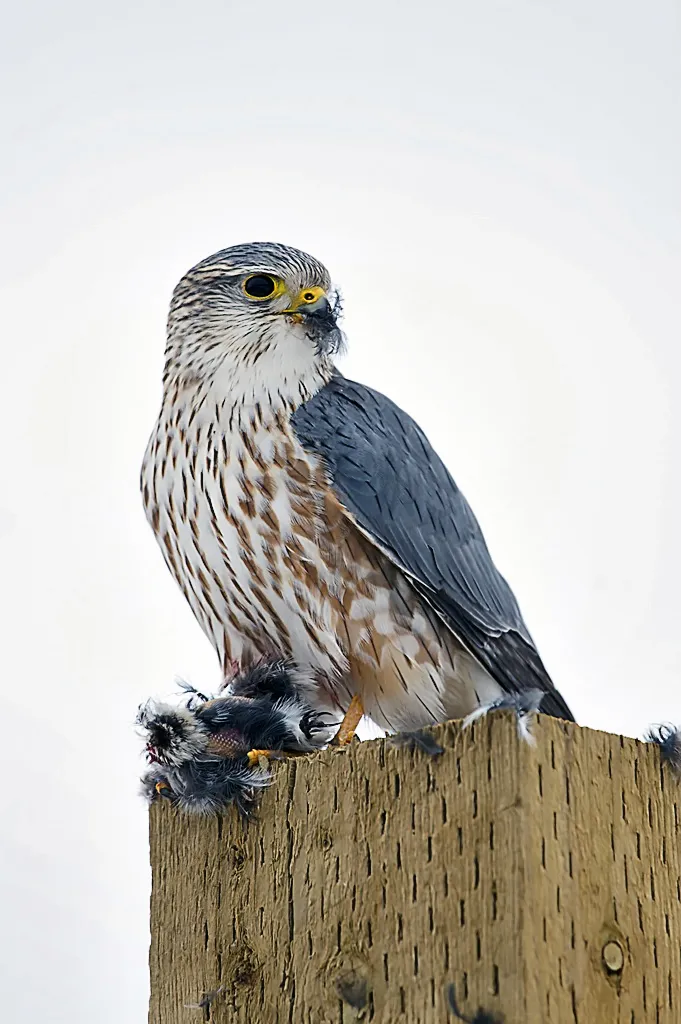
Faucon émerillon— Quebec wildlife
Falco columbarius
FalconidaeNo period published by Québec.ca
Québec.ca publishes no hunting or trapping period for this species. Check the official regulations.
Wikipedia
Faucon émerillon
The merlin (Falco columbarius) is a small species of falcon from the Northern Hemisphere, with numerous subspecies throughout North America and Eurasia. A bird of prey, the merlin breeds in the northern Holarctic; some migrate to subtropical and northern tropical regions in winter. Males typically have wingspans of 53–58 centimetres (21–23 in), with females being slightly larger. In recent decades, merlin populations in North America have been significantly increasing, with some merlins becoming so well adapted to city life that they forgo migration; in Europe, populations increased up to about 2000, but have been steady subsequently. The merlin has for centuries been well regarded as a falconry bird.
Description
The merlin is 24–33 cm (9.4–13.0 in) long with a 50–73 cm (20–29 in) wingspan. Compared with most other small falcons, it is more robust and heavily built. Males average at about 165 g (5.8 oz) and females are typically about 230 g (8.1 oz). Considerable variation, however, is seen throughout the birds' range, and in particular in migratory populations, over the course of a year. Thus, adult males may weigh 125–210 g (4.4–7.4 oz) and females 190–300 g (6.7–10.6 oz). Each wing measures 18.2–23.8 cm (7.2–9.4 in), the tail measures 12.7–18.5 cm (5.0–7.3 in) and the tarsi measure 3.7 cm (1.5 in). The male merlin has a blue-gray back, ranging from almost black to silver-gray in different subspecies. His underparts are buff- to orange-tinted and more or less heavily streaked with black to reddish brown. The female and immature are brownish-gray to dark brown above, and whitish buff spotted with brown below. Besides a weak whitish supercilium and the faint dark malar stripe—which are barely recognizable in both the palest and the darkest birds—the face of the merlin is less strongly patterned than in most other falcons. Nestlings are covered in pale buff down feathers, shading to whitish on the belly. The remiges are blackish, and the tail usually has some three or four wide, blackish bands, too. Very light males only have faint and narrow medium-gray bands, while in the darkest birds, the bands are very wide, so that the tail appears to have narrow lighter bands, instead. In all of them, however, the tail tip is black with a narrow white band at the very end, a pattern possibly plesiomorphic for all falcons. Altogether, the tail pattern is quite distinct, though, resembling only that of the aplomado falcon (F. berigora) and (in light merlins) some typical kestrels. The eye and beak are dark, the latter with a yellow cere. The feet are also yellow, with black claws. Light American males may resemble the American kestrel (F.
Text from Wikipedia — Merlin (bird), revision 1367745672, CC BY-SA 4.0, retrieved 2026-09-04. Encyclopedic text reused under CC BY-SA 4.0. Sentences about hunting or regulation are removed: on this site, the rule comes from Québec.ca.
Other names
French
Presence in Quebec
- Origin
- Indigène
- Occurrence
- Régulier
- Population status
- Reproducteur
- Certainty
- Confirmé
Conservation
Québec.ca
Official periods
Source: Québec.ca — tables reproduced as published (retrieved 2026-08-30).
Regulations change. Always check Québec.ca before hunting or trapping.
Where this data comes from
This species is listed in an official government dataset. The identification and status shown in the data sheet are reproduced from it.
Source: List of Quebec’s vertebrate wildlife (LFVQ) — Ministère de l’Environnement, de la Lutte contre les changements climatiques, de la Faune et des Parcs. File LFVQ_25_03_2026.csv, retrieved 2026-08-30 · CC BY 4.0.
Measurements, habitat, diet and reproduction are not shown: no official source is attached to them yet.