
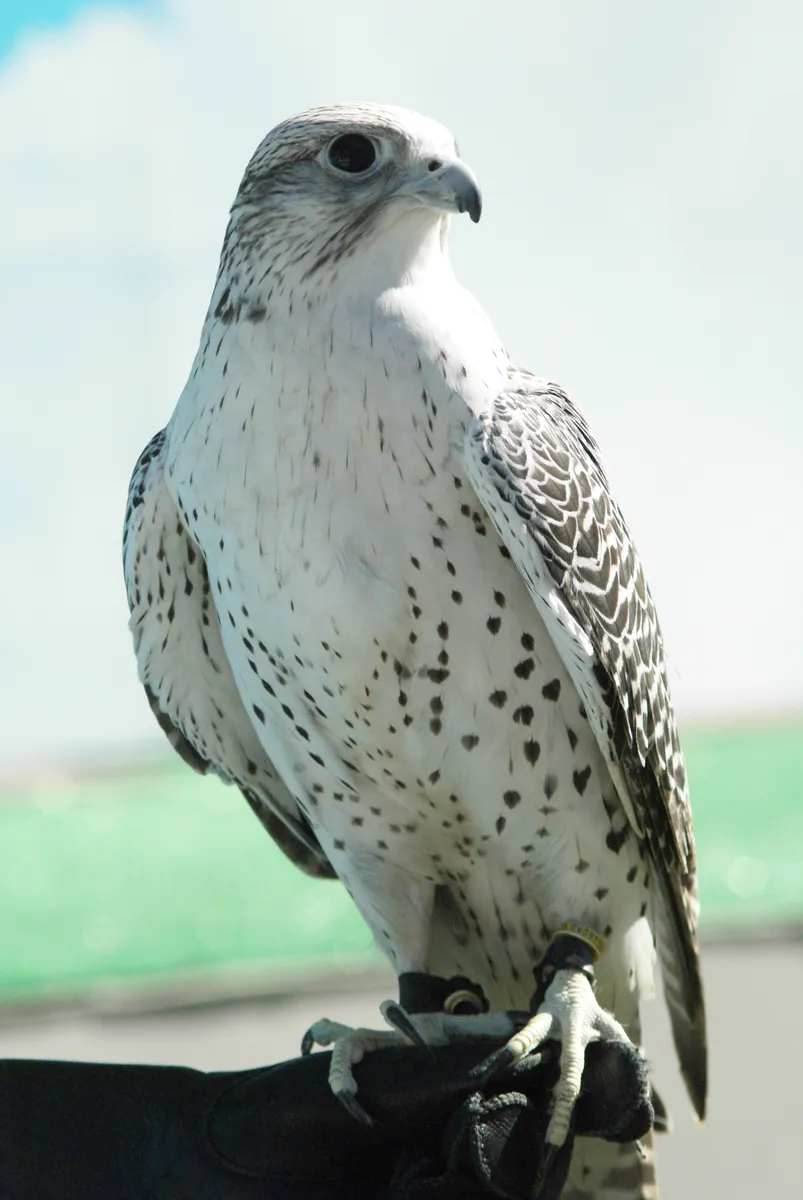
Faucon gerfaut— Quebec wildlife
Falco rusticolus
FalconidaeNo period published by Québec.ca
Québec.ca publishes no hunting or trapping period for this species. Check the official regulations.
Wikipedia
Faucon gerfaut
The gyrfalcon ( or ) (Falco rusticolus), also abbreviated as gyr, is a bird of prey and the largest species in the falcon family, Falconidae. A high-latitude species, the gyrfalcon breeds on the Arctic coasts and tundra, the islands of northern North America and Siberia, where it is mainly a resident species. Some gyrfalcons disperse more widely after the breeding season or in winter, and individual vagrancy can take birds for long distances. Its plumage varies with location, with birds being coloured from all-white to dark grey-brown. These colour variations are called morphs. Like other falcons, it shows sexual dimorphism, with the female much larger than the male.
Description
The gyrfalcon is the largest falcon in the world, being about the same size as the largest buteos but probably slightly heavier. Males are 48 to 61 centimetres (19 to 24 inches) long, weigh 805 to 1,350 grams (1 pound 12+1⁄2 ounces to 2 pounds 15+1⁄2 ounces), with average weights reported as 1,130 or 1,170 g (2 lb 8 oz or 2 lb 9+1⁄2 oz) and have a wingspan from 110 to 130 cm (43 to 51 in). Females are bulkier and larger, at 51 to 65 cm (20 to 25+1⁄2 in) long, 124 to 134 cm (49 to 53 in) wingspan, and of 1,180 to 2,100 g (2 lb 9+1⁄2 oz to 4 lb 10 oz) weight, with average weights of 1,585 or 1,752 g (3 lb 8 oz or 3 lb 13+3⁄4 oz). An outsized female from eastern Siberia was found to have scaled 2,600 g (5 lb 12 oz). Among standard measurements, the wing chord is 34.5 to 41 cm (13.6 to 16.1 in), the tail is 19.5 to 29 cm (7.7 to 11.4 in), the culmen is 2 to 2.8 cm (3⁄4 to 1+1⁄8 in) and the tarsus is 4.9 to 7.5 cm (1+7⁄8 to 3 in). It differs from the buzzard in general structure, having pointed wings. The gyrfalcon is a very polymorphic species, so its plumage varies greatly. The archetypal morphs are called "white", "silver", "brown", and "black", though they can be coloured on a spectrum from all-white to very dark. The brown form of the gyrfalcon is distinguished from the peregrine by the cream streaking on the nape and crown and by the absence of a well-defined malar stripe and cap. The black morph is similar but has a strongly black-spotted underside, rather than finely barred as in the peregrine and the brown-morph gyrfalcon. White form gyrfalcons are the only predominantly white falcons. Silver gyrfalcons resemble a light grey lanner falcon of larger size. The species shows no sex-based colour differences; juveniles are darker and browner than adults. The black colour seems to be sex-linked and to occur mostly in females; it proved difficult for breeders to get males darker than the dark side of slate grey. A colour variety that arose in captive breeding is "black chick".
Text from Wikipedia — Gyrfalcon, revision 1371251196, CC BY-SA 4.0, retrieved 2026-09-04. Encyclopedic text reused under CC BY-SA 4.0. Sentences about hunting or regulation are removed: on this site, the rule comes from Québec.ca.
Other names
French
English
Presence in Quebec
- Origin
- Indigène
- Occurrence
- Régulier
- Population status
- Toute l'année
- Certainty
- Confirmé
Conservation
Québec.ca
Official periods
Source: Québec.ca — tables reproduced as published (retrieved 2026-08-30).
Regulations change. Always check Québec.ca before hunting or trapping.
Where this data comes from
This species is listed in an official government dataset. The identification and status shown in the data sheet are reproduced from it.
Source: List of Quebec’s vertebrate wildlife (LFVQ) — Ministère de l’Environnement, de la Lutte contre les changements climatiques, de la Faune et des Parcs. File LFVQ_25_03_2026.csv, retrieved 2026-08-30 · CC BY 4.0.
Measurements, habitat, diet and reproduction are not shown: no official source is attached to them yet.