
No period published by Québec.ca
Québec.ca publishes no hunting or trapping period for this species. Check the official regulations.
Wikipedia
Fou brun
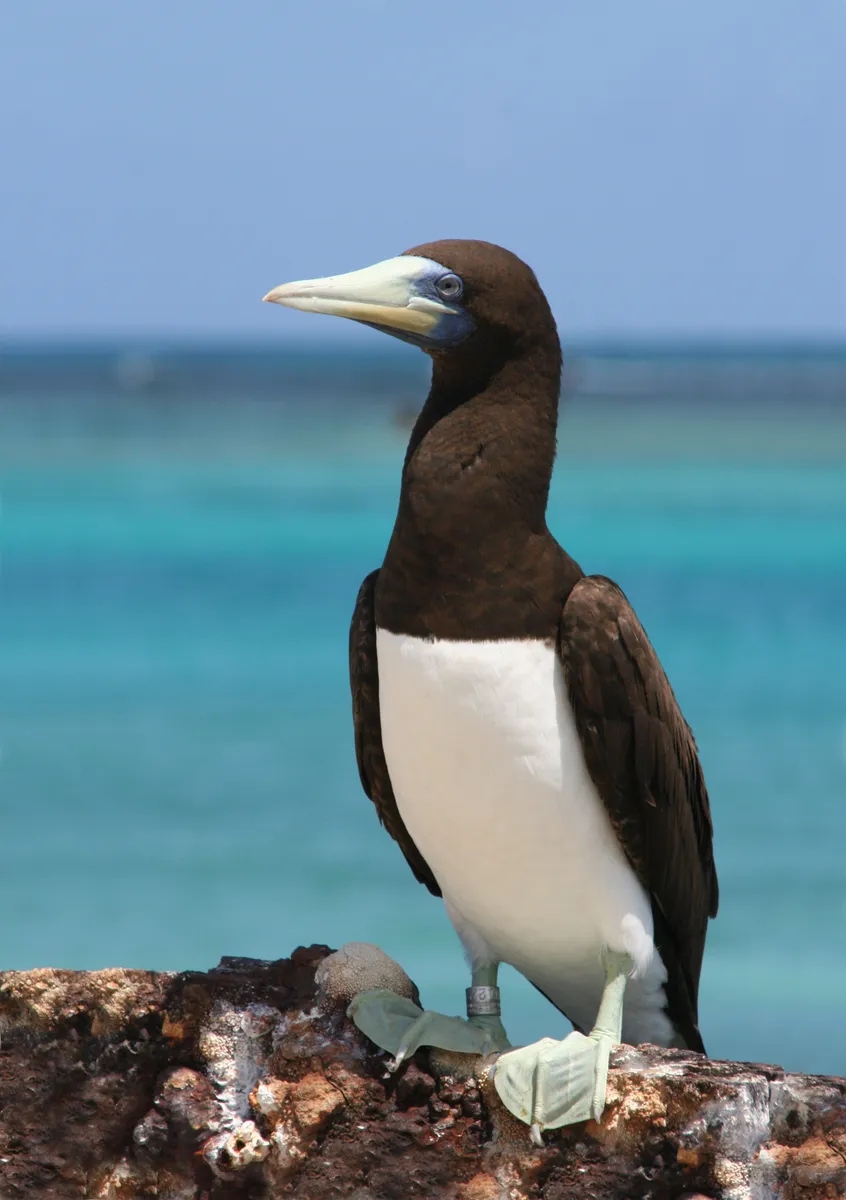
The brown booby (Sula leucogaster) is a large seabird in the booby and gannet family Sulidae, of which it is one of the most common and widespread species. It has a pantropical range, which overlaps with that of other booby species. The gregarious brown booby commutes and forages at low height over inshore waters. Flocks plunge-dive to take small fish, especially when these are driven near the surface by their predators. They nest only on the ground, and roost on solid objects rather than the water surface.
Description
The booby's head and upper body (back) is covered in dark brown to blackish plumage, with the remainder (belly) being a contrasting white. The bare-part colours vary geographically, but not seasonally. The species also displays sexual dimorphism of the bare part colours, the males having a blue orbital ring, as opposed to the yellow orbital ring of the female. Female boobies reach about 80 centimetres (31 in) in length; their wingspans measure up to 150 cm (4.9 ft), and they can weigh up to 1,300 g (2.9 lb). Male boobies reach about 75 centimetres (30 in) in length; their wingspans measure up to 140 cm (4.6 ft), and they can weigh up to 1,000 g (2.2 lb). Unlike other species of sulid, the juvenile plumage already resembles that of the adult. They are grey-brown with darkening on the head, upper surfaces of the wings and tail, while the lower breast and underpart plumages are heavily flecked brown on white. Their beaks are quite sharp and contain jagged edges. They have fairly short wings resulting in a fast flap rate, but long, tapered tails. While these birds are typically silent, they occasionally make grunting or quacking sounds.
Text from Wikipedia — Brown booby, revision 1366530339, CC BY-SA 4.0, retrieved 2026-09-04. Encyclopedic text reused under CC BY-SA 4.0. Sentences about hunting or regulation are removed: on this site, the rule comes from Québec.ca.
Presence in Quebec
- Origin
- Indigène
- Occurrence
- Accidentel/non régulier
- Population status
- Migrateur
- Certainty
- Confirmé
Conservation
Official remark
Présence de l'espèce plutôt imprévisible; elle peut ne pas être observée pendant de longues périodes.
Québec.ca
Official periods
Source: Québec.ca — tables reproduced as published (retrieved 2026-08-30).
Regulations change. Always check Québec.ca before hunting or trapping.
Where this data comes from
This species is listed in an official government dataset. The identification and status shown in the data sheet are reproduced from it.
Source: List of Quebec’s vertebrate wildlife (LFVQ) — Ministère de l’Environnement, de la Lutte contre les changements climatiques, de la Faune et des Parcs. File LFVQ_25_03_2026.csv, retrieved 2026-08-30 · CC BY 4.0.
Measurements, habitat, diet and reproduction are not shown: no official source is attached to them yet.