Fou de Bassan— Quebec wildlife
Morus bassanus
SulidaeNo period published by Québec.ca
Québec.ca publishes no hunting or trapping period for this species. Check the official regulations.
Wikipedia
Fou de Bassan
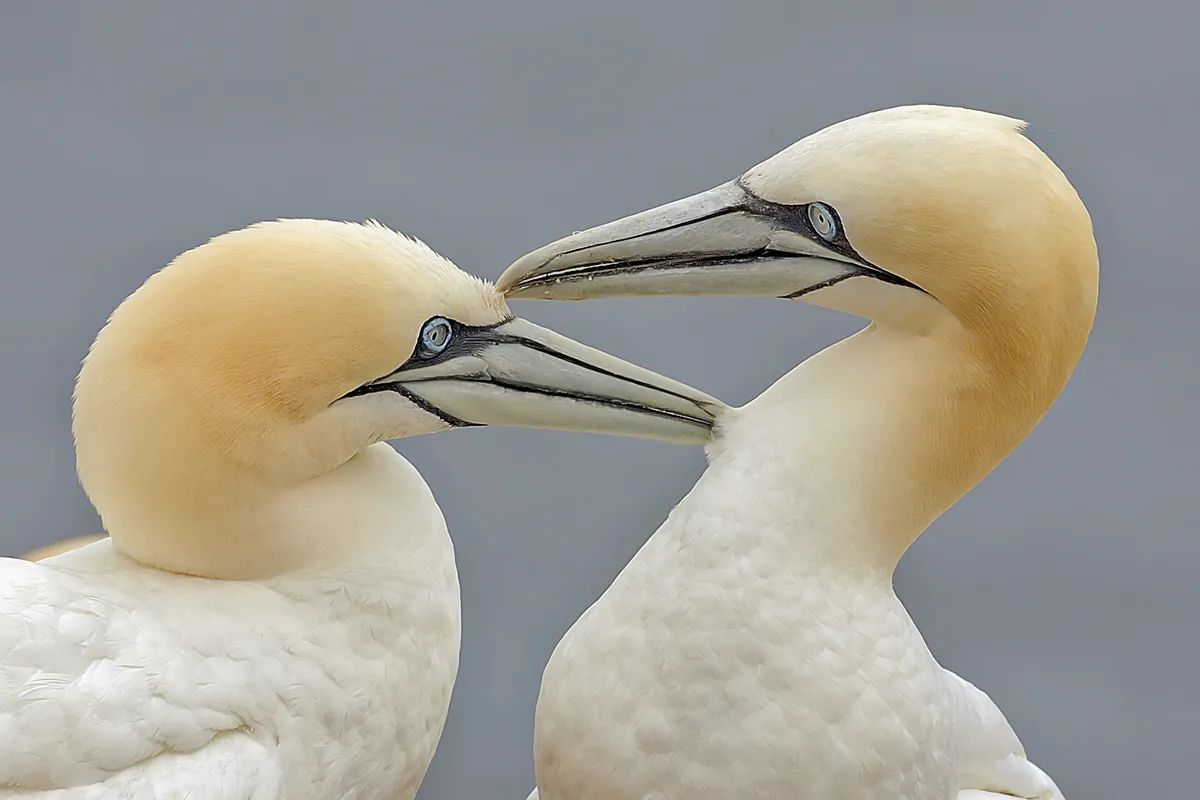
The northern gannet (Morus bassanus) is a seabird, the largest species of the gannet family, Sulidae. It is native to the coasts of the North Atlantic Ocean, breeding in Western Europe and Northeastern North America. It is the largest seabird in the northern Atlantic. The sexes are similar in appearance. The adult northern gannet has a mainly white streamlined body with a long neck, and long and slender wings. It is 87–100 cm (34+1⁄2–39+1⁄2 in) long with a 170–180 cm (67–71 in) wingspan. The head and nape have a buff tinge that is more prominent in breeding season, and the wings are edged with dark brown-black feathers. The long, pointed bill is blue-grey, contrasting with black, bare skin around the mouth and eyes. Juveniles are mostly grey-brown, becoming increasingly white in the five years it takes them to reach maturity. Nesting takes place in colonies on both sides of the North Atlantic, the largest of which are at the Bass Rock (75,000 pairs as of 2014), St. Kilda (60,000 pairs as of 2013) and Ailsa Craig (33,000 pairs as of 2014) in Scotland, in Ireland (Sceilg Bheag; little Skellig, 35,000 pairs in 2011), Grassholm in Wales, and Bonaventure Island (60,000 pairs in 2009) off the coast of Quebec. Its breeding range has extended northward and eastward, with colonies being established on Russia's Kola Peninsula in 1995 and Bear Island (the southernmost island of Svalbard), in 2011. Colonies are mostly located on offshore islands with cliffs, from which the birds can more easily launch into the air. The northern gannet undertakes seasonal migrations and catches fish (which are the mainstay of its diet) by making high-speed dives into the sea up to 60 mph. Since its population is growing, the International Union for Conservation of Nature considers it a least-concern species. Because it is both a conspicuous and a common bird, it is referred to in several ancient myths and legends.
Description
An adult northern gannet has a 170–180 cm (67–71 in) wingspan, and is 87–100 cm (34+1⁄2–39+1⁄2 in) long and weighs 2.3–3.6 kg (5–8 lb), making it the largest gannet and the largest seabird native to the western Palearctic. The two sexes are generally of a similar size and appearance. The plumage is white with dark brown to black wing tips; the primary flight feathers, primary coverts and alulae are dark. The head and neck are tinged buff-yellow, becoming much more prominent in the breeding season. Males are more deeply coloured than females. The eyes are surrounded by black bare skin and have a cobalt blue orbital ring; the iris is light blue-grey with a fine dark outer ring. Some northern gannets that recovered from highly pathogenic avian influenza H5N1 infection had black irises rather than the usual pale blue; this may provide a visible indicator of previous infection. The beak is long, strong and conical with a slight downcurve at the end and a sharp cutting edge. In adults, the beak is blue-grey with dark grey or black edges.
Text from Wikipedia — Northern gannet, revision 1367669947, CC BY-SA 4.0, retrieved 2026-09-04. Encyclopedic text reused under CC BY-SA 4.0. Sentences about hunting or regulation are removed: on this site, the rule comes from Québec.ca.
Other names
French
English
Former scientific names
Presence in Quebec
- Origin
- Indigène
- Occurrence
- Régulier
- Population status
- Reproducteur
- Certainty
- Confirmé
Conservation
Québec.ca
Official periods
Source: Québec.ca — tables reproduced as published (retrieved 2026-08-30).
Regulations change. Always check Québec.ca before hunting or trapping.
Where this data comes from
This species is listed in an official government dataset. The identification and status shown in the data sheet are reproduced from it.
Source: List of Quebec’s vertebrate wildlife (LFVQ) — Ministère de l’Environnement, de la Lutte contre les changements climatiques, de la Faune et des Parcs. File LFVQ_25_03_2026.csv, retrieved 2026-08-30 · CC BY 4.0.
Measurements, habitat, diet and reproduction are not shown: no official source is attached to them yet.