
Migratory game bird — federal regulations
Seasons and bag limits are set by Environment and Climate Change Canada.
Wikipedia
Foulque d'Amérique
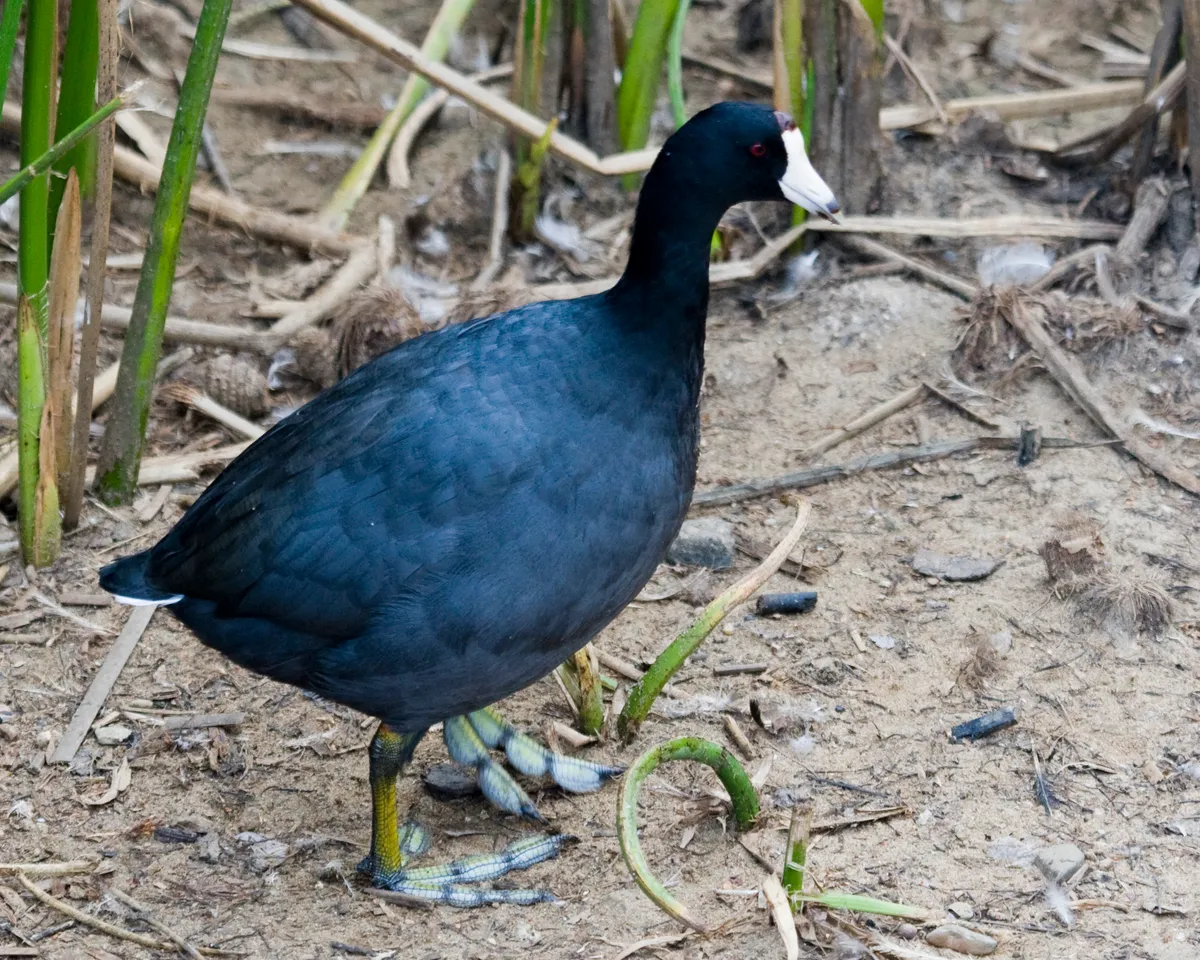
The American coot (Fulica americana), also known as a mud hen or pouldeau, is a bird of the family Rallidae. Though commonly mistaken for ducks, American coots are only distantly related to ducks, belonging to a separate order. Unlike the webbed feet of ducks, coots have broad, lobed scales on their lower legs and toes that fold back with each step to facilitate walking on dry land. Coots live near water, typically inhabiting wetlands and open water bodies in North America. Groups of coots are called covers or rafts. The oldest known coot lived to be 22 years old. The American coot is a migratory bird that occupies most of North America. It lives in the Pacific and southwestern United States and Mexico year-round and occupies more northeastern regions during the summer breeding season. In the winter they can be found as far south as Panama. Coots generally build floating nests and lay 8–12 eggs per clutch. Females and males have similar appearances, but they can be distinguished during aggressive displays by the larger ruff (head plumage) on the male. American coots eat primarily algae and other aquatic plants but also animals (both vertebrates and invertebrates) when available. The American coot is closely related to the Eurasian coot (Fulica atra), which occupies the same ecological niche in Eurasia and Australia as the American coot does in North America. Eurasian coots can be distinguished from this species by the absence of a red callus above the bird's frontal shield. The American coot is listed as "Least Concern" under the IUCN conservation ratings. American coots display several interesting breeding habits; mothers will preferentially feed offspring with the brightest plume feathers, which has resulted in coot chicks having brightly ornamented plumage which becomes drabber as they age. American coots are also susceptible to conspecific brood parasitism and have evolved mechanisms to differentiate their offspring from those of parasitic females.
Description
The American coot measures 34–43 cm (13–17 in) in length with a wingspan of 58 to 71 cm (23 to 28 in). Adults have a short, thick, white bill and white frontal shield, which usually has a reddish-brown spot near the top of the bill between the eyes. Males and females look alike, but females are smaller. Body mass in females ranges from 427 to 628 g (0.941 to 1.385 lb) and in males from 576 to 848 g (1.270 to 1.870 lb). Juvenile birds have olive-brown crowns and a gray body. They become adult-colored around 4 months of age.
Text from Wikipedia — American coot, revision 1359411093, CC BY-SA 4.0, retrieved 2026-09-04. Encyclopedic text reused under CC BY-SA 4.0. Sentences about hunting or regulation are removed: on this site, the rule comes from Québec.ca.
Other names
French
English
Presence in Quebec
- Origin
- Indigène
- Occurrence
- Régulier
- Population status
- Reproducteur
- Certainty
- Confirmé
Conservation
Québec.ca
Official periods
Source: Québec.ca — tables reproduced as published (retrieved 2026-08-30).
Regulations change. Always check Québec.ca before hunting or trapping.
Where this data comes from
This species is listed in an official government dataset. The identification and status shown in the data sheet are reproduced from it.
Source: List of Quebec’s vertebrate wildlife (LFVQ) — Ministère de l’Environnement, de la Lutte contre les changements climatiques, de la Faune et des Parcs. File LFVQ_25_03_2026.csv, retrieved 2026-08-30 · CC BY 4.0.
Measurements, habitat, diet and reproduction are not shown: no official source is attached to them yet.