
No period published by Québec.ca
Québec.ca publishes no hunting or trapping period for this species. Check the official regulations.
Wikipedia
Frégate superbe
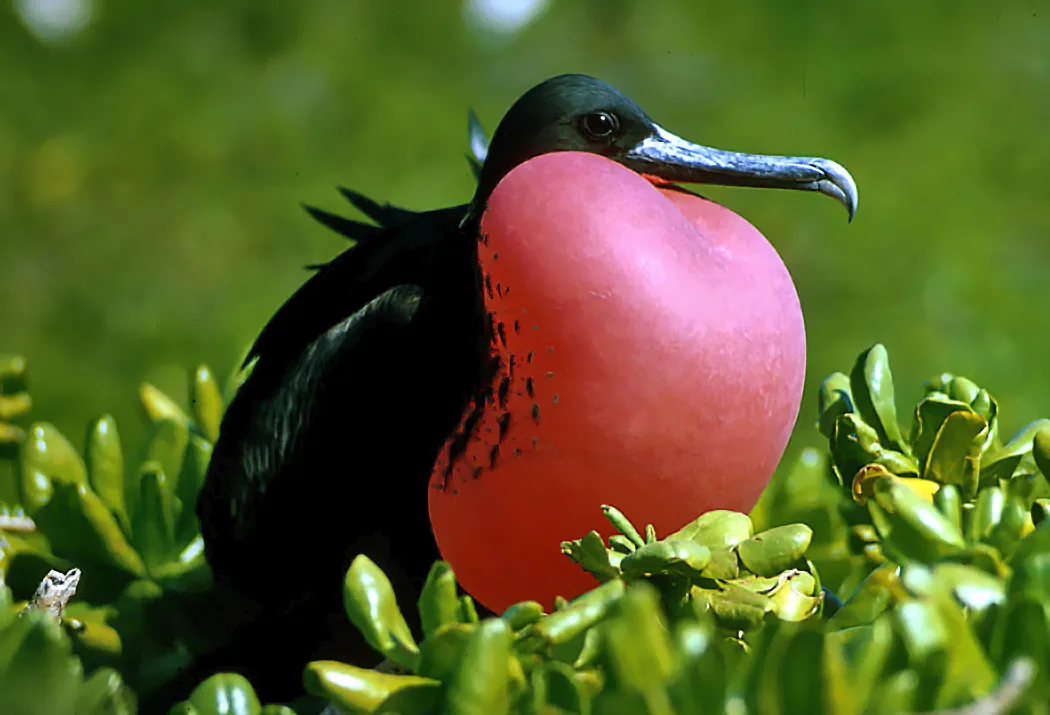
The magnificent frigatebird (Fregata magnificens), frigate petrel or man o' war is a seabird of the frigatebird family Fregatidae. With a length of 89–114 centimetres (2 ft 11 in – 3 ft 9 in) and wingspan of 2.17–2.44 m (7 ft 1 in – 8 ft 0 in), it is the largest species of frigatebird. It occurs over tropical and subtropical waters off America, between northern Mexico and Peru on the Pacific coast and between Florida and southern Brazil along the Atlantic coast. There are also populations on the Galápagos Islands in the Pacific and the Cape Verde islands in the Atlantic. It is one of the fastest birds in the world, flying at speeds of up to 153 kilometres (95 mi) per hour. The magnificent frigatebird is a large, lightly built seabird with brownish-black plumage, long narrow wings and a deeply forked tail. The male has a striking red gular sac which he inflates to attract a mate. The female is slightly larger than the male and has a white breast and belly. Frigatebirds feed on fish taken in flight from the ocean's surface (often flying fish), and sometimes indulge in kleptoparasitism, harassing other birds to force them to regurgitate their food.
Description
The magnificent frigatebird is the largest species of frigatebird. It measures 89–114 cm (2 ft 11 in – 3 ft 9 in) in length, has a wingspan of 2.17–2.44 m (7 ft 1 in – 8 ft 0 in) and weighs 1.1–1.59 kilograms (2 lb 7 oz – 3 lb 8 oz). Males are all-black with a scarlet throat pouch that is inflated like a balloon in the breeding season. Although the feathers are black, the scapular feathers produce a purple iridescence when they reflect sunlight, in contrast to the male great frigatebird's green sheen. Females are black but have a white breast and lower neck sides, a brown band on the wings, and a blue eye-ring that is diagnostic of the female of the species. Immature birds have a white head and underparts. This species is very similar to the other frigatebirds and is similarly sized to all but the lesser frigatebird. However, it lacks a white axillary spur, and juveniles show a distinctive diamond-shaped belly patch. The magnificent frigatebird is silent in flight, but makes various rattling sounds at its nest. It spends days and nights on the wing, with an average flapping rate of 2.84 beat per second, ground speed of 10 km/h (6.2 mph), covering up to 223 km (139 mi) before landing. They alternately climb in thermals, to altitudes occasionally as high as 2,500 m (8,200 ft), and descend to near the sea surface.
Habitat and range
The magnificent frigatebird is widespread in the tropical Atlantic, breeding colonially in trees in Florida, the Caribbean and also along the Pacific coast of the Americas from Mexico to Ecuador, including the Galápagos Islands. One of the largest colonies in the world is located in Codrington Lagoon, Barbuda. It has occurred as a vagrant as far from its normal range as the Isle of Man, Denmark, Spain, England, Nova Scotia, the Magdalen Islands, and British Columbia.
Text from Wikipedia — Magnificent frigatebird, revision 1371438800, CC BY-SA 4.0, retrieved 2026-09-04. Encyclopedic text reused under CC BY-SA 4.0. Sentences about hunting or regulation are removed: on this site, the rule comes from Québec.ca.
Other names
French
English
Presence in Quebec
- Origin
- Indigène
- Occurrence
- Accidentel/non régulier
- Population status
- Migrateur
- Certainty
- Confirmé
Conservation
Québec.ca
Official periods
Source: Québec.ca — tables reproduced as published (retrieved 2026-08-30).
Regulations change. Always check Québec.ca before hunting or trapping.
Where this data comes from
This species is listed in an official government dataset. The identification and status shown in the data sheet are reproduced from it.
Source: List of Quebec’s vertebrate wildlife (LFVQ) — Ministère de l’Environnement, de la Lutte contre les changements climatiques, de la Faune et des Parcs. File LFVQ_25_03_2026.csv, retrieved 2026-08-30 · CC BY 4.0.
Measurements, habitat, diet and reproduction are not shown: no official source is attached to them yet.