
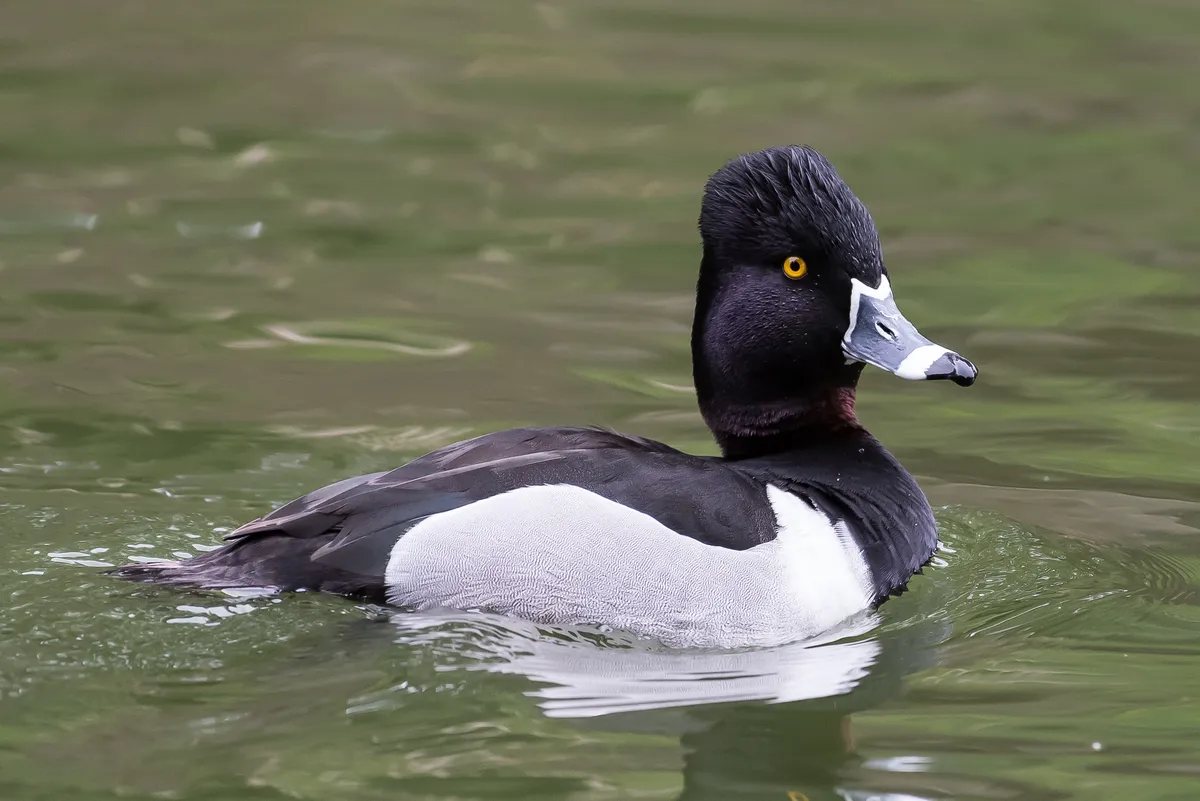
Fuligule à collier— Quebec wildlife
Aythya collaris
AnatidaeNo period published by Québec.ca
Québec.ca publishes no hunting or trapping period for this species. Check the official regulations.
Wikipedia
Fuligule à collier
The ring-necked duck (Aythya collaris) is a diving duck from North America commonly found in freshwater ponds and lakes. The scientific name is derived from Greek aithuia, an unidentified seabird mentioned by authors including Hesychius and Aristotle, and Latin collaris, "of the neck" from collum, "neck".
Description
Ring-necked ducks are small to medium-sized diving ducks with the following length, weight, and wingspan measurements: Length: 15.3–18.1 in (39–46 cm) Weight: 17.3–32.1 oz (490–910 g) Wingspan: 24.4–24.8 in (62–63 cm) The adult male is similar in color pattern to the Eurasian tufted duck, its relative. Males are a little bit bigger than the female. It has two white rings surrounding its gray bill, a shiny black angular head, black back, white line on the wings, a white breast and yellow eyes. The adult female has a grayish brown angular head and body with a dark brown back, a dark bill with a more subtle light band than the male, grayish-blue feet and brown eyes with white rings surrounding them. Females also make a noise like trrr. The cinnamon neck ring is usually difficult to observe, which is why the bird is sometimes referred to as a "ringbill".
Diet
These birds are omnivores and feed mainly by diving or dabbling at the surface. Ducklings are dependent on animal matter such as insects, earthworms, leeches, midges and snails. As they mature they tend change their diet to submerged plants such as pondweed and coontail, and emergents such as annual wild rice and snails.
Text from Wikipedia — Ring-necked duck, revision 1370787563, CC BY-SA 4.0, retrieved 2026-09-04. Encyclopedic text reused under CC BY-SA 4.0. Sentences about hunting or regulation are removed: on this site, the rule comes from Québec.ca.
Other names
French
Presence in Quebec
- Origin
- Indigène
- Occurrence
- Régulier
- Population status
- Reproducteur
- Certainty
- Confirmé
Conservation
Québec.ca
Official periods
Source: Québec.ca — tables reproduced as published (retrieved 2026-08-30).
Regulations change. Always check Québec.ca before hunting or trapping.
Where this data comes from
This species is listed in an official government dataset. The identification and status shown in the data sheet are reproduced from it.
Source: List of Quebec’s vertebrate wildlife (LFVQ) — Ministère de l’Environnement, de la Lutte contre les changements climatiques, de la Faune et des Parcs. File LFVQ_25_03_2026.csv, retrieved 2026-08-30 · CC BY 4.0.
Measurements, habitat, diet and reproduction are not shown: no official source is attached to them yet.