
No period published by Québec.ca
Québec.ca publishes no hunting or trapping period for this species. Check the official regulations.
Wikipedia
Fuligule à dos blanc
The canvasback (Aythya valisineria) is a species of diving duck, the largest found in North America.
Description
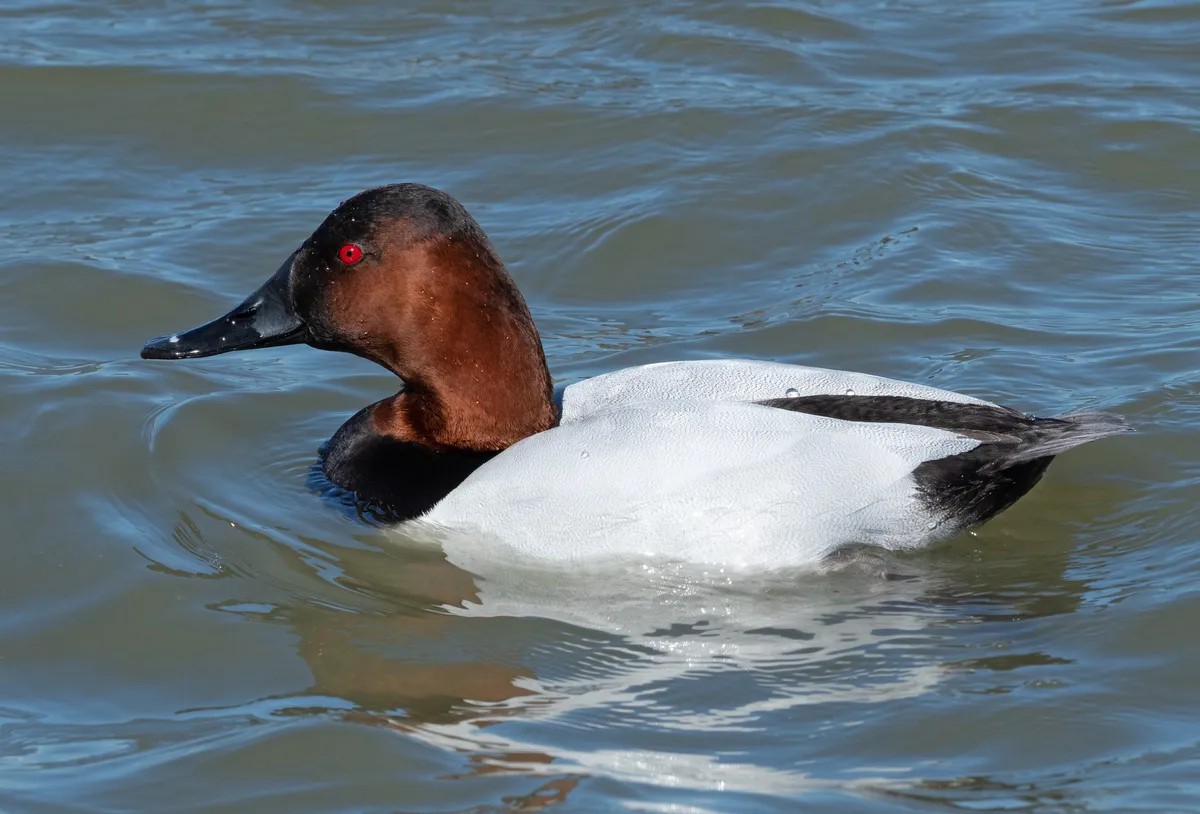
It ranges from 48–56 cm (19–22 in) in length and weighs 862–1,588 g (1.900–3.501 lb), with a wingspan of 79–89 cm (31–35 in). It is the largest species in the genus Aythya, and the largest diving duck in North America. Canvasbacks are similar in size to a mallard but with a heavier and more compact build. 191 males wintering in western New York averaged 1,252 g (2.760 lb) and 54 females there averaged 1,154 g (2.544 lb). The canvasback has a distinctive wedge-shaped head and long graceful neck. The adult male (drake) has a black bill, a chestnut red head and neck, a black breast, a grayish back, black rump, and a blackish brown tail. The drake's sides, back, and belly are white with fine vermiculation resembling the weave of a canvas, which gave rise to the bird's common name. The iris is bright red in the spring, but duller in the winter. The adult female (hen) also has a black bill, a light brown head and neck, grading into a darker brown chest and foreback. The sides, flanks, and back are grayish brown. The bill is blackish and the legs and feet are bluish-gray. Its sloping profile distinguishes it from other ducks.
Diet
The canvasback feeds mainly by diving, sometimes dabbling, mostly eating seeds, buds, leaves, tubers, roots, snails, and insect larvae. Besides its namesake, wild celery, the canvasback shows a preference for the tubers of sago pondweed, which can make up 100% of its diet at times. The canvasback has large webbed feet adapted for diving and its bill helps it dig tubers from the substrate. In the late 1930s, studies showed that four-fifths of the food eaten by canvasbacks was plant material. In the early 1950s it was estimated that there were 225,000 canvasbacks wintering in the Chesapeake Bay; this represented one-half of the entire North American population. By 1985, there were only 50,000 ducks wintering there, or one-tenth of the population. Scientists have now concluded that the decline in duck populations was due to the decline in sub-aquatic vegetation acreage. Today the population has stabilized and is even increasing slightly, although it is nowhere near previous levels. Studies have now shown that by the 1970s four-fifths of the ducks' diet was made up of Baltic Clams, which are very common in the Chesapeake Bay: the ducks have been able to adapt to the decline in sub-aquatic vegetation by changing their diet. Redheads, which also feed on the tubers of sub-aquatic vegetation, have not been able to adapt, and their population remains low.
Reproduction
The breeding habitat of the canvasback is in North American prairie potholes. The bulky nest is built from vegetation in a marsh and lined with down. Loss of nesting habitat has caused populations to decline. The canvasback usually takes a new mate each year, pairing in late winter on ocean bays.
Text from Wikipedia — Canvasback, revision 1368509687, CC BY-SA 4.0, retrieved 2026-09-04. Encyclopedic text reused under CC BY-SA 4.0. Sentences about hunting or regulation are removed: on this site, the rule comes from Québec.ca.
Other names
French
Presence in Quebec
- Origin
- Indigène
- Occurrence
- Régulier
- Population status
- Migrateur
- Certainty
- Confirmé
Conservation
Québec.ca
Official periods
Source: Québec.ca — tables reproduced as published (retrieved 2026-08-30).
Regulations change. Always check Québec.ca before hunting or trapping.
Where this data comes from
This species is listed in an official government dataset. The identification and status shown in the data sheet are reproduced from it.
Source: List of Quebec’s vertebrate wildlife (LFVQ) — Ministère de l’Environnement, de la Lutte contre les changements climatiques, de la Faune et des Parcs. File LFVQ_25_03_2026.csv, retrieved 2026-08-30 · CC BY 4.0.
Measurements, habitat, diet and reproduction are not shown: no official source is attached to them yet.