
No period published by Québec.ca
Québec.ca publishes no hunting or trapping period for this species. Check the official regulations.
Wikipedia
Fuligule à tête rouge
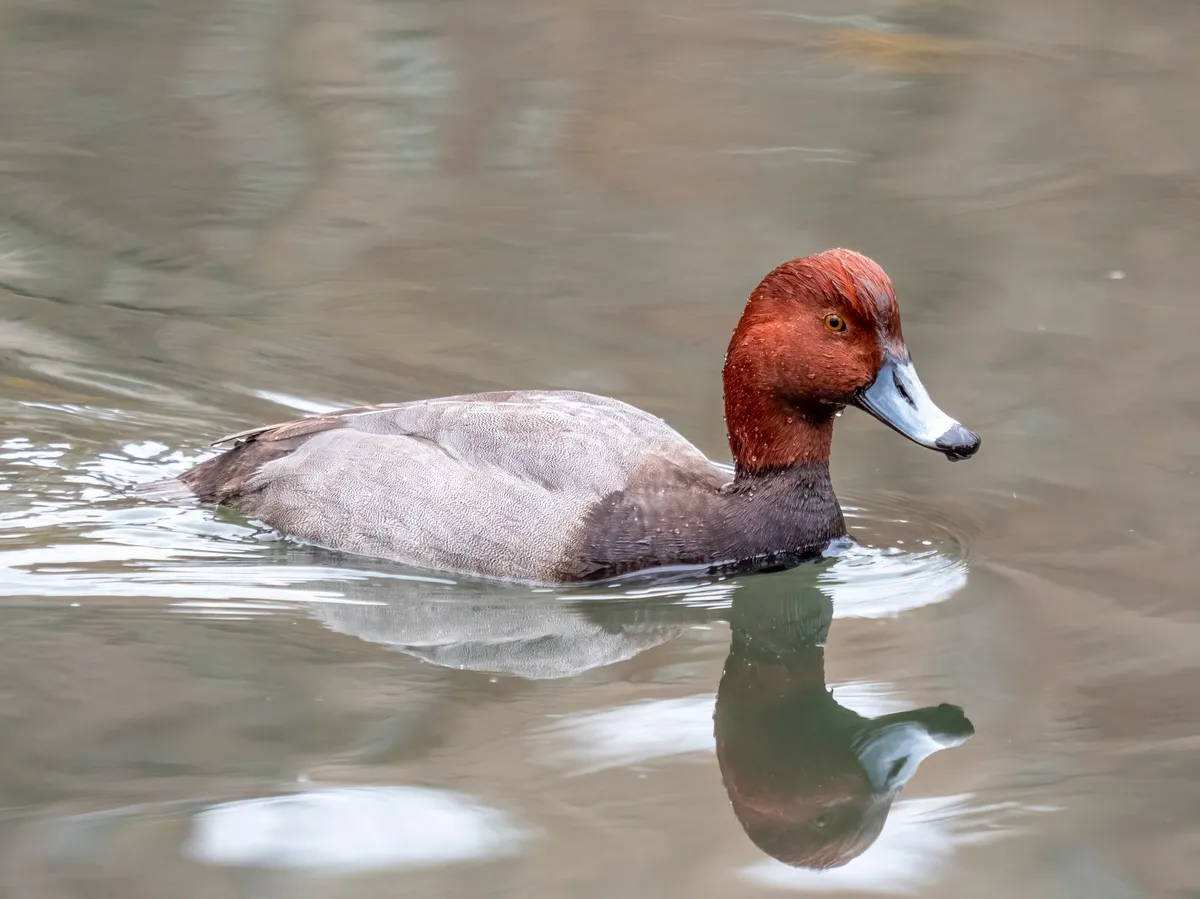
The redhead (Aythya americana) is a medium-sized diving duck. Its scientific name is derived from Greek aithuia, an unidentified seabird mentioned by authors including Hesychius and Aristotle, and Latin americana, of America. The redhead is 40–56 cm (16–22 in) long with an 74–84 cm (29–33 in) wingspan; weights range from 1,030–1,080 g (36–38 oz), with males weighing an average of 1,080 g (38 oz) and females an average of 1,030 g (36 oz). It belongs to the genus Aythya, together with 11 other described species. The redhead and the common pochard form a sister group, which together are sister to the canvasback. This waterfowl is easily distinguished from most other ducks by the male's copper-colored head and pale blue bill during the breeding season; from its close relative, canvasback, it is distinguished by the more rounded head, shorter bill, and (in the males) yellow, not red, eyes. The Eurasian common pochard is even more similar, but very rarely overlaps in range; it also differs in having a red eye, and a more acute, less rounded head shape. Other names that have been used for the redhead include red-headed duck and the red-headed pochard.
Description
The redhead is a pochard, a diving duck specially adapted to foraging underwater. Its legs are placed further back on the body, which makes walking on land difficult. The webbing on its feet is larger than dabbling ducks and its bills are broader to facilitate underwater foraging. In addition, pochards have a lobed hind toe. No pochard has a metallic-colored speculum, a characteristic of other ducks.
Habitat and range
During breeding season, redheads are found across a wide range of North America, from as far north as Northern Canada, south to the Caribbean in winter. Their preferred areas include the intermontane regions of British Columbia, Alberta, Saskatchewan, Manitoba, with some small localities in Ontario and Quebec, and North and South Dakota inn the United States. These pochards then migrate south to winter in warmer climates. These areas include the southern United States, where breeding does not occur and extends to Mexico, Guatemala, Cuba, and the Bahamas. In both seasons, redheads use wetlands as their main habitat.
Text from Wikipedia — Redhead (bird), revision 1364852409, CC BY-SA 4.0, retrieved 2026-09-04. Encyclopedic text reused under CC BY-SA 4.0. Sentences about hunting or regulation are removed: on this site, the rule comes from Québec.ca.
Other names
French
Presence in Quebec
- Origin
- Indigène
- Occurrence
- Régulier
- Population status
- Reproducteur
- Certainty
- Confirmé
Conservation
Québec.ca
Official periods
Source: Québec.ca — tables reproduced as published (retrieved 2026-08-30).
Regulations change. Always check Québec.ca before hunting or trapping.
Where this data comes from
This species is listed in an official government dataset. The identification and status shown in the data sheet are reproduced from it.
Source: List of Quebec’s vertebrate wildlife (LFVQ) — Ministère de l’Environnement, de la Lutte contre les changements climatiques, de la Faune et des Parcs. File LFVQ_25_03_2026.csv, retrieved 2026-08-30 · CC BY 4.0.
Measurements, habitat, diet and reproduction are not shown: no official source is attached to them yet.