
No period published by Québec.ca
Québec.ca publishes no hunting or trapping period for this species. Check the official regulations.
Wikipedia
Fuligule milouin
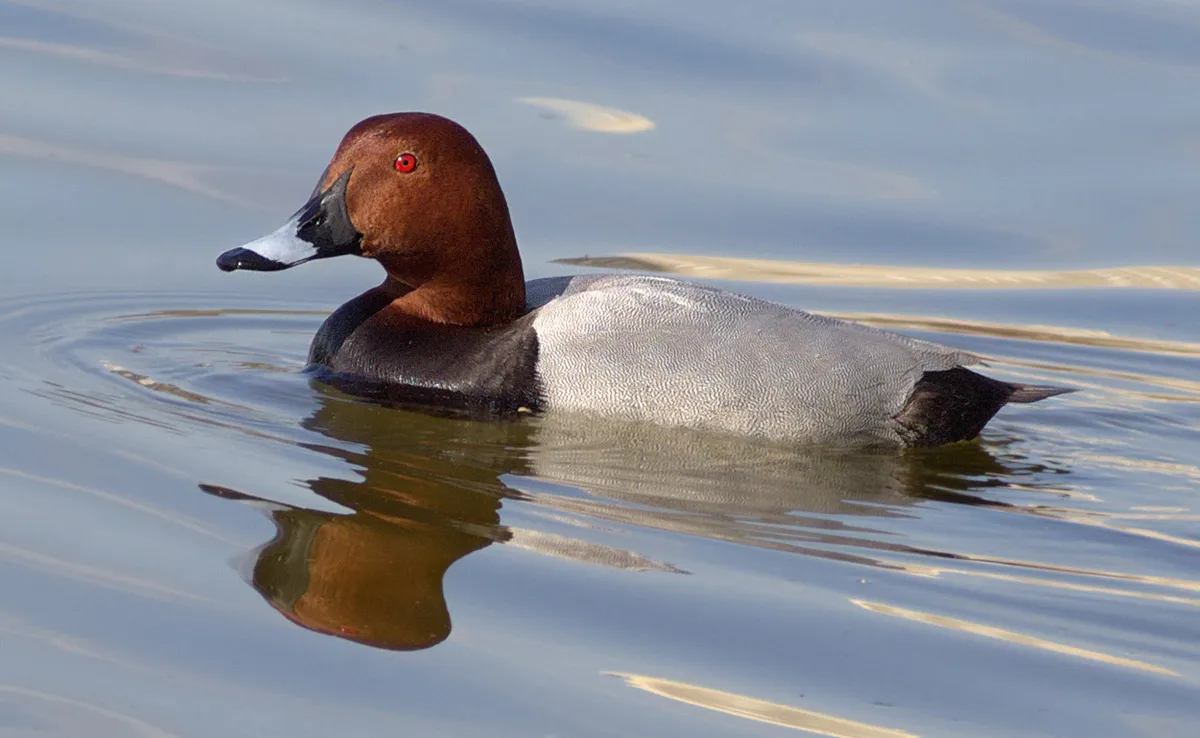
The common pochard (; Aythya ferina), known simply as pochard in the United Kingdom, is a medium-sized diving duck in the family Anatidae. It is widespread across the Palearctic. It breeds primarily in Scandinavia and the steppe regions of Siberia, and winters farther south and west.
Description
The common pochard is a plump, medium-sized diving duck, measuring 42–49 cm (17–19 in) in length, with a wingspan of 72–82 cm (28–32 in). It is stocky and short-tailed, with a sloping forehead and relatively long bill. Its weight (which has been reported only for winter birds) ranges from 467 to 1,240 g (16.5 to 43.7 oz). Males average larger and heavier than females. Like most ducks, it is sexually dimorphic. The male has a chestnut-coloured head and neck, a black breast and tail, and a pale grey body, marked with fine vermiculations. His bill is dark grey, with a wide blue-grey band across the middle. His iris is yellow-orange to red, growing brighter in the breeding season. The legs and feet are grey in both sexes and all ages. The female's iris is brown, sometimes tending towards yellowish-brown. The juvenile's iris is yellow-olive, but attains its adult colour during the first winter.
Text from Wikipedia — Common pochard, revision 1358119395, CC BY-SA 4.0, retrieved 2026-09-04. Encyclopedic text reused under CC BY-SA 4.0. Sentences about hunting or regulation are removed: on this site, the rule comes from Québec.ca.
Presence in Quebec
- Origin
- Indigène
- Occurrence
- Inconnu/non déterminé
- Population status
- Migrateur
- Certainty
- Confirmé
Conservation
Québec.ca
Official periods
Source: Québec.ca — tables reproduced as published (retrieved 2026-08-30).
Regulations change. Always check Québec.ca before hunting or trapping.
Where this data comes from
This species is listed in an official government dataset. The identification and status shown in the data sheet are reproduced from it.
Source: List of Quebec’s vertebrate wildlife (LFVQ) — Ministère de l’Environnement, de la Lutte contre les changements climatiques, de la Faune et des Parcs. File LFVQ_25_03_2026.csv, retrieved 2026-08-30 · CC BY 4.0.
Measurements, habitat, diet and reproduction are not shown: no official source is attached to them yet.