
No period published by Québec.ca
Québec.ca publishes no hunting or trapping period for this species. Check the official regulations.
Wikipedia
Fuligule milouinan
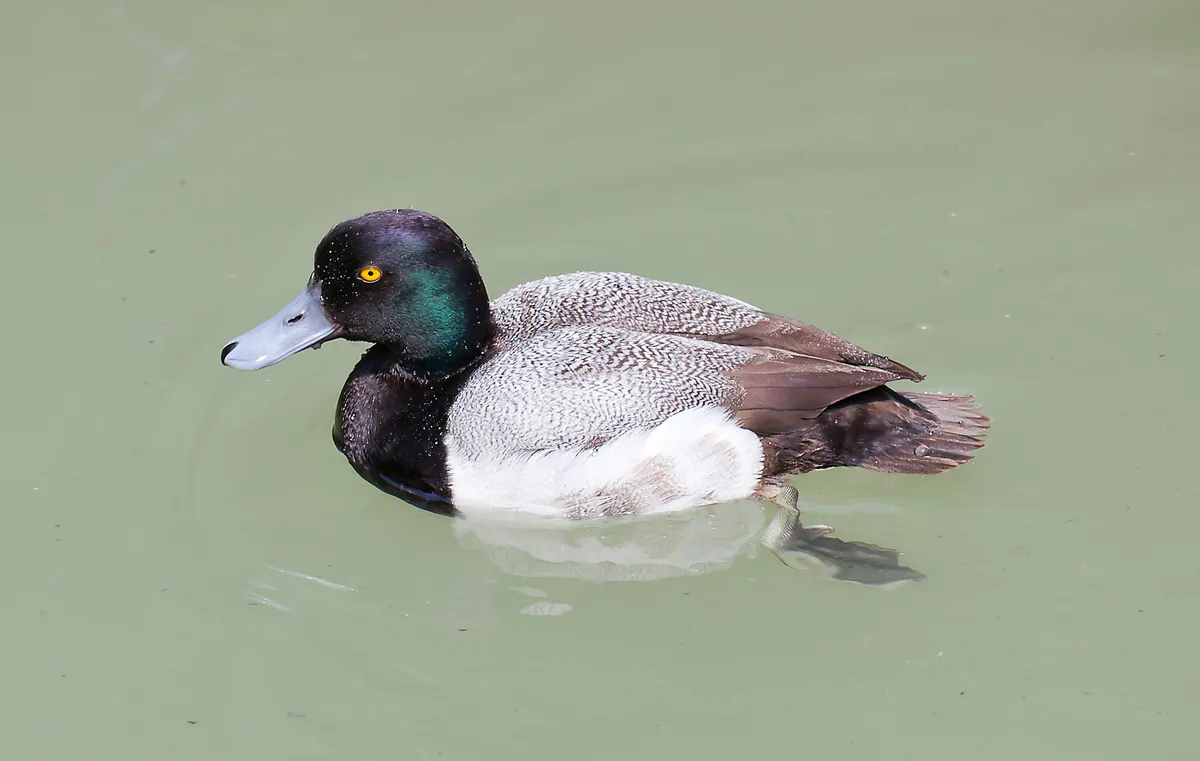
The greater scaup (Aythya marila), just scaup in Europe or, colloquially, "bluebill" in North America, is a mid-sized diving duck, larger than the closely related lesser scaup and tufted duck. It spends the summer months breeding in Iceland, east across Scandinavia, northern Russia and Siberia, Alaska, and northern Canada. During the winter, it migrates south to the coasts of Europe, eastern Asia, and North America. Male greater scaup average slightly larger than the females but with much overlap; they have a light blue-grey bill and yellow eyes. Their heads are dark, with a green to purple (depending on light angle) gloss; the breast is black, the belly white, the upperparts pale grey, and the wing shows a strong white stripe. The females are mostly brown, again with white on the wing. They have dull blue bills and a white patch on the face. Greater scaup nest near water, typically on islands in northern lakes or on floating mats of vegetation. They begin breeding at age two, but start building nests in the first year. The drakes have a complex courtship, which takes place on the return migration to the summer breeding grounds and concludes with the formation of monogamous pairs. Females lay a clutch of six to nine olive-buff-coloured eggs. The eggs hatch in 24 to 28 days. The down-covered ducklings are able to follow their mother in her search for food immediately after hatching. Greater scaup eat aquatic molluscs, plants, and insects, which they obtain by diving underwater to depths of 0.5–6 m, exceptionally 10 m. They form large groups, called "rafts", that can number in the thousands. Their main threat is human development, although they are also preyed upon by owls, skunks, raccoons, foxes, coyotes, and humans. Greater scaup populations have been declining since the 1980s; however, they are still listed as a species of least concern on the IUCN Red List.
Description
The adult greater scaup is 39–56 cm (15–22 in) long with a 71–84 cm (28–33 in) wingspan and a weight of 726–1,360 g (1.601–2.998 lb). It has a light blue bill with a small black nail on the tip, yellow eyes, and is 20% heavier and 10% longer than the closely related lesser scaup. The male has a dark head with a green to purple sheen, a black breast, a light back, a black tail, and a white underside. The drake or male is larger and has a more rounded head than the female. The drake's belly and flanks are a bright white. Its neck, breast, and tail feathers are glossy black, while its lower flanks are vermiculated grey. The upper wing has a white stripe starting as the speculum and extending along the flight feathers to the wingtip. Legs and feet of both sexes are grey. The adult female has a brown body and head, with white wing markings similar to those of the male but slightly duller. It has a white band and brown oval shaped patches at the base of the bill, which is a slightly duller shade of blue than the drake's. Juvenile greater scaup look similar to adult females.
Text from Wikipedia — Greater scaup, revision 1356838967, CC BY-SA 4.0, retrieved 2026-09-04. Encyclopedic text reused under CC BY-SA 4.0. Sentences about hunting or regulation are removed: on this site, the rule comes from Québec.ca.
Other names
French
English
Presence in Quebec
- Origin
- Indigène
- Occurrence
- Régulier
- Population status
- Reproducteur
- Certainty
- Confirmé
Conservation
Québec.ca
Official periods
Source: Québec.ca — tables reproduced as published (retrieved 2026-08-30).
Regulations change. Always check Québec.ca before hunting or trapping.
SIT Québec register
Outfitters hunting this species
90 outfitters list this species among the game they hunt.
Where this data comes from
This species is listed in an official government dataset. The identification and status shown in the data sheet are reproduced from it.
Source: List of Quebec’s vertebrate wildlife (LFVQ) — Ministère de l’Environnement, de la Lutte contre les changements climatiques, de la Faune et des Parcs. File LFVQ_25_03_2026.csv, retrieved 2026-08-30 · CC BY 4.0.
Measurements, habitat, diet and reproduction are not shown: no official source is attached to them yet.