
No period published by Québec.ca
Québec.ca publishes no hunting or trapping period for this species. Check the official regulations.
Wikipedia
Fuligule morillon
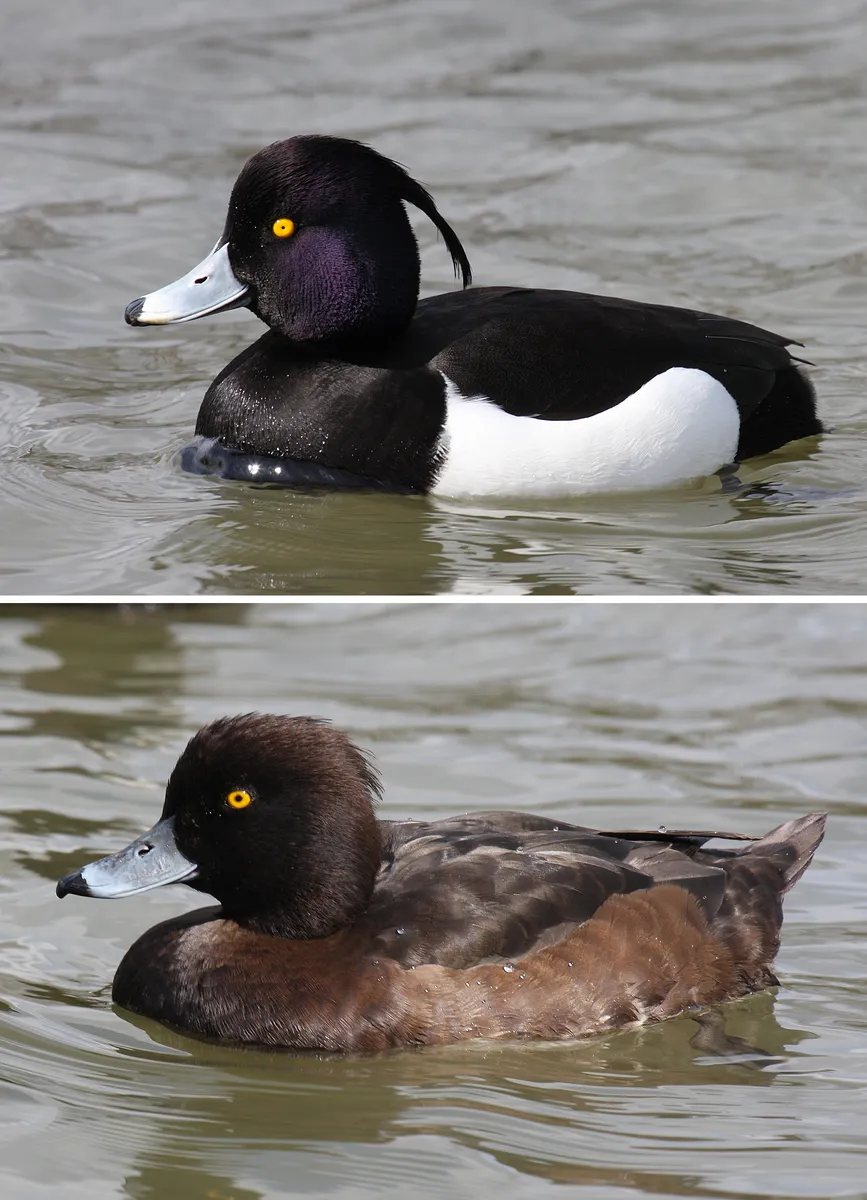
The tufted duck (or tufted pochard) (Aythya fuligula) is a small diving duck with a population of nearly one million birds, found in northern Eurasia. They are partially migratory. The scientific name is derived from Ancient Greek aithuia, an unidentified seabird mentioned by authors such as Hesychius and Aristotle, and Latin fuligo 'soot' and gula 'throat'. It is a game bird.
Description
The adult male is all black except for white flanks and a blue-grey bill with golden yellow eyes, along with a thin crest on the back of the head. It has a prominent tuft on its head, which gives the species its name. The adult female is brown with lighter flanks, and is more easily confused with other diving ducks. In particular, some have white around the base of the bill, resembling the scaup species, although the white is never as extensive as that of those ducks. The female's call is a harsh, growling "karr", usually given in flight. Males are mostly silent but will whistle during courtship, based on a simple "wit-oo". The only ducks that are similar are the greater scaup and lesser scaup, but these species lack the tuft and emit a different call. The tufted duck is one of the species to which the Agreement on the Conservation of African-Eurasian Migratory Waterbirds (AEWA) applies.Refer to the following table for measurements of the tufted duck:
Text from Wikipedia — Tufted duck, revision 1358561151, CC BY-SA 4.0, retrieved 2026-09-04. Encyclopedic text reused under CC BY-SA 4.0. Sentences about hunting or regulation are removed: on this site, the rule comes from Québec.ca.
Other names
French
English
Presence in Quebec
- Origin
- Indigène
- Occurrence
- Accidentel/non régulier
- Population status
- Migrateur
- Certainty
- Confirmé
Conservation
Québec.ca
Official periods
Source: Québec.ca — tables reproduced as published (retrieved 2026-08-30).
Regulations change. Always check Québec.ca before hunting or trapping.
Where this data comes from
This species is listed in an official government dataset. The identification and status shown in the data sheet are reproduced from it.
Source: List of Quebec’s vertebrate wildlife (LFVQ) — Ministère de l’Environnement, de la Lutte contre les changements climatiques, de la Faune et des Parcs. File LFVQ_25_03_2026.csv, retrieved 2026-08-30 · CC BY 4.0.
Measurements, habitat, diet and reproduction are not shown: no official source is attached to them yet.