
No period published by Québec.ca
Québec.ca publishes no hunting or trapping period for this species. Check the official regulations.
Wikipedia
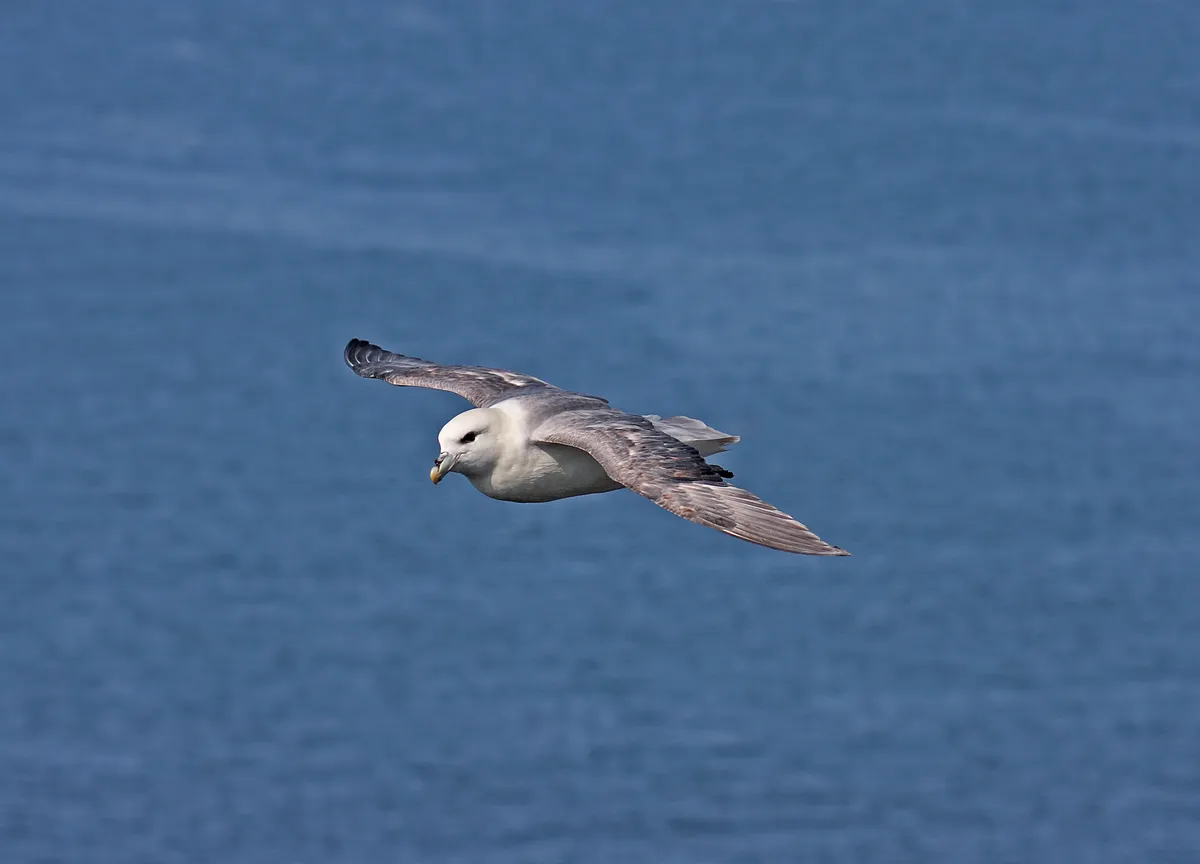
Fulmar boréal
The northern fulmar, Arctic fulmar, or simply fulmar (Fulmarus glacialis) is an abundant seabird found primarily in subarctic regions of the North Atlantic and North Pacific oceans. There has been one confirmed sighting in the Southern Hemisphere, with a single bird seen south of New Zealand. Fulmars come in one of two colour morphs; a light one in temperate populations, with white head and body and grey wings and tail, and a dark one in arctic populations, which is uniformly grey; intermediate birds are common. Though similar in appearance to gulls, fulmars are in fact members of the family Procellariidae, which includes petrels and shearwaters. The northern fulmar and its sister species, the southern fulmar (Fulmarus glacialoides), are the only extant members of the genus Fulmarus. The fulmars are in turn a member of the order Procellariiformes, and they all share certain identifying features. First, they have nasal passages that attach to the upper bill called naricorns; however, nostrils on albatrosses are on the sides of the bill, as opposed to the rest of the order, including fulmars, which have nostrils on top of the upper bill. The bills of Procellariiformes are also unique in that they are split into between seven and nine horny plates. One of these plates makes up the hooked portion of the upper bill, called the maxillary unguis. They produce a stomach oil made up of wax esters and triglycerides that is stored in the proventriculus. This can be sprayed out of their mouths as a defense against predators from a very early age, and as an energy rich food source for chicks and for the adults during their long flights. It will mat the plumage of avian predators, and can lead to their death. Finally, they also have a salt gland that is situated above the nasal passage that helps desalinate their bodies, due to the high amount of ocean water that they imbibe. This gland excretes a high saline solution from their nose. The northern fulmar was first described as Procellaria glacialis by Carl Linnaeus in 1761, based on a specimen from within the Arctic Circle, on Spitsbergen. The Mallemuk Mountain in Northeastern Greenland is named after the northern fulmar (Danish: Mallemuk).
Description
The northern fulmar has a wingspan of 102 to 112 cm (40–44 in) and is 46 cm (18 in) in length. Body mass can range from 450 to 1,000 g (16 to 35 oz). This species is grey and white with a pale yellow, thick bill and bluish legs. However, there are both a light morph and dark, or "blue", morph; in the Pacific Ocean there is an intermediate morph as well. Only the dark morph has more than dark edges on the underneath but they all have pale inner primaries on the top of the wings. The Pacific morph has a darker tail than the Atlantic morph. Like other petrels, their walking ability is limited, but they are strong fliers, with a stiff wing action quite unlike the gulls. They look bull-necked compared to gulls, and have short stubby bills.
Text from Wikipedia — Northern fulmar, revision 1369028503, CC BY-SA 4.0, retrieved 2026-09-04. Encyclopedic text reused under CC BY-SA 4.0. Sentences about hunting or regulation are removed: on this site, the rule comes from Québec.ca.
Other names
French
English
Presence in Quebec
- Origin
- Indigène
- Occurrence
- Régulier
- Population status
- Non reproducteur
- Certainty
- Confirmé
Conservation
Québec.ca
Official periods
Source: Québec.ca — tables reproduced as published (retrieved 2026-08-30).
Regulations change. Always check Québec.ca before hunting or trapping.
Where this data comes from
This species is listed in an official government dataset. The identification and status shown in the data sheet are reproduced from it.
Source: List of Quebec’s vertebrate wildlife (LFVQ) — Ministère de l’Environnement, de la Lutte contre les changements climatiques, de la Faune et des Parcs. File LFVQ_25_03_2026.csv, retrieved 2026-08-30 · CC BY 4.0.
Measurements, habitat, diet and reproduction are not shown: no official source is attached to them yet.