
No period published by Québec.ca
Québec.ca publishes no hunting or trapping period for this species. Check the official regulations.
Wikipedia
Geai bleu
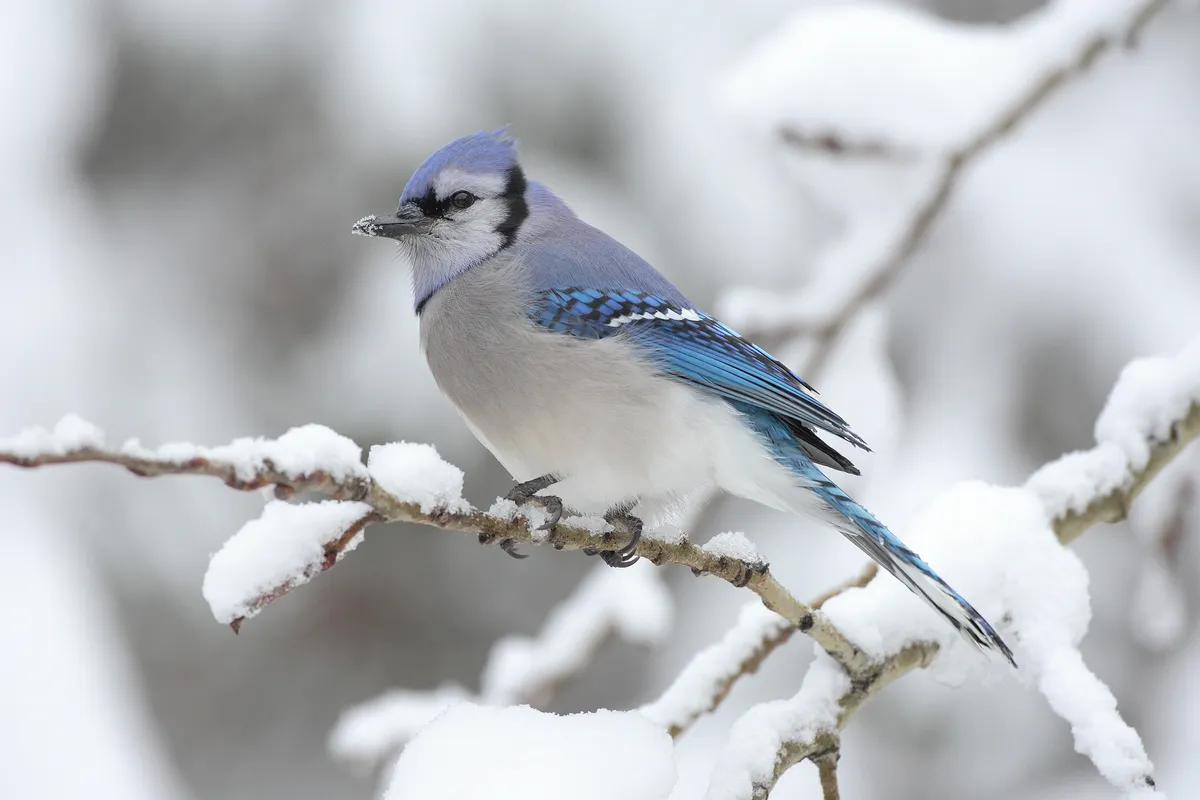
The blue jay (Cyanocitta cristata) is a passerine bird in the family Corvidae, native to eastern North America. It lives in most of the eastern and central United States; some eastern populations may be migratory. Resident populations are also in Newfoundland, Canada; breeding populations are found across southern Canada. It breeds in both deciduous and coniferous forests, and is common in residential areas. Its coloration is predominantly blue, with a white chest and underparts, and a blue crest; it has a black, U-shaped collar around its neck and a black border behind the crest. Males and females are similar in size and plumage, which does not vary throughout the year. Four subspecies have been recognized. The blue jay feeds mainly on seeds and nuts, such as acorns, which it may hide to eat later; soft fruits; arthropods; and occasionally small vertebrates. It typically gleans food from trees, shrubs, and the ground, and sometimes hawks insects from the air. Blue jays can be very aggressive to other birds; they sometimes raid nests and have even been found to have decapitated other birds. It builds an open cup nest in the branches of a tree; both sexes participate. The clutch may be two to seven eggs, which are bluish or light brown with darker brown spots. Young are altricial, and are brooded by the female for 8–12 days after hatching. They may stay with their parents for one to two months. The name jay derives from the bird's noisy, garrulous nature and has been applied to many other birds of the same family, which are also mostly gregarious. Jays are also called jaybirds.
Description
The blue jay measures 22–30 cm (9–12 in) from bill to tail and weighs 70–100 g (2.5–3.5 oz), with a wingspan of 34–43 cm (13–17 in). Consistent with Bergmann's rule, jays from Connecticut averaged 92.4 g (3.26 oz) in weight, while jays from warmer southern Florida averaged 73.7 g (2.60 oz). There is a pronounced crest on the head, a crown of feathers, which may be raised or lowered according to the bird's mood. When excited or aggressive, the crest will be fully raised. When frightened, the crest bristles outwards, brushlike. When the bird is feeding among other jays or resting, the crest is flattened on the head. Its plumage is lavender-blue to mid-blue in the crest, back, wings, and tail, and its face is white. The underside is off-white and the neck is collared with black which extends to the sides of the head. The wing primaries and tail are strongly barred with black, sky-blue, and white. The bill, legs, and eyes are all black. Males and females are almost identical, but the male is slightly larger. The black plumage on its nape, face, and throat varies extensively between individuals; it is believed to assist in recognition between individuals.
Diet
Blue jays are omnivorous, but the Audubon Society estimates that 75% of their diet is vegetable matter.They have strong black bills which they use for cracking nuts, usually while holding them with their feet, and for eating cor
Text from Wikipedia — Blue jay, revision 1359721232, CC BY-SA 4.0, retrieved 2026-09-04. Encyclopedic text reused under CC BY-SA 4.0. Sentences about hunting or regulation are removed: on this site, the rule comes from Québec.ca.
Other names
French
English
Presence in Quebec
- Origin
- Indigène
- Occurrence
- Régulier
- Population status
- Toute l'année
- Certainty
- Confirmé
Conservation
Québec.ca
Official periods
Source: Québec.ca — tables reproduced as published (retrieved 2026-08-30).
Regulations change. Always check Québec.ca before hunting or trapping.
Where this data comes from
This species is listed in an official government dataset. The identification and status shown in the data sheet are reproduced from it.
Source: List of Quebec’s vertebrate wildlife (LFVQ) — Ministère de l’Environnement, de la Lutte contre les changements climatiques, de la Faune et des Parcs. File LFVQ_25_03_2026.csv, retrieved 2026-08-30 · CC BY 4.0.
Measurements, habitat, diet and reproduction are not shown: no official source is attached to them yet.